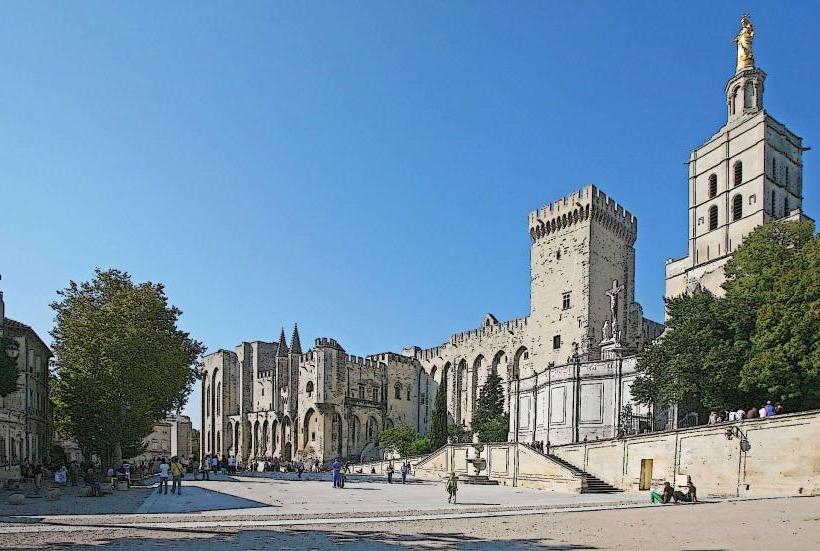
Landmark: Avignon Ramparts
City: Avignon
Country: France
Continent: Europe
Avignon Ramparts, Avignon, France, Europe
The Avignon Ramparts (Remparts d'Avignon) are a continuous circuit of medieval defensive walls encircling the historic center of Avignon, France. They constitute one of the best-preserved examples of medieval fortification in Europe and are designated as a UNESCO World Heritage site.
Visual Characteristics
The walls are constructed from local soft limestone (molasse), extending 4.3 kilometers in length with an average thickness of 3 meters. The structure features 39 solid towers, 36 corner towers, and 7 original main gates (portes). The architecture is defined by crenelated battlements, machicolations for dropping projectiles, and a wide perimeter path (chemin de ronde) along the top.
Location & Access Logistics
The ramparts surround the entire old city (intra-muros). The most prominent sections are located directly opposite the Gare d'Avignon Centre at Porte de la République. Access to the elevated walkway is available at Porte du Rhône near the Pont d'Avignon and at the Rocher des Doms. The city is encircled by the N100 and D907 roads, which follow the exterior perimeter of the walls.
Historical & Ecological Origin
Commissioned by Pope Innocent VI in 1355 and completed under Pope Urban V by 1370, the walls were built to protect the papal seat from roving mercenary bands (routiers) during the Hundred Years' War. The fortifications were built upon the alluvial plains of the Rhône River, requiring deep foundations to withstand frequent seasonal flooding.
Key Highlights & Activities
Walking the elevated section between Pont d'Avignon and the Rocher des Doms provides views of the river and the Palais des Papes. Photography of the Porte de la République and Porte de l'Oulle is a primary activity. The exterior perimeter features a paved path used for jogging and cycling.
Infrastructure & Amenities
Public restrooms are located near the Porte de l'Oulle and Porte de la République. The exterior of the walls is bordered by public parkland and shaded benches. 5G cellular coverage is continuous along the entire 4.3km circuit. Parking is available in large peripheral lots such as Parking de l'Oulle situated immediately outside the masonry.
Best Time to Visit
Late afternoon provides optimal lighting for the southern and western facades, highlighting the texture of the limestone. The walls are illuminated by floodlights at night. Spring and autumn are preferred for walking the perimeter to avoid the high heat and lack of shade on the elevated stone walkways during summer.
Facts & Legends
A historical oddity is that the walls were almost demolished in the 19th century to improve traffic flow, but were saved by the intervention of writer Prosper Mérimée. During the massive flood of 1856, the ramparts acted as a levee; though they failed to keep the water out entirely, they prevented the structural collapse of the inner city housing.
Nearby Landmarks
Pont d'Avignon (Pont Saint-Bénézet): 0.1km North
Palais des Papes: 0.4km South (from northern wall)
Rocher des Doms Garden: 0.2km South (from northern wall)
Gare d'Avignon Centre: 0.01km South (from southern wall)
Musée Calvet: 0.5km North (from southern wall)