Information
Landmark: Cementerio de la ChacaritaCity: Buenos Aires
Country: Argentina
Continent: South America
Cementerio de la Chacarita, Buenos Aires, Argentina, South America
Cementerio de la Chacarita is a large, historic cemetery located in the Chacarita neighborhood of Buenos Aires, Argentina.
It serves as one of the primary burial sites for the city's residents.
Visual Characteristics
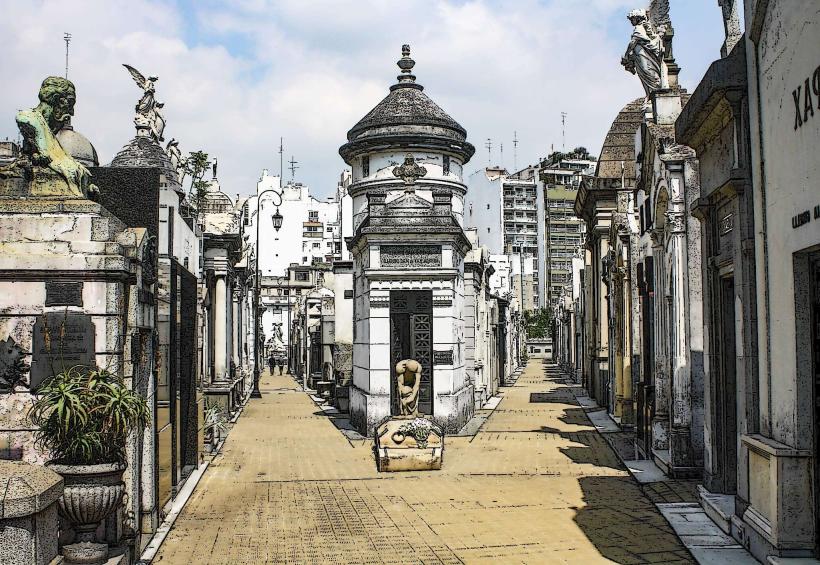
The cemetery covers approximately 90 hectares. It features a grid layout of streets and avenues lined with mausoleums, tombs, and chapels. Architectural styles vary widely, reflecting different historical periods and socioeconomic statuses, with notable examples of Neoclassical, Art Nouveau, and Art Deco designs. Many structures are constructed from marble, granite, and concrete, often adorned with sculptures and intricate stonework. The grounds are generally well-maintained, with paved pathways and mature trees providing canopy cover in some sections.
Location & Access Logistics
Cementerio de la Chacarita is situated approximately 6 kilometers northwest of Buenos Aires's city center. Access is via Avenida de los Constituyentes and Avenida del Campo. Public transport options include Subte Line B (Federico Lacroze station, followed by a 10-minute walk) and numerous bus lines, such as 39, 44, 63, 71, 76, 78, 87, 93, 108, 111, 113, 119, 127, 133, 140, 153, 168, and 176, which stop along the perimeter or nearby avenues. Limited on-site parking is available, but can be congested, especially during peak visiting hours or events.
Historical & Ecological Origin
The cemetery was established in 1871 as a response to a yellow fever epidemic that overwhelmed existing burial grounds. It was designed by architect Juan Antonio Buschiazzo. Initially known as Cementerio del Norte, it was later renamed Cementerio de la Chacarita. The land itself was formerly part of a large estancia owned by the Jesuit order before secularization.
Key Highlights & Activities
Visitors can explore the diverse architectural styles of the mausoleums, many of which are considered works of art. Notable figures interred here include presidents, artists, writers, and musicians. Guided historical tours are available, focusing on specific themes such as notable personalities or architectural significance. Photography of the structures is permitted. Walking the grounds allows for observation of the cemetery's urban planning and landscape design.
Infrastructure & Amenities
Restrooms are located near the main entrance and at designated points within the cemetery. Shade is provided by trees along many of the main avenues. Cell phone signal (4G/5G) is generally available throughout the grounds. There are no on-site food vendors, but small kiosks and cafes can be found on surrounding streets.
Best Time to Visit
The best time of day for photography is generally mid-morning or late afternoon when the sunlight creates distinct shadows on the mausoleums. The best months for visiting are typically from March to May and September to November, offering mild temperatures. Avoid visiting on major public holidays when crowds may be larger.
Facts & Legends
Cementerio de la Chacarita is one of the largest cemeteries in Latin America. A unique feature is the "Panteón de los Duendes" (Pantheon of the Goblins), a section dedicated to children who died without baptism, marked by small, often whimsical, tomb decorations. It is also rumored to be the resting place of Carlos Gardel, though his exact burial location within the cemetery is a subject of debate and popular legend.
Nearby Landmarks
- Estadio de Chacarita Juniors (0.3km West)
- Parque Los Andes (0.8km South)
- Mercado de Pulgas de Dorrego (1.2km Southwest)
- Centro Cultural de la Cooperación Floreal Gorini (2.5km Southeast)
- Museo Argentino de Ciencias Naturales "Bernardino Rivadavia" (3.0km South)