Landmark: Chateau de Chenonceau
City: Tours
Country: France
Continent: Europe
Chateau de Chenonceau, Tours, France, Europe
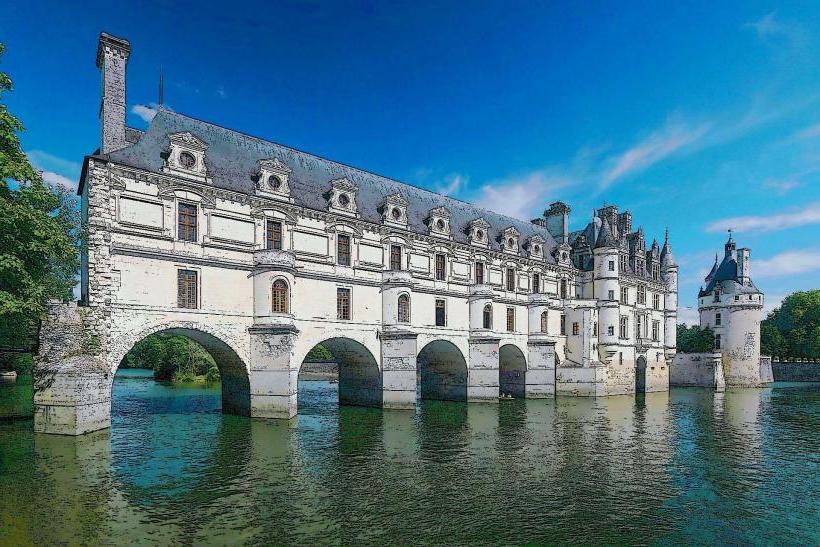
The Château de Chenonceau is a French Renaissance manor located in the Loire Valley, spanning the Cher River in the commune of Chenonceaux, approximately 34 kilometers east of Tours. It is distinguished by its unique bridge-like gallery and is the most visited privately owned historic monument in France.
Visual Characteristics
The structure is built from white tuffeau limestone and features a main square residential block with corner towers and a 60-meter-long, three-story gallery spanning the river on five stone arches. The architecture blends late Gothic and early Renaissance styles, characterized by steeply pitched slate roofs, ornate dormer windows, and a detached medieval keep, the Tour des Marques. The interior contains original 16th-century furnishings, Flanders tapestries, and a significant collection of Old Master paintings.
Location & Access Logistics
The château is situated at 37150 Chenonceaux. It is accessible from Tours via the A85 motorway (exit 11) or by the TER regional train to the Chenonceaux station, which is located 400 meters from the entrance. Large, free parking lots for cars and coaches are available on-site. The site is approximately a 35-minute drive from the Tours city center.
Historical & Ecological Origin
The current château was constructed between 1513 and 1517 by Thomas Bohier and Katherine Briçonnet on the foundations of a fortified mill. It was later expanded by Diane de Poitiers, who added the bridge over the Cher, and Catherine de' Medici, who built the gallery atop the bridge. The building is situated on the Cher River, a major tributary of the Loire, and is surrounded by a 70-hectare forest and formal parterre gardens.
Key Highlights & Activities
Visitors can tour the two-story gallery used as a ballroom and hospital during World War I. Exploration of the kitchens, located in the massive stone piers of the bridge at water level, is a primary activity. The estate offers rowboat rentals on the Cher River, a floral workshop, and a hedge maze consisting of 2,000 yew trees.
Infrastructure & Amenities
The site includes multiple dining options, including a gourmet restaurant (L'Orangerie), a creperie, and a self-service cafeteria. Public restrooms are located at the entrance and near the main restaurant. 5G cellular coverage is available throughout the gardens and park, though signal strength is reduced within the stone basement kitchens. The ground floor of the château and the gardens are wheelchair accessible via ramps.
Best Time to Visit
The best time for photography is at the 09:00 opening or during the late afternoon when the sun illuminates the river-facing facade. The gardens are at peak bloom during May and June. For a unique perspective, the "Night Promenade" (Promenade Nocturne) with musical accompaniment is held on weekends in July and August.
Facts & Legends
A verified historical oddity is that during World War II, the river Cher marked the line between occupied and Vichy France; the château’s gallery was used as a clandestine escape route, as the north entrance was in the German zone and the south door opened into the free zone. It is known as the "Château des Dames" (The Ladies' Château) because its design and history were almost exclusively shaped by women over four centuries.
Nearby Landmarks
Château d'Amboise: 13km North
Château du Clos Lucé: 12km North
Château de Montpoupon: 12km East
Château de Chaumont-sur-Loire: 25km Northeast
The Cher River: 0km (under the structure)