
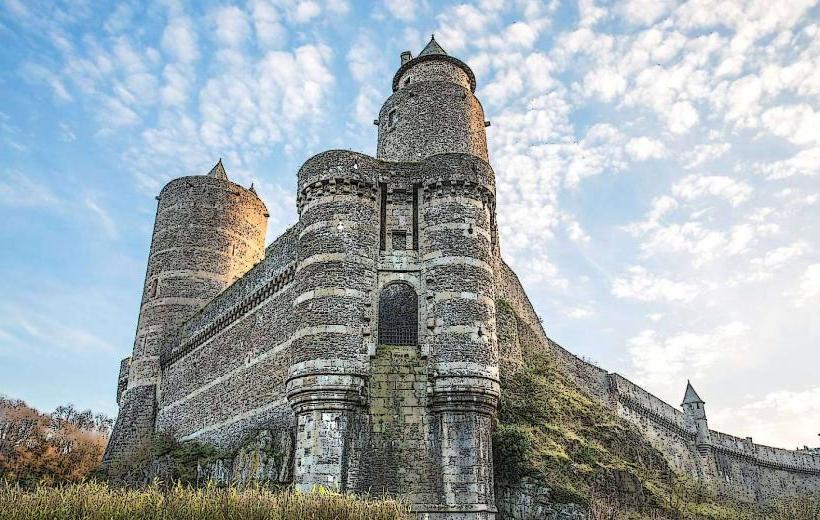
Landmark: Chateau de Fougeres
City: Rennes
Country: France
Continent: Europe
Chateau de Fougeres, Rennes, France, Europe
The Château de Fougères is one of the most significant medieval fortresses in Europe, located in the town of Fougères in the Ille-et-Vilaine department. Situated approximately 50 kilometers northeast of Rennes, it served as a crucial defensive "lock" on the border of the Duchy of Brittany.
Visual Characteristics
The fortress is a "water castle" built on a low-lying rocky islet surrounded by the Nançon River, which serves as a natural moat. It features three distinct enclosures (wards) protected by massive granite and schist curtain walls. The skyline is dominated by 13 preserved towers, including the iconic horseshoe-shaped Tour Mélusine and the Tour des Gobelins. The architecture is a prime example of military evolution, showing transitions from medieval arrow slits to Renaissance artillery platforms.
Location & Access Logistics
Address: Place Pierre Symon, 35300 Fougères.
From Rennes: A 40-minute drive via the A84 motorway. Alternatively, BreizhGo bus line 9a runs frequently from the Rennes bus station (Gare Routière) to Fougères center.
Parking: Extensive free parking is available at the Parking de la Poterne, located at the foot of the castle.
Historical & Ecological Origin
Construction began in the 11th century (originally wood), but the stone structure seen today mostly dates from the 12th to the 15th centuries. It was the primary bastion of the "Marches of Brittany," defending against French incursions. The site is ecologically integrated into the Nançon valley, utilizing the river's hydraulic power for the castle's mills, which were vital for the town's historic tanning and cloth industries.
Key Highlights & Activities
Multimedia Tour: A modern "spectacular circuit" provides audio-guided narratives of the castle’s history and the sieges it endured.
The Ramparts: Visitors can walk significant portions of the curtain walls, offering views of the medieval "Upper Town" and the Église Saint-Léonard.
Water Mills: The castle retains working water wheels on the Nançon, demonstrating medieval industrial engineering.
The Keep: Exploration of the interior of the major towers reveals vaulted chambers and defensive mechanisms.
Infrastructure & Amenities
The visitor center includes a boutique and a small museum area. Public restrooms are located at the entrance. The site is partially accessible; the lower ward is navigable for wheelchairs, but the ramparts and upper towers involve steep, narrow stone stairs. 5G signal is strong in the surrounding parkland and courtyards.
Best Time to Visit
The castle is open year-round (except January). For photography, the morning light is ideal for capturing the reflection of the towers in the moat. Visiting during the Medieval Festival of Fougères (usually July) provides live reenactments and markets within the castle walls.
Facts & Legends
A verified historical oddity is that the castle is built in a valley rather than on a hill, defying standard medieval defensive logic; it relies entirely on water and massive wall thickness for protection. Legend associates the Tour Mélusine with the mythical fairy-serpent Mélusine, claimed as an ancestress by the powerful House of Lusignan.
Nearby Landmarks
Upper Town (Haute-Ville): 0.4km East (uphill)
Public Garden (Jardin Public): 0.5km East (offers a famous panoramic view of the castle)
Saint-Sulpice Church: 0.1km South (Flamboyant Gothic style)
Fougères Forest: 3.0km North


