Landmark: Cologne City Hall
City: Cologne
Country: Germany
Continent: Europe
Cologne City Hall, Cologne, Germany, Europe
Cologne City Hall (Kölner Rathaus) is the oldest city hall in Germany with a documented history spanning over 900 years. Located in the heart of the Altstadt (Old Town), it serves as the administrative center for the City of Cologne and the seat of the Lord Mayor.
Visual Characteristics
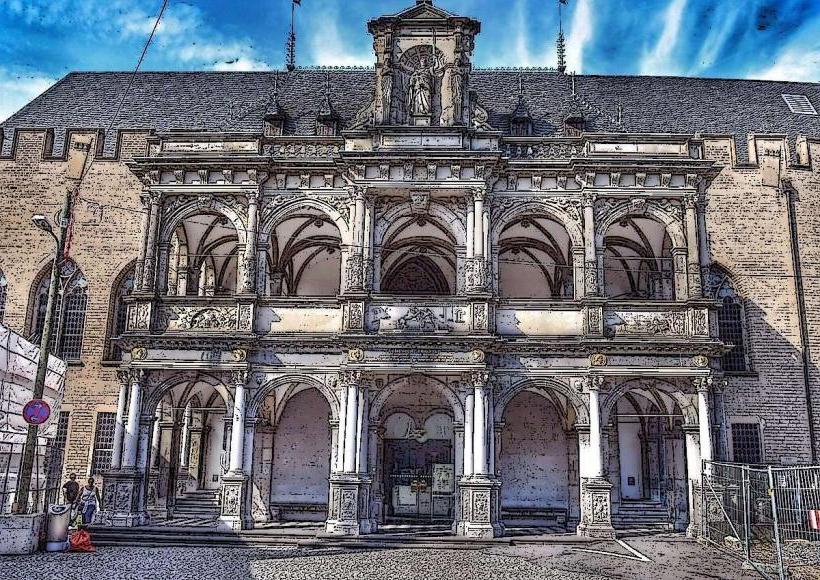
The complex is a composite of several architectural styles. The Rathaus Tower is a 61-meter-tall Late Gothic structure adorned with 124 sandstone statues of historical figures. The Renaissance Loggia (the "Laube") serves as the main entrance, featuring a two-story arcaded porch. The Spanischer Bau, located across the plaza, is a 1950s reconstruction in the Dutch Renaissance style. The interior is noted for the Hansasaal (Hanseatic Hall), which features Gothic wood carvings and figures of the "Nine Worthies."
Location & Access Logistics
Located at Rathausplatz 2, 50667 Cologne.
Public Transit: Accessible via U-Bahn lines 5 (Rathaus station) or 1/7/9 (Heumarkt station). It is a 5-minute walk from the Cathedral/Central Station.
Access: The inner courtyard and some administrative areas are open during business hours. Historical rooms are generally accessible only via guided tours or for official ceremonies (such as weddings).
Parking: No direct parking; use "Parkhaus Gürzenich" or "Parkhaus Heumarkt."
Historical & Ecological Origin
Parts of the building's foundations date back to the 12th century, positioned on the site of the former Roman Praetorium (the governor's palace). The Gothic tower was added between 1407 and 1414 to symbolize the power of the city's guilds over the local nobility. Like much of Cologne, it was heavily damaged during WWII and meticulously reconstructed in phases, with the most recent major renovations concluding in the late 20th century.
Key Highlights & Activities
The Carillon (Glockenspiel): Located in the tower, it plays four times daily (9:00 AM, 12:00 PM, 3:00 PM, and 6:00 PM) with 48 bronze bells.
Platzjabbeck: A wooden head located under the tower clock that opens its mouth and sticks out its tongue when the clock strikes the hour-a symbol of civic defiance.
Archaeological Zone: Beneath the Rathaus and the surrounding square lies the MiQua (Museum in the Quarter), which preserves the remains of the Roman Praetorium and the medieval Jewish Quarter.
Weddings: The "Rentkammer" is a popular location for civil ceremonies due to its historic ambiance.
Infrastructure & Amenities
The Rathausplatz is a pedestrian-only zone with cobblestone paving. Public restrooms are available in the nearby Alter Markt or within the Rathaus during visiting hours. The building is equipped with elevators for accessibility, though some medieval sections have restricted width. 5G signal is consistent throughout the Old Town.
Best Time to Visit
To see the carillon and the Platzjabbeck in action, arrive 5 minutes before the hour. The square is most vibrant during the Cologne Carnival (February) and the Christmas Market season (late November to December), as one of the city's main markets is held in the adjacent Alter Markt.
Facts & Legends
A historical oddity is that the 124 statues on the tower were all replaced or restored in the 1980s and 90s; they represent a "Who's Who" of Cologne history, including Roman Empress Agrippina, medieval saints, and even Karl Marx. A local legend states that the tower was built higher than the church steeples of the time to demonstrate that the city council's authority was equal to that of the clergy.
Nearby Landmarks
Alter Markt – 0.05km East
Farina Fragrance Museum – 0.1km South
Wallraf-Richartz Museum – 0.2km South
Cologne Cathedral – 0.4km North
Great St. Martin Church – 0.2km Northeast