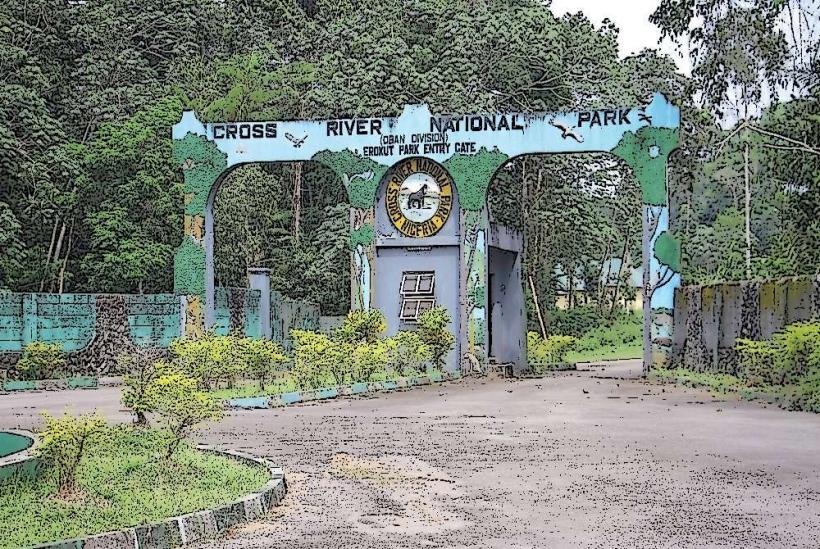
Landmark: Cross River National Park
City: Calabar
Country: Nigeria
Continent: Africa
Cross River National Park, Calabar, Nigeria, Africa
Cross River National Park is a protected area located in southeastern Nigeria, encompassing significant tracts of rainforest. It is divided into two main sectors: the Okwango Division and the Mbe Mountains Division.
Visual Characteristics
The park's landscape is characterized by dense tropical rainforest, with a canopy reaching heights of 30-40 meters. The terrain includes undulating hills and steep escarpments, with elevations ranging from 150 to 1,800 meters above sea level. Rivers and streams, often with clear water, traverse the forest floor. Vegetation is diverse, featuring a mix of evergreen trees, lianas, and epiphytes.
Location & Access Logistics
The Okwango Division is accessible via the Mfum-Ogoja road, approximately 100km north of Calabar. The Mbe Mountains Division is situated about 60km northwest of Calabar, with access points near the town of Okuni. Road conditions can vary, with some sections unpaved. Private vehicle transport is the primary means of access. Public transport to nearby towns like Ikom or Okuni is available from Calabar, followed by local taxi or motorcycle hire to park entrances. There is no dedicated public transport within the park itself. Parking is available at designated ranger stations.
Historical & Ecological Origin
Cross River National Park was established in 1991 through the amalgamation of the Okwango Forest Reserve and the Mbe Mountains Wildlife Sanctuary. Its ecological significance lies in its status as a biodiversity hotspot, containing one of the last remaining large tracts of rainforest in Nigeria. The area is a critical habitat for numerous endemic species and is part of the Cross River-Benue forest mosaic, an area of global conservation importance.
Key Highlights & Activities
Hiking is possible on designated trails within both divisions. Birdwatching is a primary activity, with over 300 bird species recorded. Wildlife viewing opportunities include primates, antelopes, and various forest mammals, though sightings are dependent on luck and time of day. Guided nature walks are available from ranger stations. The Mbe Mountains Division offers opportunities for trekking to waterfalls and observing primate behavior.
Infrastructure & Amenities
Basic accommodation, including guesthouses and chalets, is available at some ranger stations. Restrooms are generally located at these stations. Shade is abundant within the forest canopy. Cell phone signal is intermittent and unreliable within the park boundaries. Food vendors are not typically found within the park; visitors should bring their own provisions.
Best Time to Visit
The dry season, from November to March, offers the most favorable conditions for visiting, with less rainfall and more accessible trails. The early morning and late afternoon provide the best lighting for photography and increased chances of wildlife sightings. There are no tidal considerations within the park.
Facts & Legends
The Mbe Mountains Division is home to the Cross River Gorilla (Gorilla gorilla diehli), a critically endangered subspecies. Local folklore often speaks of forest spirits and the importance of respecting the natural environment. A specific tip for visitors is to hire local guides who possess intimate knowledge of the terrain and wildlife habitats.
Nearby Landmarks
- Obudu Mountain Resort (45km Northwest)
- Tiv Cultural Centre, Gboko (120km North)
- Calabar Museum (90km Southeast)
- Kwa Falls (70km Southeast)
- Afi Mountain Wildlife Sanctuary (30km Northwest)