Information
Landmark: Fort Negley ParkCity: Nashville
Country: USA Tennessee
Continent: North America
Fort Negley Park, Nashville, USA Tennessee, North America
Fort Negley Park is a 50-acre historic site and public park located in Nashville, Tennessee. It preserves the largest collection of Civil War-era fortifications remaining in the United States.
Visual Characteristics
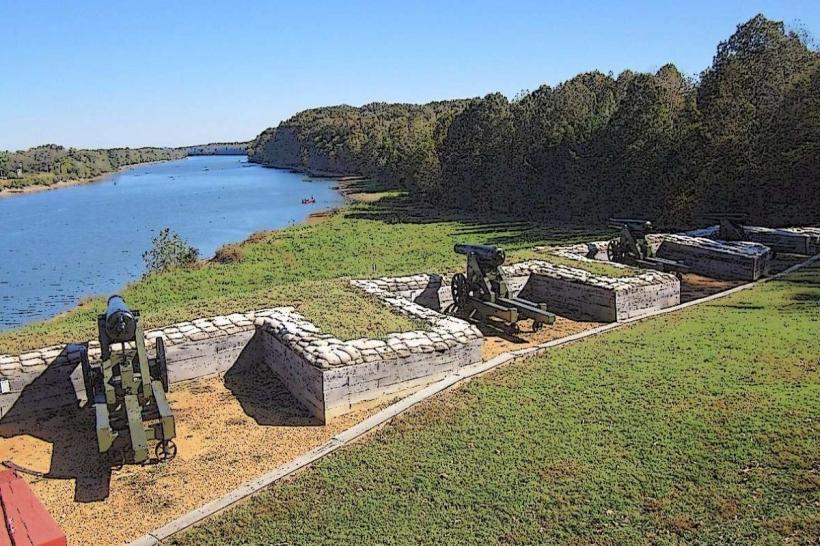
The park features a reconstructed limestone fort with earthen ramparts. The primary construction material is locally quarried limestone, with significant portions of the fort built from compacted earth. The fort's layout follows a pentagonal design, with bastions at each corner. Vegetation within the park consists of mature deciduous trees, primarily oak and maple, with a dense undergrowth of native shrubs and grasses.
Location & Access Logistics
Fort Negley Park is situated approximately 2.5 kilometers south of downtown Nashville. Access is via Interstate 65 South, taking Exit 81 for Wedgewood Avenue. The park entrance is clearly marked from Wedgewood Avenue. Ample free parking is available in a dedicated lot adjacent to the visitor center. Public transportation is accessible via the Nashville MTA bus system; Route 18 (Woodmont-Hillsboro) stops within a 0.5km walk of the park entrance.
Historical & Ecological Origin
Construction of Fort Negley began in 1862 under the direction of Union Army engineers, primarily by African American laborers, many of whom were formerly enslaved. Its original purpose was to defend Nashville, a strategically important Union stronghold, from Confederate attack. The site itself is a natural elevation offering commanding views of the surrounding terrain.
Key Highlights & Activities
Visitors can explore the reconstructed fort, including its parapets and interior structures. Interpretive signage details the fort's construction and role in the Civil War. Walking trails provide access to various vantage points within the park. Photography of the fort's architecture and the city skyline is permitted. Educational programs and ranger-led tours are offered seasonally.
Infrastructure & Amenities
A visitor center is located on-site, offering restrooms and informational displays. Shaded areas are available within the park's wooded sections. Cell phone signal (4G/5G) is generally reliable throughout the park. No food vendors are present within the park; however, dining options are available in nearby commercial areas along Wedgewood Avenue.
Best Time to Visit
For optimal lighting conditions for photography, early morning or late afternoon provides the best natural light on the fort's stonework. The most favorable weather for outdoor exploration occurs during spring (April-May) and autumn (September-October), with average temperatures ranging from 15-25 degrees Celsius. No specific tide requirements apply.
Facts & Legends
A notable historical detail is that the fort was never directly attacked by Confederate forces during the Civil War, despite its strategic importance. Local lore suggests that the spirits of soldiers who worked on its construction still patrol the ramparts at night, though this is unsubstantiated.
Nearby Landmarks
- The Parthenon (1.2km Northwest)
- Country Music Hall of Fame and Museum (2.8km North)
- Ryman Auditorium (3.1km North)
- Bridgestone Arena (3.3km North)
- Tennessee State Museum (3.5km North)