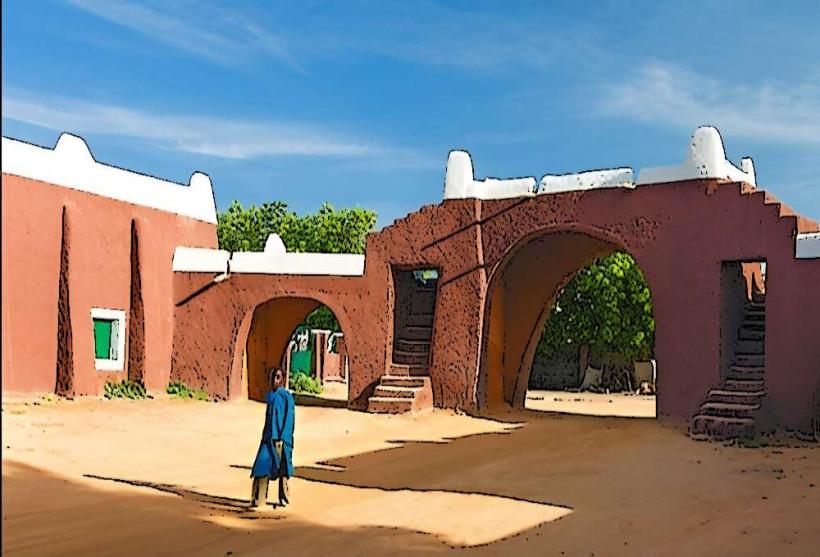
Landmark: Great Kofar Kwaya Gate
City: Katsina
Country: Nigeria
Continent: Africa
Great Kofar Kwaya Gate, Katsina, Nigeria, Africa
The Great Kofar Kwaya Gate is a historic city gate located in Katsina, Nigeria. It serves as a significant architectural remnant of the ancient Katsina city walls.
Visual Characteristics
The gate is constructed from mud brick and laterite, exhibiting a reddish-brown hue. It features a rectangular opening with a reinforced archway. The structure stands approximately 10 meters high and 8 meters wide, with crenellated battlements along its upper perimeter. The architectural style reflects traditional Sahelian mud-brick construction techniques.
Location & Access Logistics
The Great Kofar Kwaya Gate is situated in the central part of Katsina city, approximately 1.5 kilometers south of the Emir's Palace. Access is via Ahmadu Bello Way, turning onto Kofar Kwaya Road. Limited on-street parking is available in the vicinity. Public transport within Katsina typically involves minibuses and motorcycle taxis; specific routes to the gate are served by local transport.
Historical & Ecological Origin
The gate was constructed in the 17th century as part of the defensive fortifications surrounding the ancient city of Katsina. Its original purpose was to control entry and exit into the city and to provide a defensive position. The construction utilized locally sourced mud and laterite, materials common to the region's semi-arid environment.
Key Highlights & Activities
Visitors can observe the gate's construction and architectural details. Photography of the structure is permitted. Walking around the immediate vicinity provides context to its historical role within the city's layout.
Infrastructure & Amenities
Restrooms are not directly available at the gate itself but can be found in nearby commercial areas. Shade is minimal, primarily provided by adjacent structures. Cell phone signal (4G/5G) is generally strong in this urban area. Food vendors are present along the main roads leading to the gate.
Best Time to Visit
The best time for photography is during the early morning or late afternoon when the sun's angle creates distinct shadows on the mud-brick surfaces. The dry season, from November to March, offers the most comfortable weather conditions for visiting.
Facts & Legends
Local accounts suggest that the gate was named "Kwaya" due to the sound of horse hooves echoing through it during the city's active trading and defensive periods. It is believed to have been a primary entry point for traders from the north.
Nearby Landmarks
- Emir's Palace (1.5km North)
- Katsina Central Market (1.2km Northwest)
- Juma'at Mosque (1.8km North)
- Katsina State Museum (2.0km North)