Information
Landmark: Gyeongui Line Forest ParkCity: Seoul
Country: South Korea
Continent: Asia
Gyeongui Line Forest Park, Seoul, South Korea, Asia
The Gyeongui Line Forest Park is a linear urban park situated in Seoul, South Korea. It follows the former route of the Gyeongui railway line.
Visual Characteristics
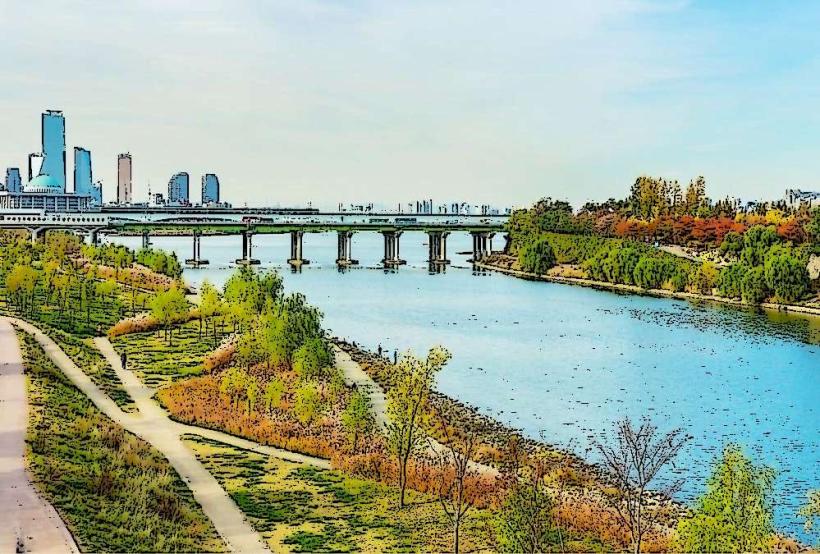
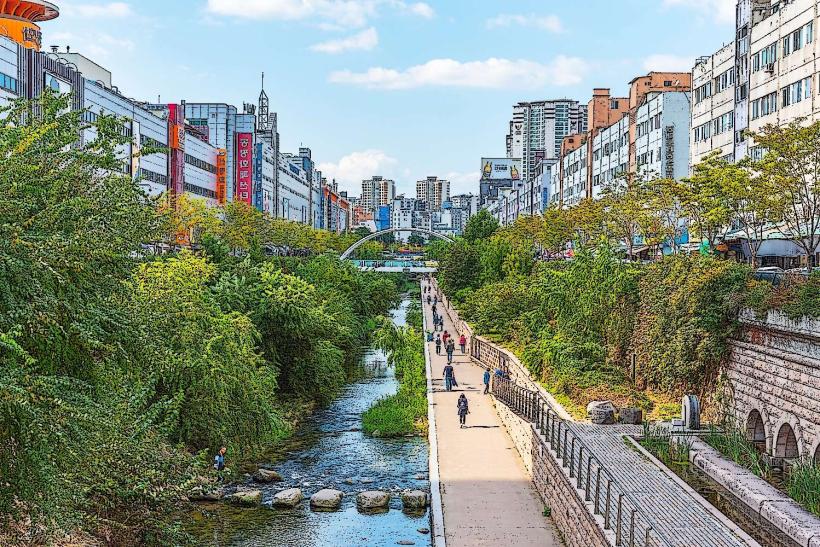
The park features a long, narrow green corridor with paved walking and cycling paths. It is characterized by a variety of trees, including zelkova and maple, interspersed with open lawn areas and small seating zones. The width varies, averaging approximately 10-15 meters.
Location & Access Logistics
The park extends from the Hongjecheon stream in Mapo District to the Gyeongui Line Forest Park Station in Seodaemun District. It is accessible via multiple subway stations along its length, including Gyeongui Line Forest Park Station (Gyeongui-Jungang Line), Hongik University Station (Line 2, Airport Railroad, Gyeongui-Jungang Line), and Sinchon Station (Line 2). Parking is limited to nearby public parking garages; on-street parking is not available along the park's primary route.
Historical & Ecological Origin
The park was developed on the disused Gyeongui railway line, which was originally built in 1906. The railway was gradually moved underground, and the surface route was repurposed into a public park, opening in 2015. The ecological origin is a re-naturalized urban corridor, replacing a former industrial transport route with green space.
Key Highlights & Activities
Activities include walking, cycling on designated lanes, and picnicking in open areas. Several small plazas and rest areas are present. The park is also a venue for occasional community events and performances.
Infrastructure & Amenities
Restrooms are available at intervals along the park. Shade is provided by mature trees. Cell phone signal (4G/5G) is generally strong throughout the park. Food vendors and cafes are concentrated near the park's entrances and adjacent streets, particularly around the Hongik University area.
Best Time to Visit
For photography, early morning or late afternoon offers optimal lighting conditions. Spring (April-May) and autumn (September-October) provide pleasant temperatures and visual appeal due to blooming flowers and fall foliage, respectively. The park is accessible year-round.
Facts & Legends
A unique aspect of the park's design is the preservation of sections of the original railway tracks in certain areas, serving as a historical marker. The park's development was part of a larger urban regeneration project aimed at reconnecting communities separated by the former railway line.
Nearby Landmarks
- Hongik University (0.2km West)
- Yeonnam-dong Cafe Street (0.3km South)
- Sinchon Rotary (1.5km Southeast)
- War Memorial of Korea (3.0km East)
- Gyeongbokgung Palace (4.5km East)