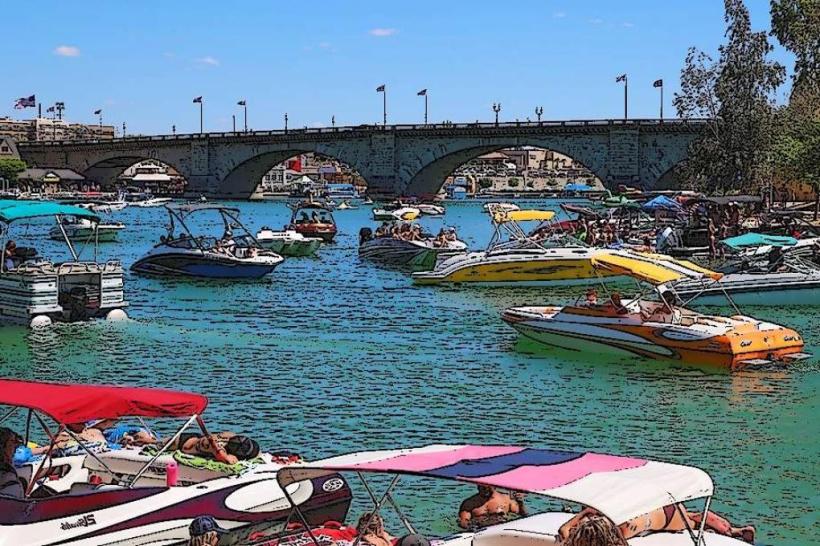
Landmark: Havasu National Wildlife Refuge
City: Lake Havasu City
Country: USA Arizona
Continent: North America
Havasu National Wildlife Refuge, Lake Havasu City, USA Arizona, North America
Havasu National Wildlife Refuge is a protected area located along the Colorado River in Arizona, USA.
This refuge encompasses a significant portion of the lower Colorado River corridor, including Lake Havasu.
Visual Characteristics
The refuge features a desert riparian environment. Vegetation includes cottonwood and willow trees along the riverbanks, transitioning to arid desert scrub and cacti in higher elevations. The Colorado River itself is a broad, slow-moving waterway, with Lake Havasu being a large reservoir. Rock formations are primarily sedimentary and volcanic in origin, with canyons and mesas characteristic of the region.
Location & Access Logistics
The refuge is accessible from Lake Havasu City, Arizona. State Route 95 runs along the western edge of the refuge. Access points include designated boat ramps and trailheads. Parking is available at developed access points, though it can be limited during peak seasons. Public transport is not available directly to refuge access points; personal vehicles or watercraft are required.
Historical & Ecological Origin
Havasu National Wildlife Refuge was established in 1941 to provide habitat for migratory birds and other wildlife. Ecologically, it represents a transition zone between the Mojave Desert and the Sonoran Desert, supporting a diverse range of plant and animal species adapted to arid and riparian conditions.
Key Highlights & Activities
Activities include birdwatching, boating, fishing, and hiking. Designated trails offer opportunities to explore the desert and riparian habitats. Boating on Lake Havasu provides access to remote areas of the refuge. Fishing is permitted in designated areas of the Colorado River and Lake Havasu.
Infrastructure & Amenities
Developed facilities within the refuge are minimal. Restrooms are available at some primary access points. Shade is primarily provided by natural vegetation along the river. Cell phone signal is intermittent and generally poor within the refuge boundaries. Food vendors are not present within the refuge; provisions should be made prior to arrival.
Best Time to Visit
The best time for visiting is during the cooler months, from October to April. Spring (March-April) offers blooming desert wildflowers. Summer months (June-August) are extremely hot, with daytime temperatures frequently exceeding 40°C (104°F). Early morning and late afternoon provide optimal lighting for photography due to lower sun angles.
Facts & Legends
The refuge protects critical habitat for the desert tortoise, a species listed as threatened. A specific tip for visitors is to be aware of flash flood potential in canyons during monsoon season (July-September), even if the sky appears clear.
Nearby Landmarks
- Lake Havasu State Park (0.5km West)
- London Bridge (2km West)
- Rotary Community Park (1km West)
- Lake Havasu Museum of History (2.5km West)
- Cocopah Museum (4km Southwest)