Landmark: Holsten Gate
City: Lubeck
Country: Germany
Continent: Europe
Holsten Gate, Lubeck, Germany, Europe
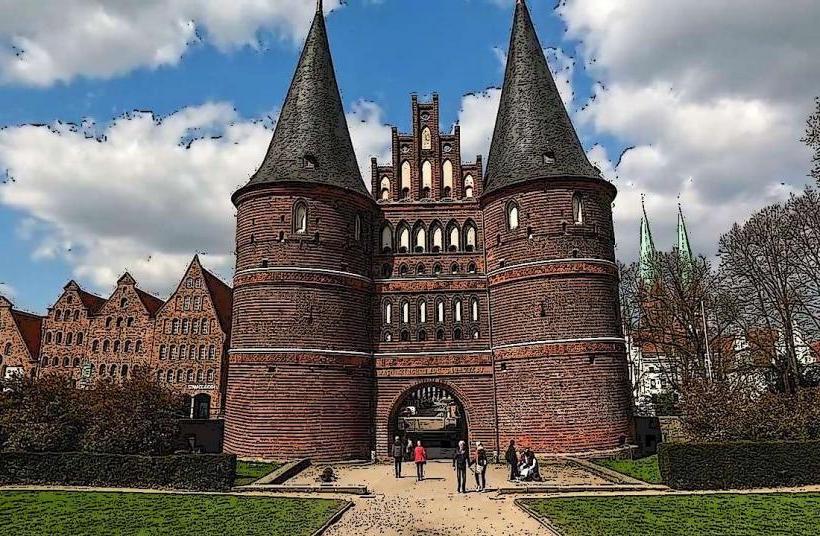
Holsten Gate (Holstentor) is a 15th-century Brick Gothic city gate and the primary landmark of Lübeck. It is one of the most recognized medieval structures in Germany and is a central part of the city’s UNESCO World Heritage status.
Visual Characteristics
The gate is defined by its two massive, cylindrical towers with conical slate roofs, linked by a central gabled building. It is famously asymmetrical; because it was built on marshy subsoil with a 15th-century "raft" foundation, the south tower has significantly leaned and sunk over centuries, giving the structure a bowed appearance.
Location & Access Logistics
Located at Holstentorplatz, 23552 Lübeck.
Public Transit: 5-minute walk from Lübeck Hauptbahnhof. Numerous bus lines (1, 2, 5, 6, 7, 9, 11, etc.) stop at "Holstentorplatz."
Access: The exterior is free and accessible 24/7. The interior houses a museum.
Hours (Museum): Daily 10:00 AM – 6:00 PM (April–October); 11:00 AM – 5:00 PM (January–March).
Admission: Paid entry for the museum; free for the surrounding park and exterior.
Parking: Use "Parkplatz Wallstraße" or "Parkhaus Holstentor-Passage."
Historical Origin
Built between 1464 and 1478 by city master builder Hinrich Helmstede. It served as both a defensive fortification and a prestigious entrance to the "Queen of the Hanseatic League." Originally, it was the "Middle Holsten Gate" in a complex of four consecutive gates. In 1863, the city council narrowly voted (42 to 41) to preserve the gate rather than demolish it for railway expansion.
Key Highlights & Activities
Field Side vs. City Side: The "Field Side" (facing west) is a fortress-like facade with 3.5-meter-thick walls and few windows. The "City Side" is richly decorated with Gothic windows and ornaments to display the city's wealth.
Inscriptions: The field side features the gilded motto CONCORDIA DOMI FORIS PAX ("Harmony within, peace without"). The city side bears the letters S.P.Q.L. (Senatus Populusque Lubecensis), modeled after ancient Rome.
Museum "The Power of Trade": Located inside the towers, featuring historical ship models, medieval armor, and interactive exhibits on the Hanseatic League's economic dominance.
Model of Lübeck: A detailed 1:300 scale model of the medieval city located within the museum.
Infrastructure & Amenities
The surrounding park is level and paved, but the interior museum involves steep, narrow spiral staircases and is not wheelchair accessible. A tourist information center and a marzipan shop are located nearby. 5G signal is robust.
Best Time to Visit
Morning: To photograph the "Field Side" in the best light.
Dusk: When the gate is illuminated, emphasizing its fairy-tale silhouette against the Trave River.
Facts & Legends
A technical oddity is that the central section of the gate is unsupported by the wooden pile foundation that holds the towers; it essentially "hangs" between them. The gate's image was famously featured on the 50 Deutsche Mark banknote and currently appears on the German 2 Euro coin. Legend states that the leaning of the towers was caused by the devil trying to push the gate into the Trave River because he was denied entry to the "Holy City."
Nearby Landmarks
Salzspeicher (Salt Warehouses) – Directly adjacent (South)
St. Peter's Church – 0.4km East
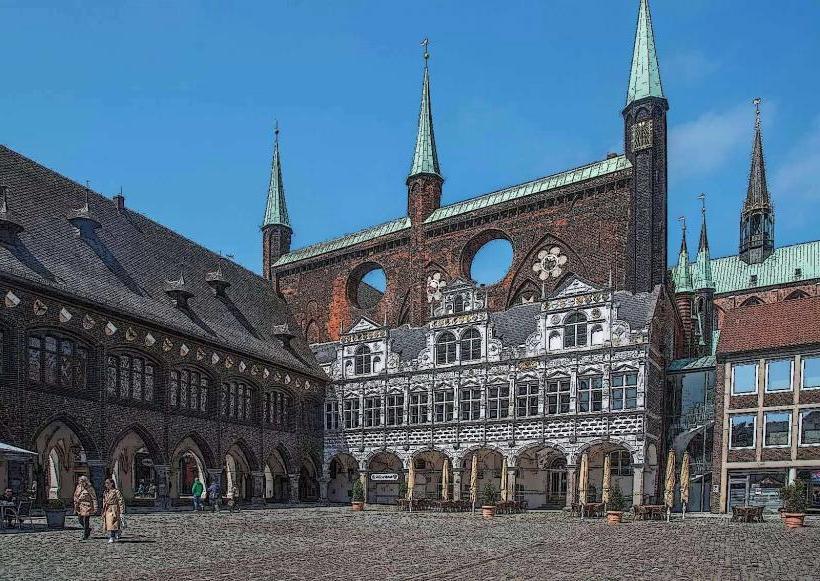
Lübeck Town Hall (Rathaus) – 0.5km East
Buddenbrook House – 0.6km Northeast