Information
Landmark: John Rylands LibraryCity: Manchester
Country: United Kingdom
Continent: Europe
John Rylands Library, Manchester, United Kingdom, Europe
The John Rylands Research Institute and Library is a Victorian Neo-Gothic building located at 150 Deansgate in Manchester, United Kingdom. It is part of the University of Manchester and is recognized as one of the finest examples of late medieval-style architecture in Europe.
Visual Characteristics
The building is constructed from dark red Barbary sandstone from Penrith, while the interior uses delicately shaded pink Shawk stone. The architectural style is Victorian Neo-Gothic with significant Arts and Crafts and Art Nouveau details, particularly in the ironmongery and bronze metalwork. Its design resembles a church or monastery gatehouse, featuring a central three-bay entrance, octagonal turrets, and intricate stone carvings of heraldry and grotesques. The Historic Reading Room is situated 30 feet above street level to mitigate city noise, featuring high vaulted ceilings, stained glass windows, and private study alcoves.
Location & Access Logistics
The library is situated on Deansgate, flanked by Wood Street to the north and Spinningfields to the south.
Public Transport: The St Peter's Square Metrolink stop is 0.3 miles (0.5km) away. Salford Central is the nearest rail station (0.4 miles). Free city buses (routes 1 and 2) stop at John Dalton Street and Deansgate opposite the library.
Parking: There is no on-site parking. The nearest public facilities are NCP Blackfriars Street and NCP Watson Street.
Entrance: Pedestrian access is through the modern 2007 glass and steel extension on Deansgate, which provides level access via a power-assisted door.
Historical & Ecological Origin
Commissioned in 1890 by Enriqueta Rylands as a memorial to her husband John Rylands, Manchester's first multi-millionaire industrialist. Designed by architect Basil Champneys, it was intended to house a largely theological collection. The building was formally dedicated in 1899 and opened on January 1, 1900. It was one of the first public buildings in Manchester to be electrically lit.
Key Highlights & Activities
Rare Collections: View the St John Fragment (the oldest known piece of the New Testament), a Gutenberg Bible, and Shakespeare’s First Folio.
Historic Reading Room: Access the primary scholarly space for study and viewing the vaulted architecture.
Exhibitions: Frequent rotations in the Special Collections Gallery and the Collections Gallery.
Victorian Staircase: View the original stone-carved staircase previously used by readers.
Infrastructure & Amenities
Facilities: Accessible toilets are located in the basement (RADAR key required).
Refreshments: An on-site café and gift shop are located in the modern entrance concourse.
Connectivity: 5G cellular signal is strong throughout the Spinningfields area.
Accessibility: Fully accessible via lifts to all floors except the historic entrance landing. Manual wheelchairs are available at reception.
Best Time to Visit
The library is open Wednesday to Saturday, 10:00 – 17:00 (Closed Sunday to Tuesday). For photography, mid-day light provides the best illumination for the stained glass in the Reading Room. During peak hours or special exhibitions, entry may be managed via a queue outside to protect the Grade I listed fabric.
Facts & Legends
The library utilized a pioneering air filtration system in 1899, which passed air through wet screens to remove industrial soot before it reached the rare manuscripts-a necessity in "Cottonopolis." A unique feature is the Victorian toilets at the base of the staircase; they are among the oldest working examples in Manchester and are frequently included in local historical tours.
Nearby Landmarks
Spinningfields: 0.1km South
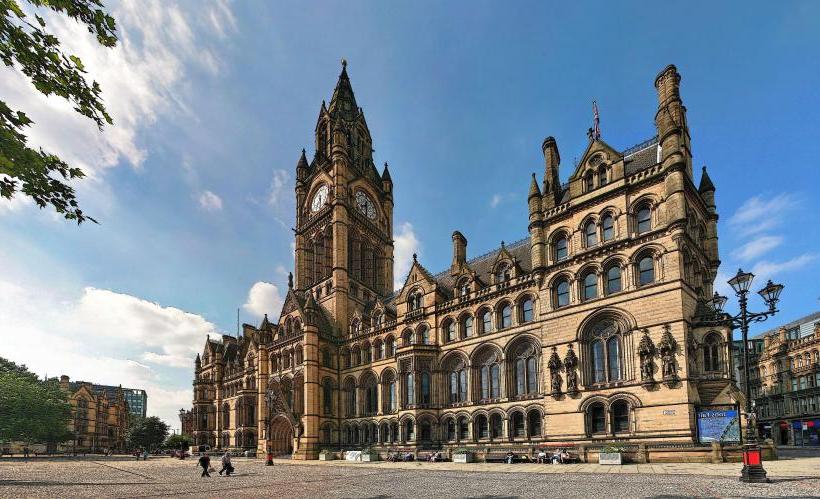
Manchester Town Hall: 0.4km East
St. Peter's Square: 0.5km Southeast
People's History Museum: 0.3km West
Manchester Cathedral: 0.7km North