Landmark: Linnaeus Garden
City: Uppsala
Country: Sweden
Continent: Europe
Linnaeus Garden, Uppsala, Sweden, Europe
The Linnaeus Garden is a historical botanical garden located in central Uppsala, Sweden, maintained by Uppsala University. It showcases plants arranged according to the classification system developed by Carl Linnaeus.
Visual Characteristics
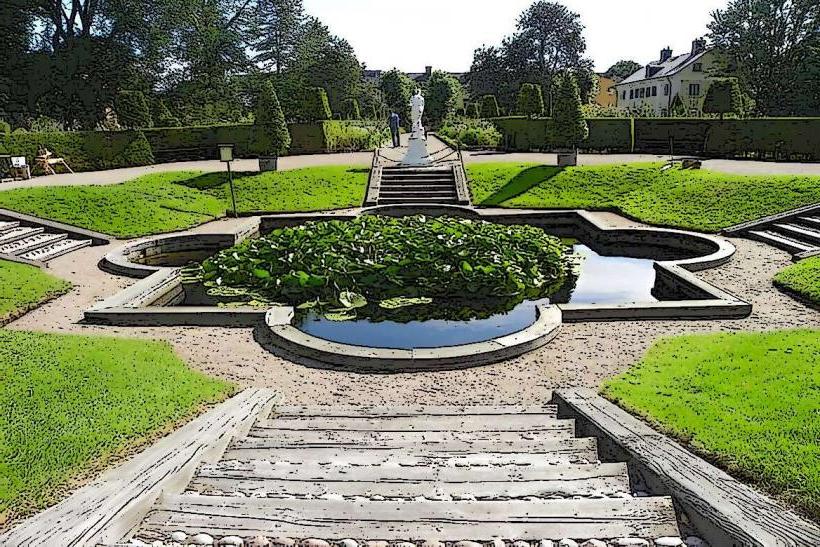
The garden features a formal Baroque design, characterized by symmetrical beds and pathways. Plantings are organized taxonomically, with individual species labeled. Key structures include the Linnaeus Museum, housed in Linnaeus's former residence, and an Orangery. Buildings within the garden complex typically exhibit 18th-century Swedish architectural styles, often painted in traditional Falun red, with white trim. The garden is enclosed by perimeter walls.
Location & Access Logistics
The Linnaeus Garden is situated at Svartbäcksgatan 27, approximately 1 kilometer north-east of Uppsala Central Station. It is accessible by foot from the city center, a walk of about 10-15 minutes. Local bus lines, such as routes 1, 2, 5, and 8, have stops on nearby streets like Svartbäcksgatan or Östra Ågatan. Limited street parking may be available, but public parking garages are located further into the city center, requiring a short walk.
Historical & Ecological Origin
The garden was originally established in 1655 by Olof Rudbeck the Elder as the botanical garden for Uppsala University. Carl Linnaeus became director in 1741 and redesigned the garden to reflect his new system of plant classification. The current layout largely represents Linnaeus's 18th-century design, restored in the early 20th century after a period of decline.
Key Highlights & Activities
Visitors can observe a diverse collection of plants arranged according to Linnaeus's classification system. The Linnaeus Museum, located within the garden, offers insight into Linnaeus's life and work. The Orangery houses tender plants. Guided tours are periodically available; schedules should be checked upon arrival.
Infrastructure & Amenities
Restroom facilities are available on-site. Some areas within the garden provide natural shade from trees, and the Orangery offers indoor shelter. Cell phone signal strength (4G/5G) is reliable throughout the garden due to its central urban location. A small café or kiosk may operate during peak season, but more extensive food vendors are located immediately outside the garden perimeter.
Best Time to Visit
The optimal period for visiting is from late spring to early autumn, specifically May through September, when most plants are in bloom. For photography, early mornings or late afternoons provide softer, more favorable lighting conditions. The garden is not subject to tidal influences.
Facts & Legends
Carl Linnaeus resided in the house adjacent to the garden for 35 years, cultivating approximately 2,000 plant species within its confines. The garden suffered significant damage during the Uppsala city fire of 1702, necessitating extensive rebuilding efforts in the subsequent decades.
Nearby Landmarks
- Uppsala Cathedral: 0.7km West
- Museum Gustavianum: 0.8km West
- Fyris River: Adjacent, East
- Carolina Rediviva (University Library): 1.0km South-West
- Uppsala Castle: 1.5km South-West