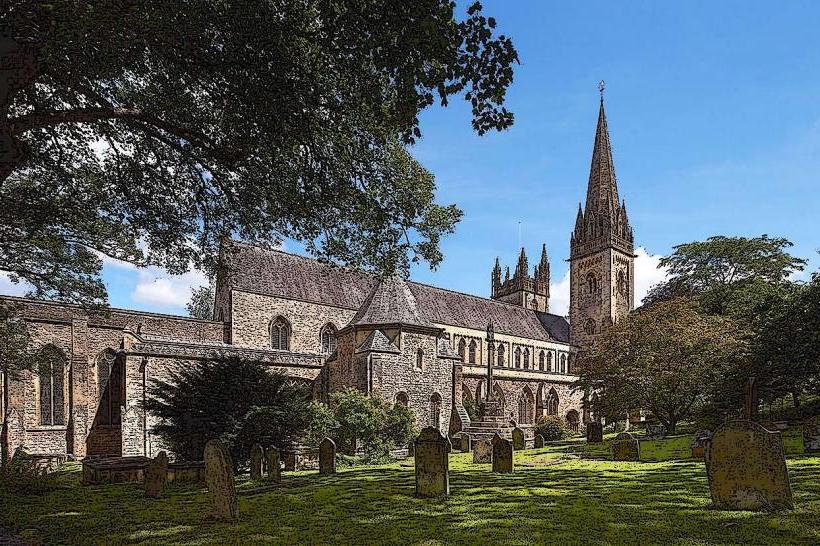
Landmark: Llandaff Cathedral
City: Cardiff
Country: United Kingdom
Continent: Europe
Llandaff Cathedral, Cardiff, United Kingdom, Europe
Llandaff Cathedral (Cathedral Church of SS Peter & Paul, Dyfrig, Teilo and Euddogwy) is an Anglican cathedral located in Llandaff, a northern district of Cardiff, Wales, United Kingdom. It is situated in a natural hollow near the banks of the River Taff.
Visual Characteristics
The cathedral is a composite of multiple architectural styles, ranging from Norman and Early English Gothic to 19th-century Victorian Gothic and mid-20th-century Modernism. The exterior is defined by its twin western towers: the northern Jasper Tower (Perpendicular Gothic) and the southern spire (Victorian). The interior’s most striking feature is the Parabolic Arch designed by George Pace, which supports the Jacob Epstein sculpture Christ in Majesty (Majestas), a massive aluminum figure suspended above the nave.
Location & Access Logistics
The cathedral is located at Cathedral Close (CF5 2LA).
Public Transport: Bus routes 24, 25, 62, and 63 run from Cardiff city center to Llandaff Village, followed by a 0.3km walk. Llandaff railway station is 1.6km away, though Danescourt station is slightly closer (1.2km).
Road: Access is via the A4119 or A4054.
Parking: Very limited street parking is available on Cathedral Close. A public car park is located at High Street in Llandaff village (0.4km).
Access: The cathedral is located at the bottom of a steep hill. Level access is available once at the site, but the descent from the village involves significant gradients.
Historical & Ecological Origin
The site has been a place of worship since the 6th century, established by Saint Teilo. The current structure was begun in 1120 by Bishop Urban. It suffered extensive damage during the Glyndŵr Rising (1400), the English Civil War, and a "Great Storm" in 1703. Most notably, the cathedral was hit by a German parachute mine in 1941 during the Cardiff Blitz, which destroyed the roof and much of the interior, leading to a radical post-war reconstruction completed in 1960.
Key Highlights & Activities
The Majestas: The aluminum sculpture by Jacob Epstein is a central landmark of 20th-century religious art.
The Rossetti Triptych: A significant Pre-Raphaelite altarpiece, The Seed of David, by Dante Gabriel Rossetti.
Illtyd’s Stone: An early Christian cross-slab dating back to the 9th or 10th century.
Choral Excellence: The cathedral maintains a traditional choir of men and boys; Choral Evensong is held regularly.
Infrastructure & Amenities
The facility includes a small shop and a café located in the adjacent Prebendal House. Accessible restrooms are available on-site. 5G cellular coverage is moderate within the hollow but strong in the surrounding village. The cathedral is active as a parish church and a seat of the Bishop of Llandaff.
Best Time to Visit
The cathedral is open daily for visitors, typically from 09:00 to 17:00. For photography, the morning light illuminates the West Front, while the interior Majestas sculpture is best viewed under soft midday light. To hear the organ and choir, visit during Sunday services or weekday Evensong (typically 17:30).
Facts & Legends
A verified historical oddity is that the cathedral possesses one of the few surviving sets of Misericords in Wales, featuring carvings of mythical beasts. Local legend suggests that the site was chosen because it was at a ford in the River Taff where three early Christian territories met.
Nearby Landmarks
Llandaff Bishop's Palace (Ruins): 0.2km East
Howell's School: 0.5km South
Insole Court: 1.2km South
Bute Park (North Entrance): 1.5km Southeast
River Taff Trail: 0.3km East