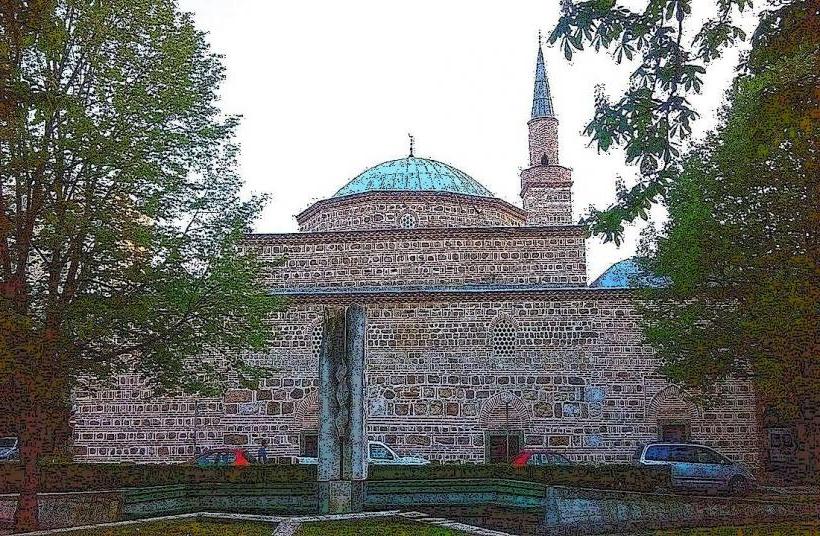
Landmark: Medieval Yambol Fortress
City: Yambol
Country: Bulgaria
Continent: Europe
Medieval Yambol Fortress, Yambol, Bulgaria, Europe
The Medieval Yambol Fortress is situated on the left bank of the Tundzha River in the southeastern part of Yambol, Bulgaria, within the modern-day Karagonin district. It represents the primary defensive fortification of the medieval city of Diampolis, which served as a critical strategic point between the Bulgarian and Byzantine empires.
Visual Characteristics
The site consists of partially excavated stone and brick foundations, including remnants of thick defensive walls and the circular bases of former watchtowers. The primary construction material is rough-cut river stone bonded with white mortar, typical of the Second Bulgarian Kingdom. The surrounding terrain is flat with low-lying grass and shrubs, while the excavated sections are approximately 1.5 to 2 meters below the current street level.
Location & Access Logistics
The remains are located at the intersection of Tsar Ivan Alexander Street and Georgi Dragzhev Street, approximately 1km southeast of the Bezisten. It is accessible via the main road bridge crossing the Tundzha River. Parking is available on the adjacent residential streets or in the nearby public lot of the Church of St. George. Local bus lines 2 and 5 stop within 200 meters of the archaeological site.
Historical & Ecological Origin
The fortress was constructed during the 11th century on the site of an earlier Late Antique fortification and reached its zenith during the 13th and 14th centuries under the Bulgarian Tsars. It was designed as a military stronghold to control the Tundzha river crossing. The site is located on an alluvial terrace formed by the meandering Tundzha River.
Key Highlights & Activities
Visitors can walk around the perimeter of the excavated foundations and view the exposed masonry of the southern gate. Information plaques provide historical context and diagrams of the original layout. Outdoor photography of the ruins and the adjacent riverbank is possible at all times.
Infrastructure & Amenities
The site is an open-air archaeological park with no admission fee or gated entrance. There are no restrooms or visitor centers directly on-site; however, benches and shade are available in the adjacent street-side greenery. 4G and 5G cellular coverage is strong. Food vendors and pharmacies are located within a 300-meter radius in the surrounding residential neighborhood.
Best Time to Visit
The ruins are accessible 24 hours a day, but the best time for photography is during the "golden hour" before sunset when the low-angle light emphasizes the texture of the stone foundations. Weather-wise, late spring and early autumn offer the clearest visibility of the site without excessive heat or snow cover.
Facts & Legends
According to historical accounts, the fortress was so formidable that it resisted Ottoman siege for several months in 1373 before finally falling. A local legend suggests the existence of a secret tunnel running beneath the Tundzha River, connecting the fortress to the Kabile ancient city to allow for the movement of troops during sieges.
Nearby Landmarks
Church of St. George: 0.4km North
Tundzha River: 0.1km South
Church of St. Nicholas: 0.8km Northwest
Regional Museum of History: 1.1km Northwest
Borovets Hill: 1.6km Northeast