Landmark: Museum of Eastern Bohemia
City: Hradec Kralove
Country: Czech Republic
Continent: Europe
Museum of Eastern Bohemia, Hradec Kralove, Czech Republic, Europe
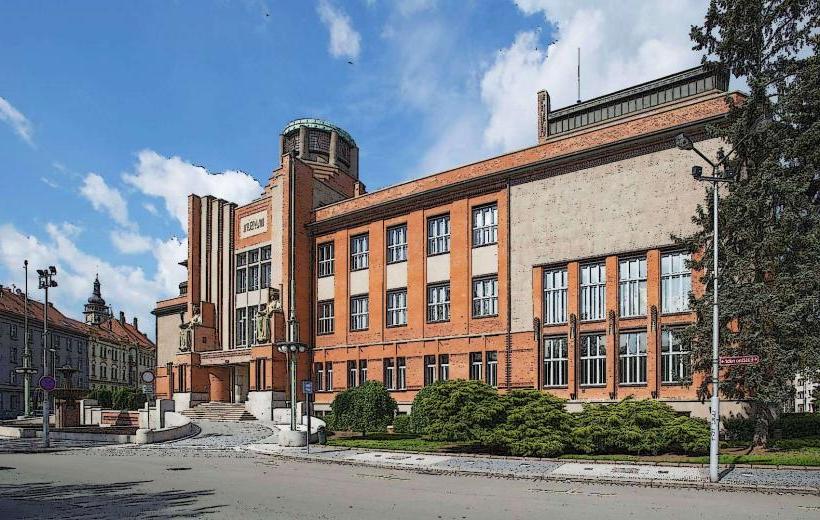
The Museum of Eastern Bohemia is a prominent Art Nouveau landmark and the largest regional museum in the Hradec Králové Region, situated on the bank of the Elbe River. It houses extensive archaeological, historical, and natural science collections totaling approximately three million exhibits.
Visual Characteristics
The building is a monumental Art Nouveau structure modeled on a classical temple, with a ground plan in the form of a Latin cross and a polygonal nave. Its exterior features red face-brick masonry combined with decorative stone elements and is topped by a large dome with mosaic decorations added by Josef Novák. The entrance is flanked by two 7-meter allegorical sculptures by Stanislav Sucharda representing History and Industry, accompanied by a bronze figure of the city's former mayor, František Ulrich.
Location & Access Logistics
The museum is located at Eliščino nábřeží 465/7, approximately 1.5km east of the Hradec Králové hlavní nádraží railway station. It is accessible by foot from the city center or via trolleybus lines 2 and 7 to the Adalbertinum stop. Paid parking is available at the nearby Jana Gayera parking lot or along the Eliščino nábřeží embankment.
Historical & Ecological Origin
The building was constructed between 1909 and 1912 according to the designs of Jan Kotěra, a leading figure of Czech modern architecture. Kotěra’s asymmetrical design was initially criticized by his teacher, Otto Wagner, for its perceived excessive luxury, but the project proceeded and was declared a national cultural monument in 1995.
Key Highlights & Activities
Permanent exhibitions include "The Journey to the City of Czech Queens" and "The Path to the Salon of the Republic," which utilize large-scale models to show the city's evolution. Key artifacts include the Gothic "Eliška belt," rare musical manuscripts, and instruments from the historical torture chamber. A 1934 bronze fountain is located directly in front of the museum entrance.
Infrastructure & Amenities
The facility contains public restrooms, a lecture hall with a capacity of 230, and an adjacent museum café. The interior is fully accessible following a major reconstruction in 1999–2002. 5G cellular signal is strong throughout the riverside area. Most exhibits include bilingual Czech and English information boards.
Best Time to Visit
The museum is open Tuesday through Sunday from 10:00 to 18:00, with extended hours until 20:00 on the last Wednesday of each month. Morning visits are recommended to avoid school groups and to utilize the natural light filtered through the stained-glass windows designed by František Kysela.
Facts & Legends
The building's floor plan and asymmetrical layout were so progressive for the early 20th century that the project almost failed to secure funding from the city council. A local historical oddity is the museum's role in preserving the "Eliška belt," a medieval relic associated with the city’s status as a dowry town for Bohemian queens.
Nearby Landmarks
Adalbertinum – 0.15km East
White Tower (Bílá věž) – 0.4km Southeast
Cathedral of the Holy Spirit – 0.45km Southeast
Hučák Hydroelectric Power Station – 0.5km South
Great Square (Velké náměstí) – 0.5km Southeast