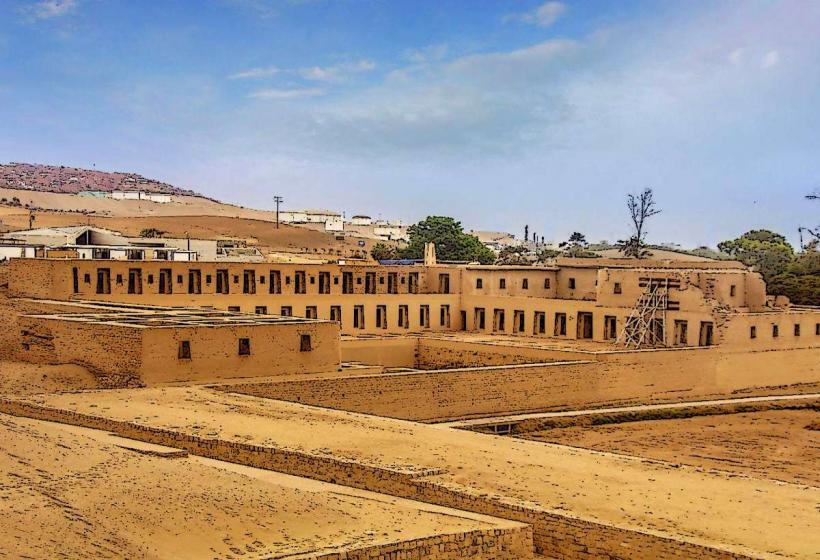
Landmark: Pachacamac Archaeological Complex
City: Lima
Country: Peru
Continent: South America
Pachacamac Archaeological Complex, Lima, Peru, South America
Pachacamac is an ancient archaeological site located south of Lima, Peru. It served as a significant religious and administrative center for various pre-Inca and Inca cultures.
Visual Characteristics
The complex comprises adobe and stone structures, including pyramids, temples, and plazas. Dominant colors are earthen tones of adobe and weathered stone. Structures vary in height, with the Temple of the Sun reaching approximately 30 meters. Architectural styles reflect a blend of Ichma and Inca influences, characterized by stepped platforms and trapezoidal doorways.
Location & Access Logistics
Pachacamac is situated approximately 40 kilometers south of Lima's city center. Access is via the Pan-American Highway South. Take exit 31 towards Lurín. Parking is available on-site for private vehicles. Public transport options include local buses (e.g., Linea 18, Linea 85) that stop near the entrance, requiring a short walk or taxi ride to the complex itself.
Historical & Ecological Origin
The site's origins date back to approximately 200 CE, with significant construction and expansion occurring between the 11th and 15th centuries CE by the Ichma culture, followed by Inca occupation. It was a major pilgrimage center dedicated to the god Pachacamac, the creator deity. The site is situated on a coastal desert plain, characterized by arid conditions and proximity to the Lurín River valley.
Key Highlights & Activities
Visitors can explore the Temple of the Sun, the Old Temple, the Painted Temple, and the Inca Palace. Guided tours are available, providing context on the site's history and significance. Walking the designated paths allows for observation of the various architectural phases and ceremonial spaces.
Infrastructure & Amenities
On-site facilities include restrooms and a small museum. Limited shade is available within the museum area and some covered sections of the archaeological paths. Cell phone signal (4G) is generally available within the complex. Food vendors are not present within the archaeological site; options are available in the nearby town of Lurín.
Best Time to Visit
The best time of day for photography is generally in the morning or late afternoon when the sun's angle creates defined shadows on the structures. The dry season, from May to October, offers the most pleasant weather with minimal rainfall. No tide-specific considerations apply.
Facts & Legends
Local legends suggest that the god Pachacamac created the first man and woman here but abandoned them due to a tragic event, leaving them to perish. A specific tip for visitors is to observe the intricate adobe brickwork, which varies significantly between the Ichma and Inca construction periods, offering a visual timeline of the site's development.
Nearby Landmarks
- Museo de Sitio Pachacamac (0.1km North)
- Lurín River (1km West)
- Playa Arica (3km South-West)
- San Pedro de Lurín Church (2km North)
- Cerro Pan de Azúcar (4km North-East)