Landmark: Red Rocks
City: La Plaine
Country: Dominica
Continent: North America
Red Rocks, La Plaine, Dominica, North America
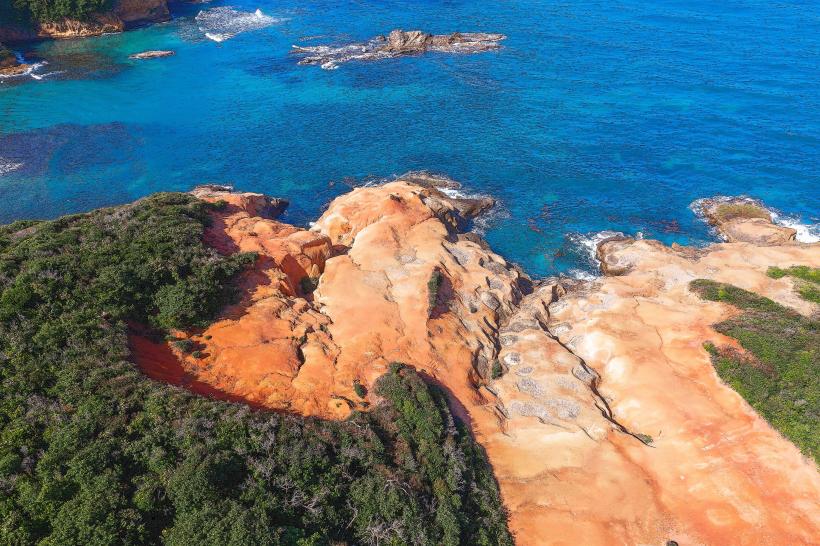
Red Rocks is a geological formation located on the southeastern coast of Dominica, near the village of La Plaine.
The site features striking red-hued volcanic rock formations that descend into the Caribbean Sea.
Visual Characteristics
The formations consist of iron-rich volcanic rock, giving them a distinct reddish-orange color. The rocks are eroded into various shapes, including arches and sea stacks. The coastline is characterized by a mix of exposed rock and small, dark sand coves. Vegetation, primarily low-lying coastal scrub and scattered palm trees, grows on the upper sections of the formations.
Location & Access Logistics
Red Rocks is situated approximately 2 kilometers south of the village of La Plaine. Access is via the local road running south from La Plaine, which is a continuation of the main East Coast Road (Rte 3). Parking is available on the shoulder of the road adjacent to the site. No public transport directly serves Red Rocks; visitors typically arrive by private vehicle or taxi from Roseau (approximately 30km west) or Marigot (approximately 20km north).
Historical & Ecological Origin
Red Rocks is a product of volcanic activity, specifically the erosion of iron-rich basaltic lava flows that form the island's southeastern coastline. The specific geological period of formation is part of the island's broader volcanic history, dating back thousands of years. Ecologically, it represents a coastal zone interface between terrestrial and marine environments.
Key Highlights & Activities
Observation of the rock formations and coastal scenery. Photography of the colored rocks and sea. Limited access for swimming or wading in calmer sections of the sea at the base of the rocks, dependent on wave conditions. Exploration of the immediate surrounding coastline.
Infrastructure & Amenities
There are no dedicated facilities at Red Rocks. Restrooms, food vendors, and shade are not present at the site itself. Cell phone signal (4G/5G) is generally available in the vicinity due to proximity to La Plaine.
Best Time to Visit
For photography, the late afternoon (approximately 3 PM to 5 PM) offers favorable lighting conditions that enhance the red hues of the rocks. The dry season, from January to May, generally provides the most stable weather. Access to the base of the rocks is best during low tide, though this is not a strict requirement for viewing from above.
Facts & Legends
Local folklore suggests the red color of the rocks is due to the blood of ancient sea serpents that once inhabited the waters. Geologically, the color is attributed to the high concentration of iron oxides in the volcanic rock, which oxidizes when exposed to air and water.
Nearby Landmarks
- La Plaine Village (0.5km North)
- Morne Trois Pitons National Park (10km Northwest)
- Emerald Pool (12km Northwest)
- Wotton Waven (15km West)
- Boiling Lake Trailhead (18km Northwest)