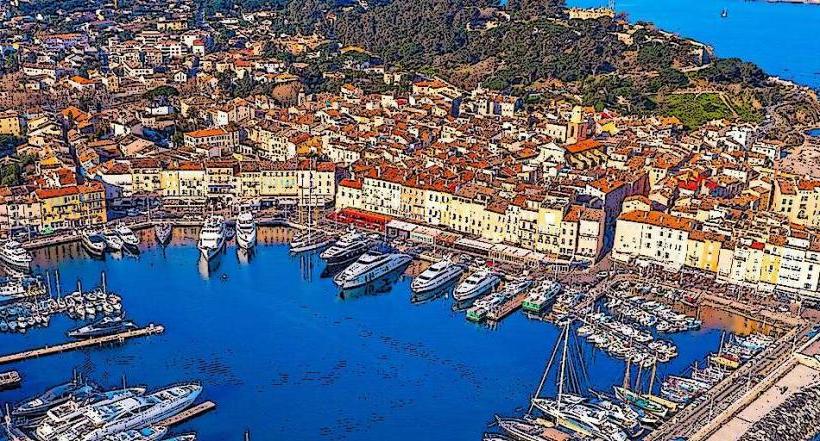
Landmark: Saint Tropez Old Town
City: Saint Tropez
Country: France
Continent: Europe
Saint Tropez Old Town, Saint Tropez, France, Europe
The Old Town of Saint-Tropez, known as La Ponche, is the historic fisherman's quarter situated between the Port of Saint-Tropez and the Citadel. It is the most traditional district of the town, characterized by its narrow, pedestrian-only streets and Provencal architecture.
Visual Characteristics
The district is defined by ochre, terracotta, and pastel-pink buildings with traditional shutters. The streets are paved with cobblestones and are often narrow enough to remain shaded throughout the day. Key architectural features include the 18th-century Église Notre-Dame-de-l'Assomption with its distinctive sienna-and-gold bell tower and the 15th-century stone defensive structures like the Tour Portalet.
Location & Access Logistics
La Ponche is located in the northern sector of the town. Access is primarily on foot from the Port de Saint-Tropez or the Place des Lices. Vehicle access is highly restricted; visitors typically park in the large peripheral lots such as Parking du Port or Parking des Lices and walk into the historic core. The district is approximately 1.5 km from the town's main entrance road.
Historical & Ecological Origin
Originally a small fishing village founded on the site of a Greco-Roman settlement, La Ponche served as the defensive heart of Saint-Tropez for centuries. It gained international prominence in the 1950s following the filming of And God Created Woman. Geologically, the town sits on a rocky peninsula extending into the Mediterranean, which historically provided a strategic vantage point against maritime incursions.
Key Highlights & Activities
Place de la Mairie: A small, picturesque square home to the town hall and the entrance to the old fish market.
La Ponche Beach: A tiny, historic cove at the foot of the old town walls used for swimming and boat launching.
Shopping: The district houses high-end boutiques interspersed with traditional artisan shops selling "Tropéziennes" leather sandals.
Église Notre-Dame-de-l'Assomption: Observation of the baroque interior and the bust of Saint Torpes, the town's patron saint.
Infrastructure & Amenities
Public restrooms are located near the Place des Lices and the harbor. 5G cellular coverage is generally strong in open areas but can be obstructed by the thick stone walls of the older buildings. The district's steep and narrow streets, combined with historic cobblestones, make wheelchair accessibility challenging in many areas. Numerous high-end restaurants and cafes are concentrated along the waterfront and main plazas.
Best Time to Visit
The optimal time for photography is at dawn, before the arrival of day-trippers, when the rising sun illuminates the pastel facades. To experience the town's original atmosphere, visit during the "Bravades de Saint-Tropez" in mid-May. The peak summer months (July-August) see extreme crowd density and high temperatures.
Facts & Legends
A historical oddity is that the town was an independent republic for over a century (1470–1672), governed by its own "Capitaine de Ville." Legend states that the town is named after Saint Torpes, a Roman officer beheaded by Nero, whose body supposedly drifted ashore in a boat with a cock and a dog. The bell tower of the main church is one of the most photographed icons of the French Riviera.
Nearby Landmarks
Citadelle de Saint-Tropez: 0.4 km East
Port de Saint-Tropez: 0.2 km West
Place des Lices: 0.3 km South
Musée de l'Annonciade: 0.3 km West
Tour Portalet: 0.1 km North