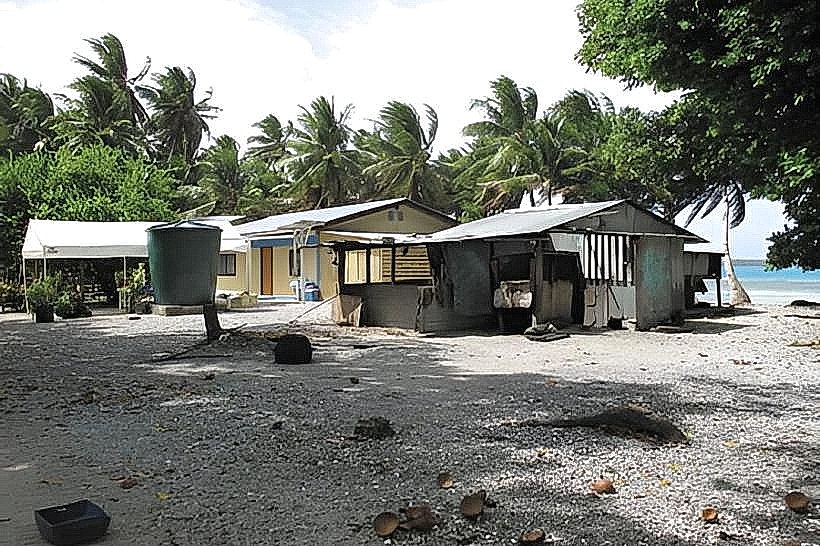
Landmark: Traditional Village Compounds
City: Namu Atoll
Country: Marshall Islands
Continent: Australia
Traditional Village Compounds, Namu Atoll, Marshall Islands, Australia
Traditional Village Compounds are a collection of indigenous dwellings located on Namu Atoll in the Marshall Islands.
These compounds represent the historical living arrangements of the atoll's inhabitants.
Visual Characteristics
Compounds consist of multiple thatched-roof structures, typically constructed from pandanus leaves and coconut fronds, arranged around a central open space. Structures are low-lying, generally single-story. Materials are natural and locally sourced. Colors are muted earth tones, reflecting the organic materials used.
Location & Access Logistics
Namu Atoll is situated in the Ralik Chain of the Marshall Islands. Access is primarily via boat from other inhabited atolls or by chartered small aircraft to a local airstrip (if available). There are no direct road connections from major cities. Inter-island transport is the primary logistical challenge. Parking is not a formal consideration; vessels anchor offshore or dock at rudimentary jetties.
Historical & Ecological Origin
These compounds are a direct continuation of ancestral building techniques and social organization, dating back centuries. The design reflects adaptation to the tropical climate and the availability of local resources. The ecological context is a low-lying coral atoll environment, characterized by limited landmass and reliance on marine resources.
Key Highlights & Activities
Observation of traditional dwelling construction methods. Understanding of communal living arrangements. Interaction with local residents (subject to availability and cultural protocols). Exploration of the immediate village surroundings.
Infrastructure & Amenities
Basic sanitation facilities may be present but are not standardized. Shade is provided by the thatched roofs of the dwellings. Cell phone signal is generally unreliable and dependent on satellite connectivity. Food vendors are not typically present within the compounds; sustenance is usually self-provided or sourced from the community.
Best Time to Visit
The dry season, generally from December to April, offers more predictable weather patterns. Mornings provide softer light for observation. Tidal conditions are less critical for compound access than for reef activities.
Facts & Legends
A specific architectural feature often found is the "bwebwenato," a raised sleeping platform constructed from woven pandanus mats, designed to keep occupants off the damp ground and away from insects.
Nearby Landmarks
- Local Church (0.2km West)
- Community Meeting House (0.3km Northwest)
- Primary School (0.4km Southwest)
- Artisan Craft Area (0.5km North)