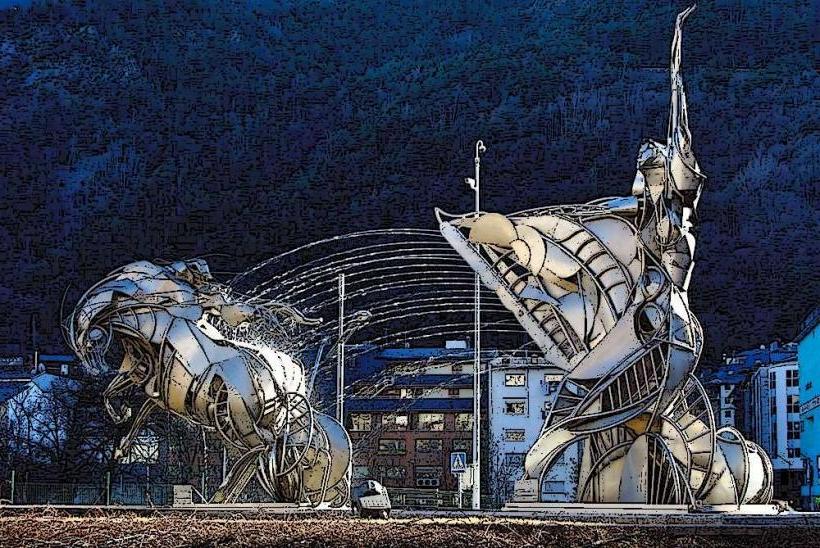
Landmark: Water Cycle Sculpture
City: Escaldes Engordany
Country: Andorra
Continent: Europe
Water Cycle Sculpture, Escaldes Engordany, Andorra, Europe
Visual Characteristics
The sculpture is an abstract, multi-component installation primarily constructed from bronze and steel, featuring a dark, patinated finish. It comprises several interconnected elements that suggest the flow and transformation of water. A central, vertical structure rises approximately 10 meters, from which water cascades into a series of basins and channels at its base. The design incorporates smooth, organic curves alongside more angular forms, creating a dynamic visual representation of water's movement. The base is integrated into a paved plaza, often surrounded by low-level landscaping.
Location & Access Logistics
The Water Cycle Sculpture is located in the Plaça de la Rotonda, a prominent roundabout and public square in the center of Escaldes Engordany, at the intersection of Avinguda Carlemany and Avinguda Meritxell. It is approximately 0.5 kilometers from the main bus station in Andorra la Vella. Public parking is available in underground garages such as Parking Comunal de la Rotonda or Parking Caldea, both within 100 meters. Local bus lines, including L1, L2, L3, and L4, have stops directly adjacent to Plaça de la Rotonda, providing direct access from various points within Andorra la Vella and Escaldes Engordany.
Historical & Ecological Origin
The Water Cycle Sculpture was inaugurated in 1999. It was created by the Catalan sculptor Josep Viladomat (1906-1989), though completed posthumously. The sculpture's original purpose was to serve as a significant piece of public art, symbolizing the importance of water to Andorra, particularly given the country's reliance on its mountain springs and rivers, and the presence of the nearby Caldea thermal spa complex.
Key Highlights & Activities
Visitors can observe the intricate design and the continuous flow of water within the sculpture. Photography of the artwork and its surrounding urban environment is a common activity. The plaza around the sculpture provides a public space for relaxation and people-watching. The sculpture is illuminated at night, offering a different visual experience.
Infrastructure & Amenities
Public restrooms are not directly adjacent to the sculpture but are available within nearby commercial establishments and the Caldea thermal spa complex, located approximately 150 meters away. Limited shade is provided by surrounding buildings and a few trees in the plaza. Cell phone signal (4G/5G) is consistently strong in this central urban area. Numerous food vendors, including cafes, restaurants, and snack bars, are located within a 50-meter radius of the sculpture.
Best Time to Visit
The sculpture can be visited at any time of day. For photography, late morning or early afternoon provides optimal natural light, minimizing harsh shadows. Visiting during the evening allows observation of the sculpture's artificial illumination. The months of May through October offer the most pleasant weather conditions for an outdoor visit, with milder temperatures and less precipitation. There are no tide requirements for visiting.
Facts & Legends
The sculpture's location in Plaça de la Rotonda is a significant urban landmark, often serving as a meeting point for locals. A lesser-known fact is that the water used in the sculpture's circulation system is sourced from the local municipal water supply, emphasizing the theme of the water cycle within the city's infrastructure. The artist, Josep Viladomat, is also known for other public works in Andorra, including the sculpture "La Dama de Gel" (The Ice Lady) in Canillo.
Nearby Landmarks
- Caldea Thermal Spa: 0.15km South
- Pont de París: 0.2km West
- Church of Sant Pere Màrtir: 0.4km North
- Andorra la Vella Old Town: 0.8km West
- Shopping Mile (Avinguda Meritxell): 0.05km North