
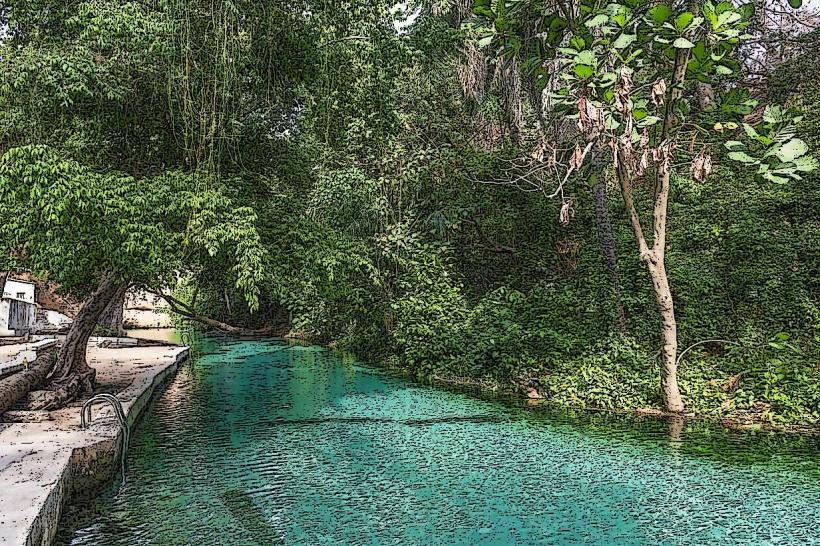
Landmark: Yankari National Park
City: Bauchi
Country: Nigeria
Continent: Africa
Yankari National Park, Bauchi, Nigeria, Africa
Yankari National Park is a large wildlife reserve located in the south-central part of Bauchi State, Nigeria. It is the country's most popular tourist destination, featuring a variety of natural attractions and wildlife.
Visual Characteristics
The park's landscape comprises savanna grasslands, woodlands, and riverine forests. The dominant vegetation is Sudan savanna, characterized by scattered trees and shrubs. The Gaji River flows through the park, creating areas of denser vegetation along its banks. Rock formations are present, including granite outcrops and laterite hills. The terrain is generally undulating.
Location & Access Logistics
Yankari National Park is situated approximately 100 kilometers southeast of Bauchi city. Access is primarily via the A3 highway, which connects Bauchi to Gombe. The main entrance is located near the town of Dindima. Driving from Bauchi city to the park entrance takes approximately 1.5 to 2 hours. There is a designated parking area at the park headquarters and at various accommodation sites within the park. Public transport options to Bauchi city are available, from where private taxis or hired vehicles can be arranged for the onward journey to the park.
Historical & Ecological Origin
The area was established as a game reserve in 1956 and later became a national park in 1991. Its ecological origin is rooted in the savanna biome, supporting a diverse range of flora and fauna adapted to semi-arid conditions. The park was created to conserve these species and their habitats.
Key Highlights & Activities
Activities include wildlife viewing, particularly during the dry season when animals congregate around water sources. Specific wildlife sightings may include elephants, baboons, hippopotami, and various antelope species. Guided safaris are available. The Wikki Warm Springs, a natural spring with a constant temperature of 31°C, is a primary attraction for bathing. Hiking trails are present, offering opportunities to explore the park's diverse ecosystems. Birdwatching is also a significant activity, with over 350 bird species recorded.
Infrastructure & Amenities
Accommodation options range from chalets to guest houses within the park. Restrooms are available at the park headquarters and accommodation areas. Shade is provided by trees in natural areas and by structures at visitor points. Cell phone signal (primarily 2G/3G) is intermittent within the park, with better reception near the headquarters. Limited food services are available at the park's restaurant and bar.
Best Time to Visit
The best time for wildlife viewing is during the dry season, from November to April, when water sources are limited, concentrating animals. The period from December to February offers cooler temperatures. The wet season, from May to October, brings lush vegetation but can make wildlife spotting more challenging. The Wikki Warm Springs can be visited year-round.
Facts & Legends
A notable historical oddity is the presence of ancient rock shelters and cave paintings within the park, indicating past human habitation. Local folklore suggests the Wikki Warm Springs have healing properties.
Nearby Landmarks
- Gubi Lake (15km Northwest)
- Sumaila Local Government Area (25km East)
- Kano City (approximately 150km North)
- Zaria (approximately 200km Southwest)


