
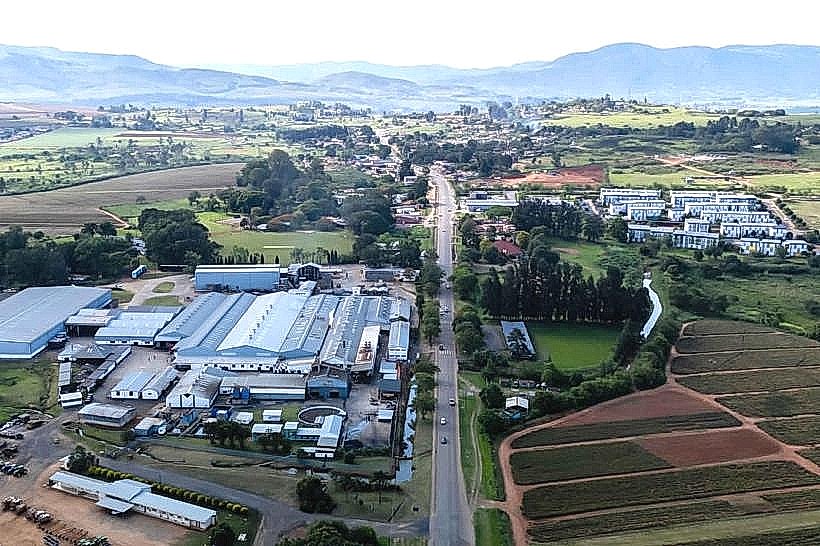
City: Malkerns
Country: Eswatini
Continent: Africa
Malkerns, Eswatini, Africa
Malkerns is a major agricultural, industrial, and handicraft hub within the Malkerns Valley of Eswatini. It is located in the Manzini Region, positioned 23 kilometers south of the executive capital, Mbabane, and 15 kilometers west of the industrial city, Manzini, along the MR27 corridor.
Historical Timeline
Early 1900s: Established as a colonial commercial farming settlement focused on large-scale citrus and sugarcane irrigation from the Usutu River network.
1953: Opening of the Malkerns Pineapple Cannery (now Rhodes Food Group), establishing the valley as an industrial agro-processing center.
1970s: Arrival of local craft cooperatives, transforming the area into the center of Eswatini's artisanal export industry.
2007: Launch of the annual MTN Bushfire Festival at House on Fire, establishing the town as an international cultural destination.
Primary Urban Event: The development of the Malkerns Irrigation Canal system in the mid-20th century transformed the dry bushveld into a high-yield, permanently irrigated agricultural basin, directly dictating the town's spatial layout around massive commercial estates.
Demographics & Population
Town Limits Population: 6,500
Metropolitan Area Population (Valley Basin): 14,000
Top Three Demographics: Swazi (96.8%), South African (1.4%), British/European expatriates (1.0%).
Median Age: 21.8 years
Urban Layout & Key Districts
Mbabane is organized linearly along the main MR27 highway corridor, surrounded by expansive agricultural fields.
Malkerns Town Center: The commercial strip running along the MR27, consisting of a primary shopping complex, fuel stations, and processing plants.
The Creative Quarter / Mahlanya: Located on the eastern edge toward the MR103 junction, containing traditional craft markets and performance venues.
Agricultural Estates: Large-scale privately owned sugarcane and pineapple plantations flanking the north and south parameters of the urban strip.
Top City Landmarks
Swazi Candles Craft Centre: A world-renowned artisanal workshop where workers use a millenia-old core-molding technique to create paraffin wax animal sculptures.
House on Fire: A massive, surrealist open-air performance arena and architectural park featuring mosaic towers, stone arches, and wood carvings.
Malkerns Square: The modern retail development anchoring the central commercial zone with corporate supermarkets and banking institutions.
Rhodes Food Group Cannery: The sprawling industrial processing facility that drives the town's agricultural economy and export logistics.
Mahlanya Market: A bustling, traditional open-air fruit and vegetable wholesale depot located at the valley's main highway junction.
Transportation Network
Intra-valley transit is dominated by 15-seater public minibuses (kombis) traveling back and forth along the MR27, connecting Mahlanya to the central town strip. There is no rail network or municipal bus system. Private metered taxis are clustered at Malkerns Square but require negotiated pricing. No ride-sharing applications function in this area. Traffic density is generally low, except during the evening commute when agricultural workers exit the plantations, and during the late-May Bushfire Festival, which creates multi-kilometer gridlock across the entire valley.
Safety & "Red Zones"
Malkerns is considered one of the safer urban corridors in Eswatini due to its semi-rural layout and tight-knit agricultural community. Property crime and opportunistic thefts do occur around the Mahlanya transit junction and near the dark margins of the informal settlements behind the cannery. Walking along the unlit edges of the MR27 highway after dark is highly discouraged due to the risk of pedestrian-vehicle collisions. No organized tourist scams operate within the craft centers.
Digital & Financial Infrastructure
Average Internet Speed: 20 Mbps fixed broadband; 12 Mbps mobile.
Main Mobile Carriers: MTN Eswatini, Eswatini Mobile.
Card Acceptance: High within formal craft centers, Malkerns Square, and established restaurants; cash is strictly mandatory at the Mahlanya Market and for public kombi transport.
ATMs: Readily available at Malkerns Square (FNB, Standard Bank, Nedbank). The local currency is the Lilangeni (SZL), trading at a 1:1 peg with the South African Rand (ZAR), which is accepted universally in banknote form.
Climate & Air Quality
Malkerns possesses a subtropical climate with warm, humid conditions ideal for agricultural production, situated at an altitude of roughly 750 meters.
Winter (Jun–Aug): 8°C to 24°C; mild days and cool nights. Air quality is fair, though smoke from agricultural cane-burning fields occurs periodically.
Summer (Dec–Feb): 18°C to 30°C; hot, humid days punctuated by intense late-afternoon downpours.
Weather Risks: Occasional severe hailstorms during early summer can damage crops and disrupt localized power grids.
Culture & Social Norms
Tipping: 10% is standard practice in sit-down restaurants catering to tourists and professionals; it is not expected at local takeaway shops.
Greeting: It is customary to greet locals with a polite "Yebo" before asking for assistance. When exchanging money or items, using both hands (or touching your right forearm with your left hand) signals respect.
Dress Code: Casual but respectful. Revealing clothing is frowned upon when moving outside the designated resort and craft areas into local markets.
Alcohol & Smoking: Consuming alcohol openly on public roads is illegal. Smoking is banned inside public structures and heavily discouraged around the crowded outdoor agricultural markets.
Accommodation Zones
MR27 West Corridor: Recommended for travelers seeking country estates, bed-and-breakfasts, and direct walking access to the core craft centers.
Mantenga Periphery (North-East): Recommended for quick logistics, placing visitors at the boundary of the Ezulwini tourist infrastructure while remaining within a 5-minute drive of Malkerns' agricultural valley.
Local Cost Index
1 Espresso: 32 SZL ($1.78 USD)
1 Standard Lunch (Farm-to-table cafe meal): 110 SZL ($6.15 USD)
1 Kombi Transit Ticket (To Manzini or Mahlanya): 14 SZL ($0.78 USD)
Nearby Day Trips
Mantenga Cultural Village: A living museum of a traditional 19th-century Swazi homestead adjacent to a major waterfall; 10 km northeast, reachable via the MR103 in 12 minutes.
Mlilwane Wildlife Sanctuary: A wildlife reserve permitting self-guided walking and mountain biking among wild herds; 8 km north, accessible via a dirt road connection in 10 minutes.
Lobamba Legislative Capital: The historical center housing the Houses of Parliament and National Museum; 12 km northeast, reachable via the MR103 in 15 minutes.
Facts & Legends
An urban myth persists regarding the massive, sculpted architecture of House on Fire. Local folklore alleges that the complex was constructed over a subterranean node of natural spiritual energy that amplifies musical and artistic expression. This myth grew out of the historical reality that the complex's multi-tiered stone walls and mosaic galleries were built entirely by local craftsmen using purely recycled materials, scrap metal, and local stones without formal blueprints, creating a structure that texturally matches the organic landscape of the valley floor.


