
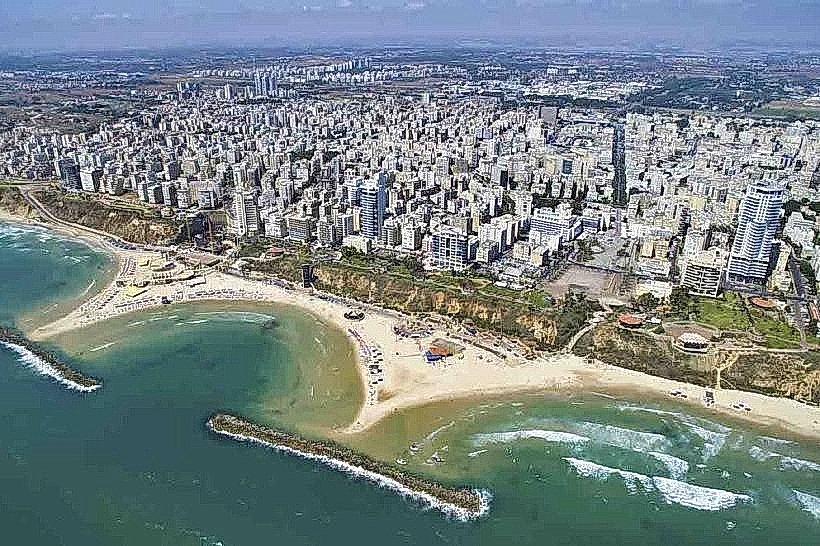
City: Netanya
Country: Israel
Continent: Asia
Netanya, Israel, Asia
Netanya serves as the administrative and economic center of the Sharon plain and is a major coastal resort city. It is situated on the Mediterranean coast of central Israel, approximately 30 kilometers north of Tel Aviv and 50 kilometers south of Haifa.
Historical Timeline
Netanya was founded on February 18, 1929, by the Bnei Binyamin association and named after the American philanthropist Nathan Straus. Primary eras of governance include the British Mandate (1929–1948) and the Israeli state (1948–present), with the city officially declared a municipality on December 3, 1948. The primary event shaping the current urban form was the 1933 Master Plan by British architect Clifford Holliday, which designated specific coastal tourism zones, a central commercial core, and an eastern industrial sector.
Demographics & Population
The total population within city limits is approximately 257,700 residents. The top three ethnic or national demographics are Jews of European descent (including a large French-speaking community), Jews from the former Soviet Union, and Jews of North African descent. The median age of the population is approximately 34 years.
Urban Layout & Key Districts
The city is organized linearly along 14 kilometers of coastline and divided by the north-south Highway 2. The most important districts for visitors are the City Center (Herzl Street and Independence Square), located at the central-western coastline; the Promenade (Nitsa Boulevard), extending north and south from the center; and Ir Yamim/Ramat Poleg, located at the southern cardinal direction.
Top City Landmarks
Independence Square (Kikar HaAtzmaut)
The Ancient Sycamore Tree (Umm Khaled area)
Victory Monument (Honoring the Red Army)
Netanya City Museum
The Iris Nature Reserve
Transportation Network
Movement within Netanya is provided by an extensive bus network operated by Egged and Kavim. There is no metro or tram system. Ride-sharing is available via Gett and Uber. Official taxis are white. Traffic density is high during peak hours, particularly at the Poleg and Netanya North interchanges on Highway 2.
Safety & "Red Zones"
Netanya maintains a general safety level comparable to other large Israeli cities. Areas to avoid late at night include the neighborhoods of Dora (Ramat Herzl) and Kiryat Nordau, as well as the immediate vicinity of the central market (Shuk) and bus station due to higher reported rates of petty crime. Common scams involve unlicensed taxis and aggressive panhandling near the central promenade.
Digital & Financial Infrastructure
Average internet speed is 200–500 Mbps via fiber optics. Main mobile carriers include Cellcom, Partner, and Pelephone. Card acceptance is nearly universal for all transactions; Google and Apple Pay are standard. ATMs are widely available at bank branches and within the Ir Yamim and Sharon malls.
Climate & Air Quality
Summers (June–September) are hot and muggy, with temperatures between 24°C and 31°C. Winters (December–February) are mild and wet, ranging from 10°C to 18°C. Air quality is generally moderate, though high humidity in summer can trap pollutants, and occasional sandstorms (Sharav) occur in spring and autumn.
Culture & Social Norms
Tipping of 10–15% is standard in restaurants. Handshakes are the standard greeting. Dress code is generally casual, though modest clothing is required for religious sites and the Kiryat Sanz neighborhood. Alcohol is restricted in public parks after 23:00, and smoking is prohibited in enclosed public spaces.
Accommodation Zones
Stay in the City Center for direct walking access to the beach, nightlife, and Independence Square.
Stay in Ir Yamim/Ramat Poleg for modern luxury hotels, quieter surroundings, and proximity to the Iris Reserve.
Local Cost Index
1 Espresso: 12 ILS ($3.25 USD)
1 Standard Lunch: 65 ILS ($17.50 USD)
1 Metro/Bus Ticket: 5.50 ILS ($1.50 USD)
Nearby Day Trips
Caesarea National Park (25 km)
Tel Aviv-Yafo (32 km)
Haifa and the Baháʼí Gardens (50 km)
Alexander River Nature Reserve (15 km)
Facts & Legends
A unique local oddity involves the "Straus Disappointment." The city was named after Nathan Straus in the explicit hope that he would donate a significant portion of his fortune to the fledgling settlement. When he informed the founders he had already given away most of his wealth elsewhere, they were reportedly disappointed but retained the name, making Netanya one of the few cities in the world named for a donation that never materialized.


