
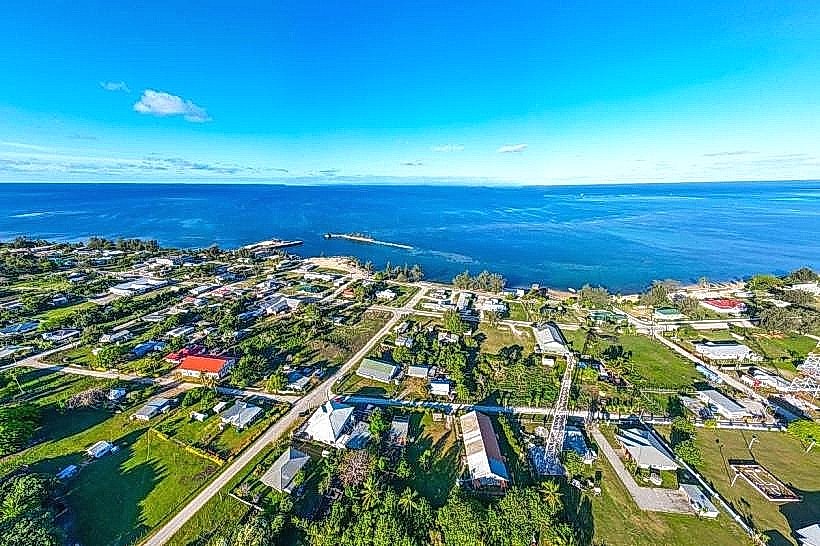
City: Pangai
Country: Tonga
Continent: Australia
Pangai, Tonga, Australia
Pangai is the administrative center and main township of the Ha'apai island group in the Kingdom of Tonga, located on the western coast of Lifuka Island. It serves as the local seat of government, primary inter-island transport terminal, and commercial hub for the central Tongan island chain.
Historical Timeline
Lifuka Island was settled by Lapita ancestors around 1000 BCE, later becoming a strategic regional stronghold for Tongan chiefs. Captain James Cook anchored off Pangai in 1777, naming the surrounding region the "Friendly Islands." In 1806, the British privateer ship Port-au-Prince was captured off the coast of Pangai by the forces of Chief Finau 'Ulukalala II. King George Tupou I spent significant parts of his early reign on Lifuka during the mid-19th century. The town's present linear settlement pattern along the coastline was established primarily during the consolidation of administrative infrastructure following Tongan national unification in the late 19th century.
Demographics & Population
The population of Pangai is approximately 1,000 residents within the main village limits, with Lifuka Island as a whole housing roughly 2,200 people. Indigenous Tongans make up over 98% of the local demographic, with small numbers of Chinese shop owners and Euro-Pacific expatriates comprising the remainder. The median age of the population is 20.8 years.
Urban Layout & Key Districts
Pangai is structured in a compact grid parallel to the western shoreline facing the Lifuka Passage. The waterfront area along Holopeka Road contains the main shipping wharf, police station, and administrative offices. The central market and retail storefronts cluster around the main intersection near the Royal Residence grounds, while residential homes extend eastward toward the island's interior and northward toward Koulo village.
Top City Landmarks
Shirley Baker Monument: A large stone monument and tomb dedicated to Rev. Shirley Waldemar Baker, Tonga's first Prime Minister, who died in Pangai in 1903.
Pangai Market: The town's central public market where local farmers and fishermen sell fresh produce, fish, and traditional handicrafts.
Centenary Church Pangai: A prominent Free Wesleyan church located near the town center that serves as the chief gathering place for major civic ceremonies.
Lifuka Port & Harbor: The principal deep-water dock accommodating inter-island passenger ferries, cargo ships, and fishing vessels.
Royal Compound: The official coastal grounds and residence reserved for the Tongan royal family during visits to the Ha'apai group.
Transportation Network
Pangai has no formal public transit system, metro, or scheduled bus network. Local travel relies on personal vehicles, bicycles, or walking. Taxis are privately owned cars without meters, identified by a "T" on the license plate. International ride-sharing applications like Uber, Bolt, or Grab do not exist on the island. Road traffic density is extremely low, with no traffic congestion.
Safety & "Red Zones"
Pangai is an exceptionally safe village environment with negligible crime rates. Standard precautions against leaving valuables unattended on beaches or in unlocked rooms are sufficient. Nighttime walking is safe, though street lighting is sparse outside the central strip. Free-roaming domestic dogs can be occasionally assertive in peripheral rural lanes.
Digital & Financial Infrastructure
Average fixed internet speeds range from 15 to 50 Mbps, backed by submarine fiber-optic connections to Tongatapu. Mobile network connectivity is provided by Digicel Tonga and Tonga Communications Corporation (TCC / U-Call) via 4G. Credit card acceptance is virtually non-existent outside of one or two larger resort properties; cash is required for almost all daily transactions. Bank South Pacific (BSP) maintains an ATM in central Pangai.
Climate & Air Quality
Pangai experiences a tropical climate, with a warm, humid period from November to April and a cooler, drier period from May to October. Average daily temperatures range between 21°C in August and 28°C in February. Air quality is pristine year-round due to continuous trade winds. Tropical cyclones represent the primary seasonal natural hazard during the wet season.
Culture & Social Norms
Life in Pangai adheres strictly to traditional Tongan etiquette (anga faka-Tonga) and Christian principles. Tipping is not expected or customary. Greetings are polite and understated, often a mild node or handshake. Public dress standards are strict; revealing attire is considered disrespectful, and men are legally required to wear shirts in public places. Sundays are strictly observed as a day of rest under Tongan law, during which all businesses, services, and recreational activities are suspended.
Accommodation Zones
Pangai Town Center: Recommended for proximity to local shops, government facilities, the ferry terminal, and the airport.
Northern Lifuka (Koulo Road): Recommended for quieter beachfront guesthouses set away from the main administrative center.
Local Cost Index
1 Espresso: 6.50 TOP ($2.70 USD)
1 Standard Lunch: 18.00 TOP ($7.50 USD)
1 Bus Ticket: N/A (No bus service)
Nearby Day Trips
Foa Island: An island directly north of Lifuka connected by a drivable causeway, known for pristine reef beaches and water sports.
Uoleva Island: An uninhabited island located 6 kilometers south across a shallow channel, accessible by boat or low-tide wading for whale watching and beach trekking.
'Uiha Island: An island situated 15 kilometers south containing the ancient Makahokovalu stone monuments and traditional royal burial sites.
Facts & Legends
Off the coast of Pangai in 1777, Chief Finau 'Ulukalala I hosted Captain James Cook with lavish feasts, sports, and night dances. Unbeknownst to Cook, the local chiefs had secretly plotted to assassinate him during the festivities to seize his ship's iron and weapons. Due to a last-minute disagreement among the chiefs over the timing of the attack, the plan was abandoned. Unaware of the conspiracy, Cook named Ha'apai the "Friendly Islands"-a title later applied to the entire Kingdom of Tonga.


