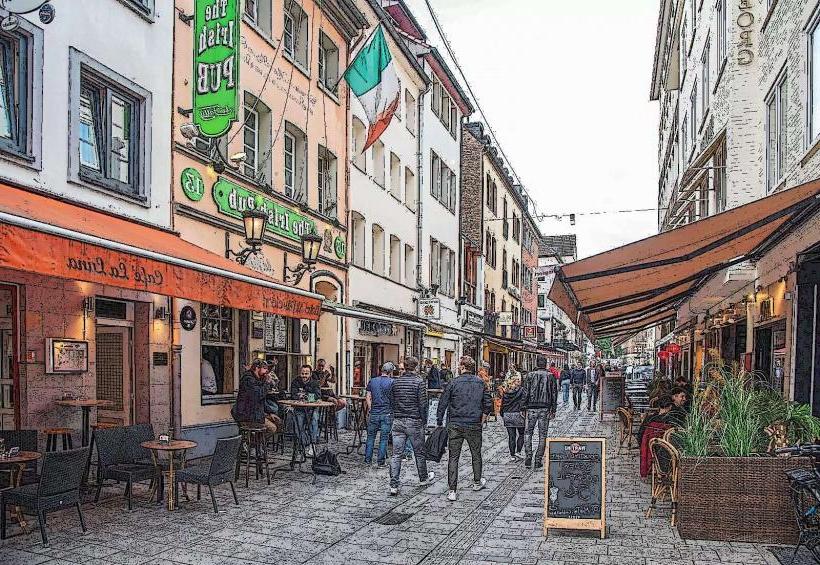
Landmark: Altstadt
City: Dusseldorf
Country: Germany
Continent: Europe
Altstadt, Dusseldorf, Germany, Europe
Düsseldorf Altstadt (Old Town) is the historical, cultural, and social center of the city. Despite its compact size, it is internationally recognized as the "Longest Bar in the World" (Längste Theke der Welt).
Visual Characteristics
The district is characterized by narrow, cobblestone streets and dense rows of traditional brick buildings. It maintains a historic atmosphere through its gabled houses and the iconic twisted spire of the St. Lambertus Basilica. The area is a high-contrast zone, blending centuries-old breweries with modern retail and art institutions. To the west, it opens onto the wide, paved Rhine Embankment Promenade.
Location & Access Logistics
The Altstadt is situated between the Rhine River to the west and the modern city center (Stadtmitte) to the east.
Public Transit: Directly served by the major interchange station Heinrich-Heine-Allee (all U-Bahn lines and numerous trams).
Walking: Centrally located; 10-15 minutes from the Central Station (Hauptbahnhof).
Parking: Strictly pedestrianized. Use "Parkhaus Altstadt," "Parkhaus Rheinufertunnel," or "Parkhaus Kunsthalle."
Historical & Ecological Origin
Düsseldorf was granted city rights in 1288 following the Battle of Worringen. The Altstadt marks the original settlement at the mouth of the Düssel river (which still flows through parts of the district). While heavily damaged in WWII, it was reconstructed to preserve its medieval street plan. The Rhine Promenade acts as a flood defense and an urban ecological space, separating the dense architecture from the river.
Key Highlights & Activities
Hausbrauereien (Home Breweries): Traditional breweries like Füchschen, Uerige, and Schlüssel serve the local Altbier (top-fermented dark beer).
St. Lambertus Basilica: Famous for its "leaning" or twisted tower.
Schlossturm (Castle Tower): The only remaining part of the city palace, now housing the Maritime Museum.
Marktplatz: Features the Renaissance-style City Hall (Rathaus) and the equestrian statue of Jan Wellem.
Schneider-Wibbel-Gasse: A small alley famous for its clock that performs a theatrical play several times daily.
Infrastructure & Amenities
The district is almost entirely pedestrianized. It contains over 300 bars, clubs, and restaurants, ranging from traditional taverns to fine dining. Public restrooms are available in the Rathaus area and major department stores bordering the district. 5G signal is exceptional.
Best Time to Visit
Weekday Afternoons: For a quieter exploration of the historical landmarks.
Friday/Saturday Nights: For the peak local nightlife experience.
Carnival (February): The Altstadt is the epicenter of the "Fifth Season" celebrations.
December: Hosts one of Germany's most atmospheric Christmas Markets.
Facts & Legends
A technical oddity is the Rheinufertunnel (Rhine Bank Tunnel), which moved heavy traffic underground in the 1990s, allowing the creation of the promenade and re-connecting the Altstadt to the river. A local legend explains the twisted spire of St. Lambertus as the work of the devil or, more humorously, that the tower will straighten itself only when a true virgin marries in the church.
Nearby Landmarks
Rhine Embankment Promenade – 0.1km West
Königsallee – 0.5km East
Hofgarten (Park) – 0.2km North
Kunstsammlung Nordrhein-Westfalen (K20) – 0.1km East
Rheinturm (Rhine Tower) – 1.2km Southwest