Landmark: Schloss Benrath
City: Dusseldorf
Country: Germany
Continent: Europe
Schloss Benrath, Dusseldorf, Germany, Europe
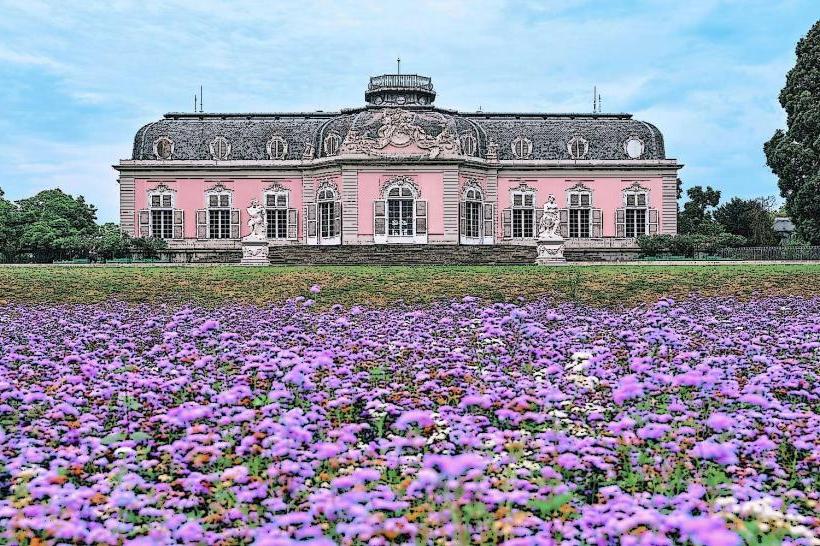
Schloss Benrath is a Late Baroque maison de plaisance (pleasure palace) located in the Benrath district of Düsseldorf. It is considered one of the most significant architectural ensembles of the transition period between Rococo and Neoclassicism in Europe.
Visual Characteristics
The palace is a symmetrical complex consisting of a central Corps de Logis (main building) flanked by two arched wings. The exterior is finished in a distinctive "Benrath Pink" with white stone detailing. The interior is noted for its optical illusions; while the exterior appears to be a single-story building, it actually contains four levels. The central hall features elaborate stucco work and dome paintings depicting hunting scenes and mythological themes.
Location & Access Logistics
Located at Benrather Schloßallee 100-108, 40597 Düsseldorf.
Public Transit: Served by Schloss Benrath (Tram 701, U-Bahn U71) or the Düsseldorf-Benrath S-Bahn station (S6, S68, and regional trains).
Access: The park is free and open to the public. Entry to the Palace, Museum of Natural History, and Museum of European Garden Art requires a paid ticket.
Tours: Guided tours are mandatory for viewing the interior of the Corps de Logis to protect the historic parquet and silk wall coverings.
Parking: Limited on-site parking; use the public lots on Bayreuther Straße.
Historical & Ecological Origin
Built between 1755 and 1773 for Elector Palatine Charles Theodore and his wife, Elisabeth Auguste, by architect Nicolas de Pigage. The site was designed as a "Total Work of Art" (Gesamtkunstwerk), where the architecture, interior design, and gardens are perfectly integrated. The 60-hectare park includes a formal French garden and an English landscape park. Ecologically, the park serves as a protected habitat for several rare bird species and centuries-old trees.
Key Highlights & Activities
Corps de Logis: The central palace building housing the ducal apartments.
Museum of European Garden Art: Located in the East Wing, documenting the history of garden design from antiquity to the present.
Museum of Natural History: Located in the West Wing, focusing on the ecology of the Rhine and local biodiversity.
The Mirror Pond (Spiegelweiher): A long, rectangular pond that provides a perfect reflection of the palace facade.
Kitchen Garden: A restored 18th-century vegetable and herb garden used for educational purposes.
Infrastructure & Amenities
The complex includes the Schlosscafé in the West Wing. The park features wide, level gravel paths suitable for walking and cycling. While the park is accessible, the historic upper floors of the palace have limited wheelchair access due to the original staircases. Public restrooms are available in the museum wings. 5G signal is stable throughout the grounds.
Best Time to Visit
Spring/Summer: When the formal flower beds and orange trees are in full bloom.
Winter: The "Palace Magic" Christmas market takes place in the courtyard during late November and December.
Weekday Mornings: To experience the gardens with minimal crowds.
Facts & Legends
A technical oddity is the hidden system of "servant corridors" and concealed doors, designed to allow staff to move through the palace without being seen by the nobility. Historically, despite the grandeur of the construction, the Elector and his wife only stayed at the palace for one night together, as the court was primarily based in Mannheim and later Munich.
Nearby Landmarks
Benrath City Center – 0.3km North
Rhine River Bank – 0.6km West
Urdenbacher Kämpe (Nature Reserve) – 1.5km Southwest