Landmark: Arjuna’s Penance
City: Konark
Country: India
Continent: Asia
Arjuna’s Penance, Konark, India, Asia
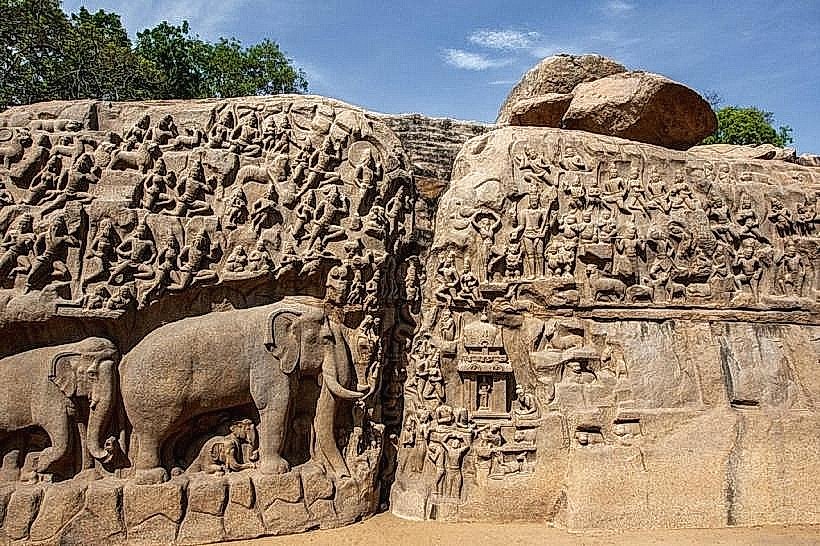
Arjuna's Penance is a large rock relief located in Mahabalipuram, India. It is also known as Descent of the Ganges.
Visual Characteristics
This massive bas-relief, carved from two monolithic boulders, measures approximately 96 feet long and 43 feet high. It depicts a multitude of figures, including humans, animals, and deities, in various poses. The carving style is characteristic of the Pallava dynasty, with detailed musculature and flowing drapery. The rock itself is a coarse-grained pinkish granite.
Location & Access Logistics
Arjuna's Penance is situated in the town of Mahabalipuram, Tamil Nadu, India. It is located approximately 60 kilometers south of Chennai city center. Access is via East Raja Street. Parking is available on the street adjacent to the monument. Public transport options include buses from Chennai to Mahabalipuram, with frequent services. The site is a short walk from the main bus stop.
Historical & Ecological Origin
The relief is believed to have been carved in the 7th century CE during the reign of the Pallava king Narasimhavarman I. Its original purpose was likely to serve as a public monument and a representation of religious narratives. The geological origin is a natural granite boulder formation.
Key Highlights & Activities
Observation of the detailed carvings is the primary activity. Visitors can examine the depiction of Arjuna performing penance to obtain the Pasupatastra weapon. The relief also features a representation of the celestial river Ganges descending to Earth. Photography is permitted.
Infrastructure & Amenities
Restrooms are available near the monument. Shade is limited, provided primarily by natural trees. Cell phone signal (4G/5G) is generally good in the area. Food vendors are present along the main road leading to the monument.
Best Time to Visit
The best time of day for photography is in the late afternoon when the sunlight casts shadows that enhance the relief's depth. The months of October to March offer the most pleasant weather, with lower humidity and moderate temperatures. No tide-specific considerations apply.
Facts & Legends
A notable feature is the carving of a cat in a meditative pose, often interpreted as a representation of hypocrisy or a satirical element within the larger narrative. Local lore suggests the relief depicts the descent of the sacred river Ganges, though scholarly interpretation focuses on Arjuna's penance.
Nearby Landmarks
- Shore Temple (0.3km South)
- Pancha Rathas (0.8km West)
- Mahishasuramardini Mandapa (0.2km South)
- Varaha Cave Temple (0.4km West)