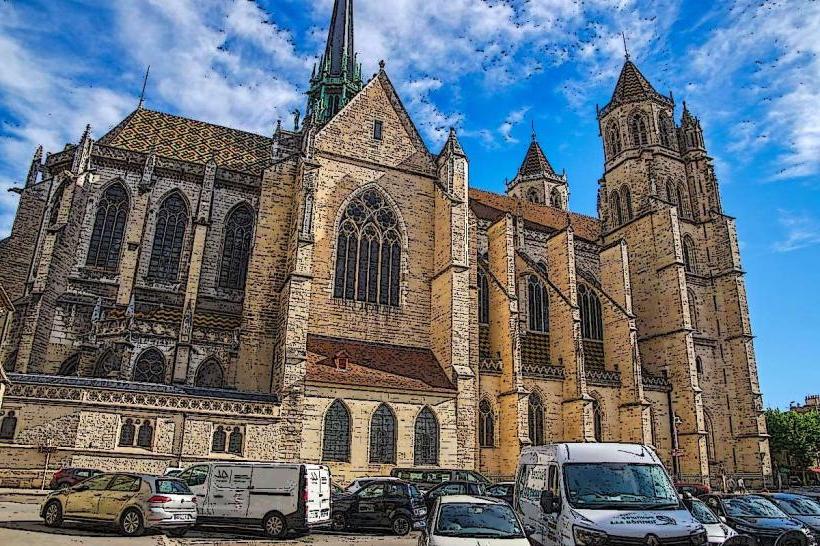
Landmark: Dijon Cathedral
City: Dijon
Country: France
Continent: Europe
Dijon Cathedral, Dijon, France, Europe
Dijon Cathedral, officially the Cathédrale Saint-Bénigne de Dijon, is a Roman Catholic church and former abbey situated in the heart of Dijon, the capital of the Burgundy region. It is a national monument of France and serves as a prime example of the Burgundian Gothic style.
Visual Characteristics
The cathedral is defined by its austere Gothic facade flanked by two massive 14th-century towers and a soaring 19th-century wooden spire that reaches 93 meters. A distinctive feature is the polychrome roof-glazed, geometrically patterned tiles in green, yellow, black, and red-a hallmark of Burgundian architecture. The interior is characterized by its vast, light-filled nave and an expansive 11th-century rotunda and crypt.
Location & Access Logistics
The building is located at Place Saint-Bénigne, 21000 Dijon. It is approximately 0.6km east of the Dijon-Ville Train Station (Gare de Dijon-Ville), a roughly 7-minute walk. The site is served by the Divia tramway network (Lines T1 and T2) at the "Darcy" or "Godrans" stops. Public parking is available at the Parking Darcy-Liberté or Parking Condorcet, both within a 5-minute walk.
Historical & Ecological Origin
The site has been a place of worship since the late Roman period, originally dedicated to the martyr Saint Benignus. The current Gothic structure was built between 1280 and 1325 over the remains of a Romanesque abbey church that collapsed in 1271. Geologically, the cathedral is constructed primarily from Oolitic limestone, a material abundant in the Burgundy region that allowed for the intricate carvings and structural durability of the Gothic period.
Key Highlights & Activities
The primary attraction is the Crypt of Saint-Bénigne, one of the oldest Christian sanctuaries in France, featuring the remains of a massive Romanesque rotunda with circular rows of columns. Visitors can attend regular Catholic services or explore the 18th-century Riepp pipe organ, which is frequently used for concerts. The building is also a key stop on the "Parcours de la Chouette" (Owl's Trail) walking tour of historic Dijon.
Infrastructure & Amenities
The cathedral is open daily (09:00–12:00 and 14:00–18:30). Public restrooms are located in the nearby Place Darcy. 5G cellular coverage is reliable in the surrounding plaza, though signal penetration is minimal inside the thick-walled crypt. The nave is accessible to visitors with reduced mobility, but the crypt involves navigating steep stone stairs.
Best Time to Visit
The best light for viewing the polychrome roof tiles is during mid-day when the sun is overhead. For interior photography, the morning light illuminates the western rose window. Visiting on a Saturday allows for a more vibrant experience as the nearby Halles Centrales market is in full operation.
Facts & Legends
A verified historical oddity is that the cathedral's rotunda was originally three stories high and inspired by the Church of the Holy Sepulchre in Jerusalem, though only the lower crypt level survived the French Revolution. Local legend holds that the "Owl" carved on the nearby Church of Notre-Dame brings good luck, but a similar spiritual protection is often attributed to the relics of Saint Benignus housed within the cathedral’s lower vaults.
Nearby Landmarks
Musée Archéologique de Dijon (located in the former abbey): 0.1km West
Jardin de l'Arquebuse: 0.4km West
Place Darcy: 0.3km North
Palace of the Dukes of Burgundy: 0.7km East
Church of Notre-Dame de Dijon: 0.6km East