Landmark: Eglise Saint Joseph
City: Le Havre
Country: France
Continent: Europe
Eglise Saint Joseph, Le Havre, France, Europe
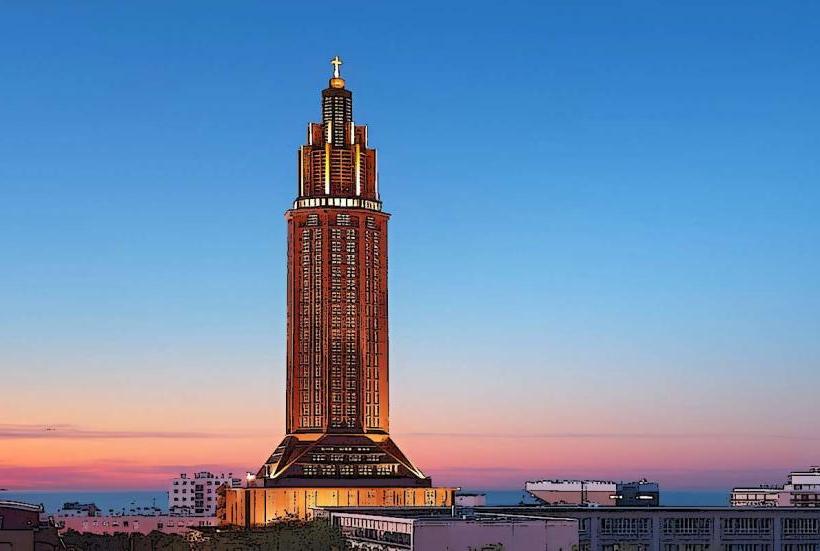
The Église Saint-Joseph is a reinforced concrete masterpiece in Le Havre, Normandy. Designed by Auguste Perret and completed in 1957, it serves as both a parish church and a memorial to the victims of the 1944 aerial bombardments. It is a centerpiece of the UNESCO-listed city center.
Visual Characteristics
The structure is a "spiritual skyscraper" defined by a 107-meter-long octagonal bell tower. The exterior is austere, raw concrete (béton brut), while the interior is a hollow, cavernous space completely devoid of traditional pillars in the center. The walls are embedded with 12,768 pieces of mouth-blown stained glass arranged in geometric patterns, shifting in color from dark tones at the base to bright, clear glass at the summit.
Architectural Style & Construction
Style: Modernist / Structural Classicism.
Material: Reinforced concrete, textured through bush-hammering.
The Tower: Acts as a maritime landmark (lantern), visible from the sea.
Stained Glass: Created by artist Marguerite Huré, the glass is not pictorial but symbolic, using color "temperatures" to influence the internal atmosphere based on the sun's position.
Location & Access Logistics
Address: Boulevard François 1er, 76600 Le Havre.
Transport: Tram lines A and B (Stop: "Hôtel de Ville") followed by a 10-minute walk.
Parking: Street parking is available on Boulevard François 1er or the nearby "Parking de la Mairie."
Entry: Admission is free. The church is an active place of worship; silence is required.
Historical Origin
The original 19th-century church was destroyed during the Allied bombing of September 1944. Perret designed the new structure to be a "lighthouse" for the reconstructed city. Construction began in 1951, shortly before Perret's death, and was completed by his students (the Atelier Perret).
Infrastructure & Amenities
Accessibility: The main nave is fully accessible to wheelchair users.
Environment: The interior is naturally cool in summer and can be quite cold in winter due to the massive volume of the tower.
Connectivity: 5G/4G signals are stable outside, but cellular reception is significantly weakened inside the dense concrete shell.
Best Time to Visit
The interior experience is entirely dependent on sunlight. Mid-day on a clear, sunny day is optimal to see the "kaleidoscope" effect as sunlight hits the thousands of stained glass apertures. The church is illuminated at night, making it a primary subject for architectural photography from the exterior.
Facts & Legends
The church is often compared to a "hollow chimney" or a "torch." A verified engineering fact: the tower is supported by four groups of pillars sunk into the ground, but the interior remains entirely open to the top of the 107-meter spire, creating a vertical void designed to draw the eye upward.
Nearby Landmarks
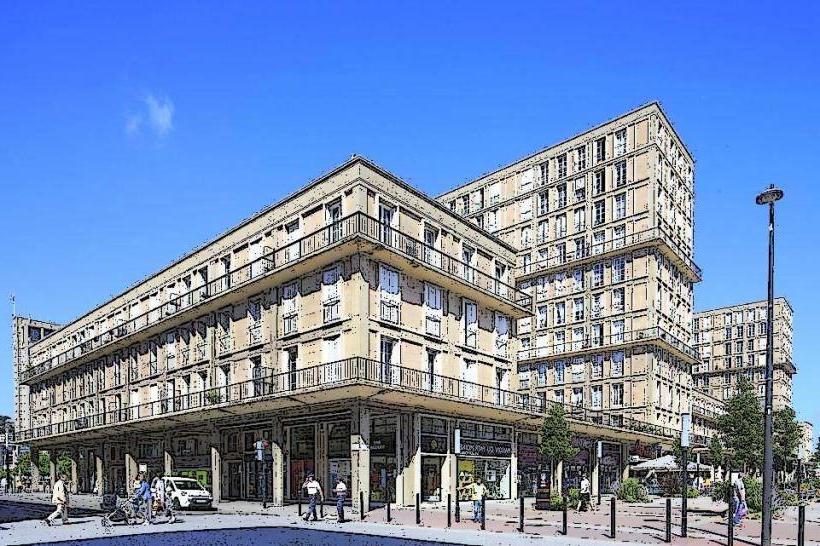
Quartier Perret: Immediate surrounds.
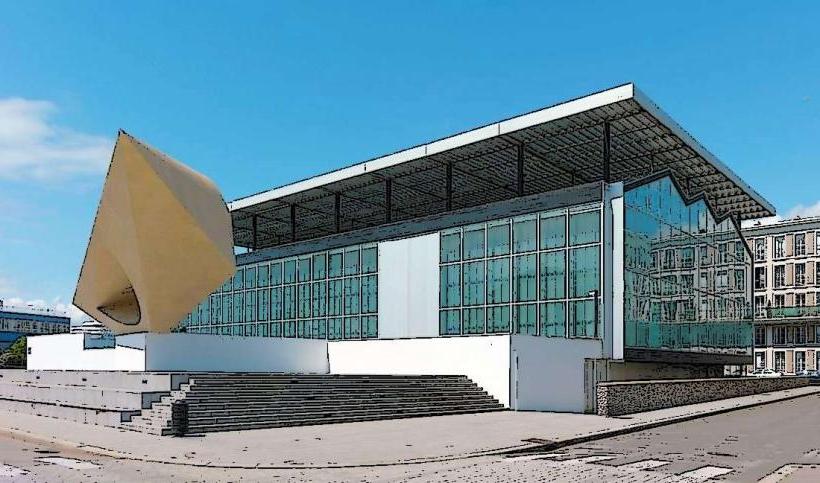
MuMa (Musée d'art moderne André Malraux): 0.5km South.
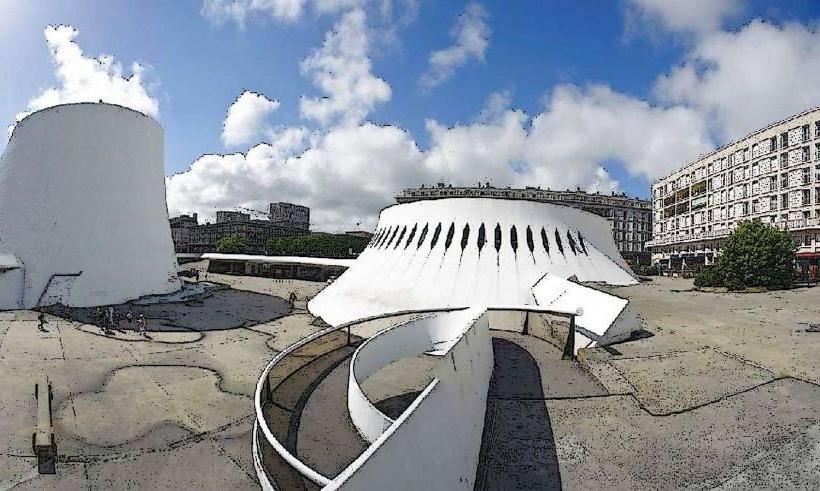
Le Volcan (Oscar Niemeyer): 0.6km East.
Le Havre Beach: 0.6km West.