Information
Landmark: Gellért HillCity: Budapest
Country: Hungary
Continent: Europe
Gellért Hill, Budapest, Hungary, Europe
Gellért Hill (Gellért-hegy) is a 235-meter dolomite hill rising steeply from the Danube in the Buda district. It is a UNESCO World Heritage site and offers the most comprehensive 360-degree panorama of Budapest.
Visual Characteristics
The hill is defined by its rugged cliffs, wooded parkland, and the prominent Liberty Statue at its summit. It serves as a natural barrier between the central city and the southern residential districts, providing a high-contrast view of the flat Pest side across the river.
Location & Access Logistics
Transit:
Bus: Line 27 from Móricz Zsigmond körtér goes to the summit (Búsuló Juhász stop).
Tram: Lines 19, 41, 47, 48, 49 to the foot of the hill (Szent Gellért tér).
Metro: Line M4 to "Szent Gellért tér."
Ascent: Several hiking paths lead up from both the Elisabeth Bridge and the Szent Gellért Bath. The climb takes approximately 15–20 minutes.
Note: The Citadella fortress at the summit is currently undergoing a long-term reconstruction project; access to the fortress walls may be restricted, but the Liberty Statue remains visible.
Historical & Religious Origin
Named after Saint Gerard (Gellért), an Italian bishop who was purportedly martyred here in 1046 during a pagan uprising.
The Citadella: A fortress built in 1851 by the Habsburgs following the 1848–49 Hungarian Revolution. Its purpose was not to protect the city, but to intimidate the Hungarian population from above.
Liberty Statue: Erected in 1947 to commemorate the Soviet liberation of Hungary. After 1989, the pro-Soviet inscriptions were removed to redefine it as a symbol of general independence.
Key Highlights & Activities
Liberty Statue: A 14-meter bronze figure holding a palm leaf aloft.
Gellért Hill Cave (Sziklatemplom): A chapel and monastery built into a natural cave system, run by the Pauline Order.
Saint Gerard Monument: A large statue and semi-circular colonnade with a waterfall facing the Elisabeth Bridge.
Garden of Philosophers: A group of statues representing world religions and philosophical thinkers (Jesus, Buddha, Laozi, etc.).
"Buda meets Pest" Statue: A small, modern sculpture depicting the two sides of the city.
Infrastructure & Amenities
Accessibility: Most paths are steep and involve stairs; it is generally not barrier-free for manual wheelchairs. Those with mobility issues should use Bus 27.
Connectivity: 5G/4G coverage is strong throughout the park.
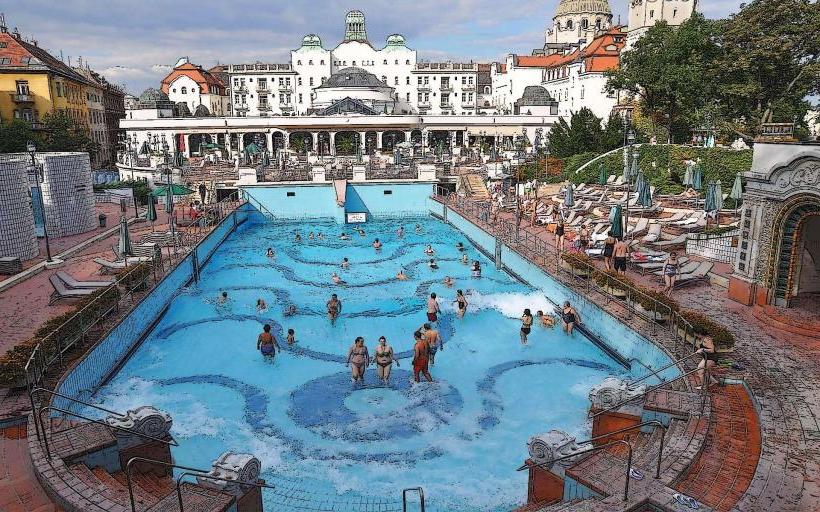
Baths: The Gellért Thermal Bath, located at the foot of the hill, is famous for its Art Nouveau architecture.
Best Time to Visit
Sunset: For the most iconic views of the city bridges and the Parliament as the city lights turn on.
Spring: When the almond trees on the hillside are in bloom.
Facts & Legends
Local folklore once claimed the hill was a meeting place for witches. Technically, the hill’s geology is crucial to the city’s identity; the fault line at its base allows the mineral-rich thermal waters to reach the surface, supplying the Gellért and Rudas Baths.
Nearby Landmarks
Gellért Thermal Bath – South foot
Rudas Thermal Bath – North foot
Elisabeth Bridge – North foot
Liberty Bridge – South foot