Landmark: Marc Chagall National Museum
City: Nice
Country: France
Continent: Europe
Marc Chagall National Museum, Nice, France, Europe
The Marc Chagall National Museum is a monographic art institution located in the Cimiez district of Nice, France. It was specifically established to house the "Biblical Message," a series of seventeen monumental paintings donated by the artist to the French state.
Visual Characteristics
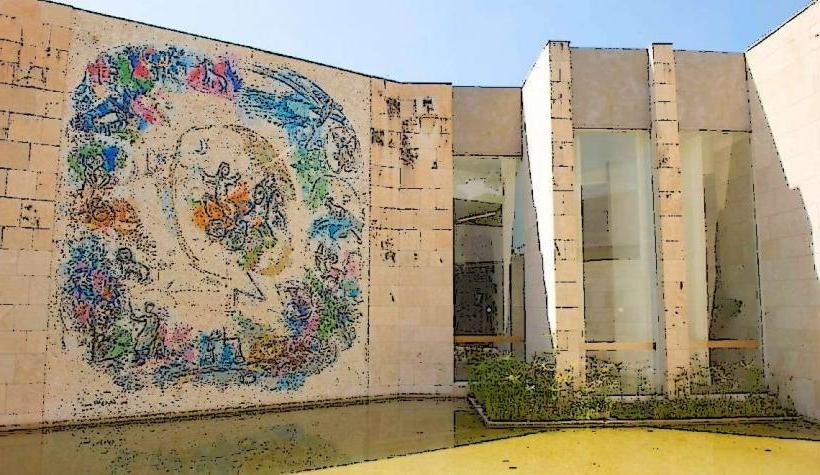
The museum is a single-story modernist building constructed with light-colored La Turbie limestone and aluminum-silicon lintels, creating a matte, understated exterior. The interior features a central hall designed as a series of interlocking rhombuses to provide twelve distinct wall surfaces for the large-scale canvases. Notable architectural integrations include three large stained-glass windows in the auditorium depicting the creation of the world and a large outdoor mosaic reflected in a rectangular pond.
Location & Access Logistics
Situated at 36 Avenue Docteur Ménard, the museum is approximately 1.5 kilometers north of the Nice-Ville railway station. It is accessible via the Lignes d'Azur bus lines 15 and 22, stopping at the "Musée Chagall" station. Limited free parking is available on-site for cars and coaches, and the museum is a 20-minute uphill walk from the city center (Avenue Jean Médecin).
Historical & Ecological Origin
The museum was inaugurated on July 7, 1973, making it the first national museum dedicated to a living artist in France. Architect André Hermant, a former collaborator of Le Corbusier, designed the structure in close consultation with Marc Chagall to ensure the architecture served the specific dimensions and spiritual themes of the artwork. The surrounding gardens were designed by landscape architect Henri Fisch, featuring Mediterranean species such as olive trees, cypresses, and agapanthus.
Key Highlights & Activities
Visitors view the "Biblical Message" cycle, which covers themes from Genesis, Exodus, and the Song of Songs. The auditorium hosts regular film screenings about Chagall’s life and occasional musical concerts. The garden allows for pedestrian exploration of the mosaic of the Prophet Elijah and the reflection pool.
Infrastructure & Amenities
The museum contains a dedicated "Buvette" (snack bar) located in the garden, providing light meals and refreshments outdoors or under a terrace. Restrooms are located within the main entrance pavilion. While large bags are prohibited and no cloakroom for oversized items is provided, 4G/5G cellular coverage is maintained across the site.
Best Time to Visit
The best lighting for viewing the stained-glass windows and interior galleries is at opening (10:00) or during mid-afternoon. Spring (April to June) and autumn (September to October) offer optimal weather for the Mediterranean garden. The museum is closed on Tuesdays and major holidays including January 1st, May 1st, and December 25th.
Facts & Legends
A specific botanical choice in the garden ensures that the blue agapanthus flowers bloom every year around July 7th, coinciding with Marc Chagall’s birthday. The museum was originally titled the "National Museum of the Marc Chagall Biblical Message" before expanding its scope to include the artist’s full body of work in 2008.
Nearby Landmarks
Musée Matisse - 1.2km North
Arènes de Cimiez (Roman Ruins) - 1.1km North
Basilique Notre-Dame de l’Assomption - 1.0km South
St. Nicholas Russian Orthodox Cathedral - 1.4km Southwest