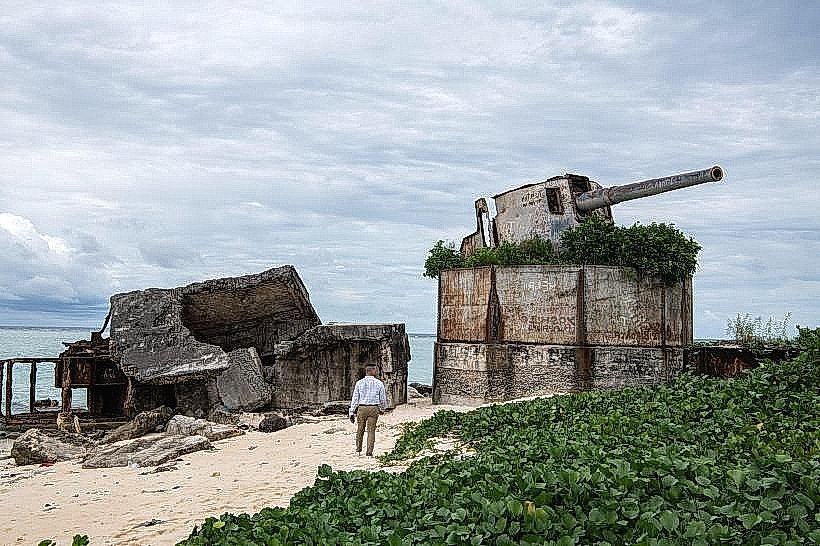
Landmark: Mili WWII Airfield
City: Mili Atoll
Country: Marshall Islands
Continent: Australia
Mili WWII Airfield, Mili Atoll, Marshall Islands, Australia
The Mili WWII Airfield is a historical site located on Mili Atoll in the Marshall Islands.
This location served as a Japanese airbase during World War II.
Visual Characteristics
The site consists of a partially intact concrete runway, approximately 1,500 meters in length. Remnants of revetments and scattered debris, including rusted metal fragments and concrete structures, are visible along the runway's edges. Vegetation, primarily low-lying scrub and palm trees, encroaches on the airfield's perimeter.
Location & Access Logistics
Mili Atoll is accessible via a small airstrip on the adjacent island of Mili. Flights to Mili are infrequent and typically depart from Majuro. From Mili island, the airfield is approximately 2 kilometers inland. Access requires local arrangement for transport, as there are no public roads or designated visitor pathways. No formal parking facilities are present.
Historical & Ecological Origin
The airfield was constructed by the Imperial Japanese Navy in 1943 as part of their defensive strategy in the Pacific theater. Its purpose was to support air operations and reconnaissance missions. The atoll itself is a coral formation, typical of the Marshall Islands, with a lagoon protected by a barrier reef.
Key Highlights & Activities
Exploration of the runway and associated structures. Observation of wartime debris. Photography of the historical site and surrounding atoll environment.
Infrastructure & Amenities
No public restrooms, shade structures, or food vendors are available at the airfield. Cell phone signal is unreliable to non-existent. Visitors should carry all necessary supplies.
Best Time to Visit
The dry season, from January to April, offers the most favorable weather conditions with reduced rainfall. Mid-morning provides consistent daylight for site examination. Access is dependent on inter-island flight schedules.
Facts & Legends
During the war, the airfield was a target for Allied bombing raids. Local accounts suggest that some Japanese personnel remained on the atoll for a period after the war's conclusion, surviving on local resources.
Nearby Landmarks
- Wotje Atoll (100km Northwest)
- Kwajalein Atoll (250km West)
- Majuro Atoll (150km West)