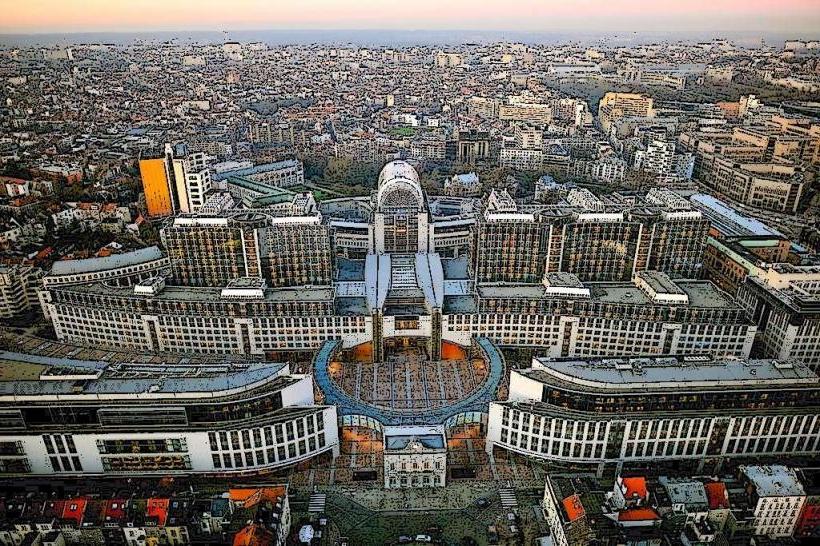
Landmark: Museum of Natural Sciences
City: Brussels
Country: Belgium
Continent: Europe
Museum of Natural Sciences, Brussels, Belgium, Europe
The Museum of Natural Sciences is a research and exhibition institution located within the southern edge of Leopold Park in Brussels. It is a part of the Royal Belgian Institute of Natural Sciences and is primarily known for housing the largest dinosaur gallery in Europe.
Visual Characteristics
The museum complex consists of several interconnected wings, most notably a 19th-century red-brick and limestone wing featuring high arched windows and a modern glass-and-steel extension. The interior Dinosaur Gallery is a vast, multi-level glass-roofed hall with exposed iron supports and dark-toned flooring designed to showcase fossil skeletons. Other galleries use focused spotlighting and neutral-toned wall panels to highlight taxidermy and mineralogical specimens.
Location & Access Logistics
The museum is located at Rue Vautier 29, 1000 Brussels. It is accessible via the Bruxelles-Luxembourg railway station (5-minute walk) and the Maelbeek or Trône metro stations (Lines 1, 2, 5, and 6). Bus lines 34, 38, 80, and 95 stop at the nearby Place du Luxembourg. Limited street parking is available, but the Interparking Jourdan (Place Jourdan) is the nearest public garage at 0.4km.
Historical & Ecological Origin
Founded in 1846, the museum originated from the private collection of Prince Charles Alexander of Lorraine. The main building was originally designed by architect Émile Janlet in the late 19th century specifically to house the Bernissart Iguanodon skeletons discovered in a Belgian coal mine in 1878. The site is geographically situated in the Maelbeek valley, integrated into the mature woodland of Leopold Park.
Key Highlights & Activities
The central attraction is the Dinosaur Gallery, featuring 30 nearly complete Iguanodon skeletons and a permanent display of predatory dinosaurs like the Tyrannosaurus rex. Visitors can explore the Gallery of Humankind, focused on human evolution, and the Gallery of Evolution, which displays over 600 fossils and specimens. Interactive educational stations and a "paleo-lab" for children allow for hands-on examination of casts and fossils.
Infrastructure & Amenities
The museum includes the Dino Café, a specialized gift shop, and accessible restrooms on multiple levels. High-speed 5G signal is available throughout the main halls. The facility is fully accessible via elevators and ramps. Secure lockers for bags and coats are provided in the entrance lobby.
Best Time to Visit
The museum is open Tuesday through Sunday from 10:00 AM to 6:00 PM. Weekday mornings are frequently occupied by school groups; therefore, visiting after 2:00 PM on weekdays or early Sunday morning is optimal for lower density. The glass-roofed Dinosaur Gallery provides maximum natural light during midday for photography.
Facts & Legends
The Bernissart Iguanodons were found 322 meters underground in a coal mine; they were the first nearly complete dinosaur skeletons ever discovered. A historical oddity involves the "Ishango Bone," a 20,000-year-old mathematical tool found in the Congo and housed here, which is considered one of the oldest examples of human tallying or prime number notation.
Nearby Landmarks
European Parliament (Espace Léopold) – 0.2km Northwest
Leopold Park – 0.1km North
House of European History – 0.2km North
Parc du Cinquantenaire – 0.9km East
Solvay Library – 0.3km North