Landmark: Parc Leopold
City: Brussels
Country: Belgium
Continent: Europe
Parc Leopold, Brussels, Belgium, Europe
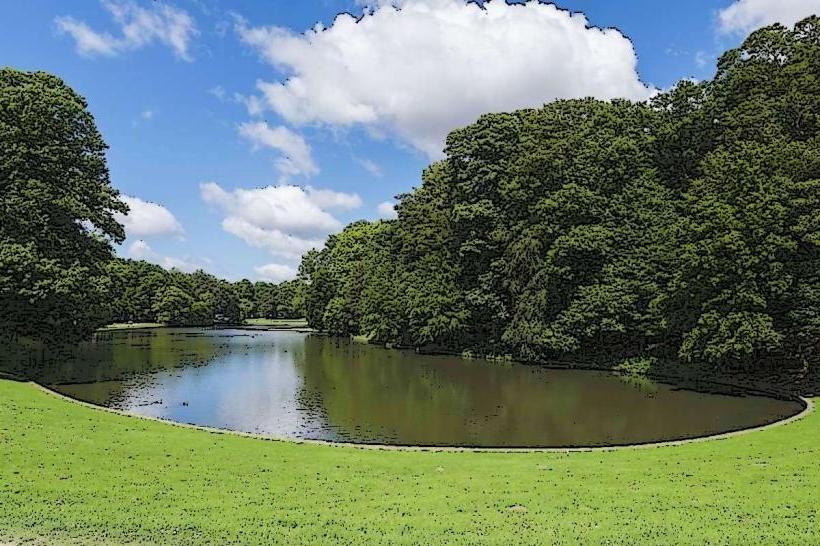
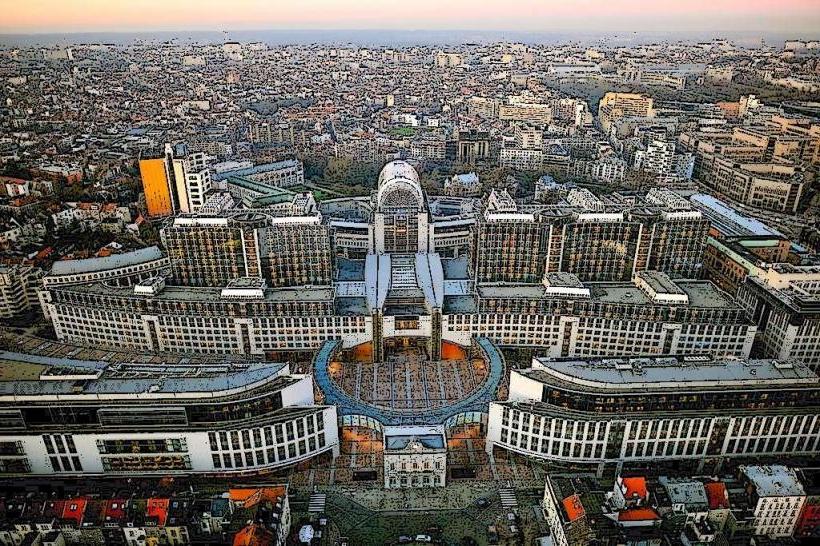
Leopold Park is a 10-hectare public park located in the Leopold Quarter of Brussels, directly adjacent to the European Parliament. It occupies a valley site formerly known as the Eggevoorde valley and contains a large central pond fed by the Maelbeek stream.
Visual Characteristics
The park features a dramatic topographical relief with steep slopes descending toward a central pond. The landscape is designed in the English scenic style, characterized by winding gravel paths, irregular clusters of mature trees, and expansive lawns. Architectural elements within the park include 19th-century academic buildings constructed of red brick and white limestone, a medieval stone tower, and a modern glass-and-steel footbridge.
Location & Access Logistics
The park is situated at Rue Belliard, 1040 Brussels, approximately 2.5km east of the Grand Place. It is accessible via the Schuman or Maelbeek metro stations (Lines 1 and 5) and the Bruxelles-Luxembourg railway station. Bus lines 12, 21, 34, 59, 64, and 80 stop at the park’s perimeter. Vehicle access is limited as the surrounding streets are heavily regulated, though the Interparking Jourdan is located 0.4km to the south.
Historical & Ecological Origin
The site opened in 1880 as a Royal Zoological Garden but failed commercially and was repurposed in 1891 as a "Science City" for the Solvay Institute and the Free University of Brussels. The park contains several rare botanical specimens, including a historic swamp cypress and a collection of oriental planes. It serves as a vital ecological corridor for local waterfowl, including grey herons and Egyptian geese, which inhabit the central pond year-round.
Key Highlights & Activities
The park houses the House of European History, located in the former Eastman Dental Clinic, and the Museum of Natural Sciences at its southern edge. Visitors can follow an architectural walking path to see the Solvay Library, the Institut d'Anatomie, and the ruins of the 15th-century Eggevoorde Tower. The lawns are used for recreational seating and picnicking by employees of the nearby European institutions.
Infrastructure & Amenities
Public benches and trash receptacles are distributed along the primary walkways. Restrooms are available within the House of European History and the Museum of Natural Sciences during operating hours. 5G signal is robust throughout the valley. While the park is heavily shaded by its tree canopy, no permanent public pavilions exist for rain cover. Food vendors and cafes are concentrated at the adjacent Place du Luxembourg and Place Jourdan.
Best Time to Visit
The park is open 24 hours daily. The best time for photography is early morning when the sun rises behind the European Parliament, reflecting the glass towers in the pond. Spring (April–May) is the optimal period for viewing the flowering horse chestnuts, while autumn provides high-contrast foliage against the surrounding glass architecture.
Facts & Legends
The park hosted the famous 1927 Solvay Conference, where Albert Einstein and Marie Curie met at the Physiology Institute to discuss quantum mechanics. A local legend concerns the "Tower of Eggevoorde," the last remnant of a medieval estate; it is often mistaken for a defensive fortification, though it was originally built as a noble residence and later served as a hunting lodge.
Nearby Landmarks
European Parliament (Espace Léopold) – 0.1km West
Museum of Natural Sciences – 0.1km South
House of European History – 0.05km East
Parc du Cinquantenaire – 0.8km East
Berlaymont Building – 0.6km North