Landmark: Palais des Beaux Arts
City: Lille
Country: France
Continent: Europe
Palais des Beaux Arts, Lille, France, Europe
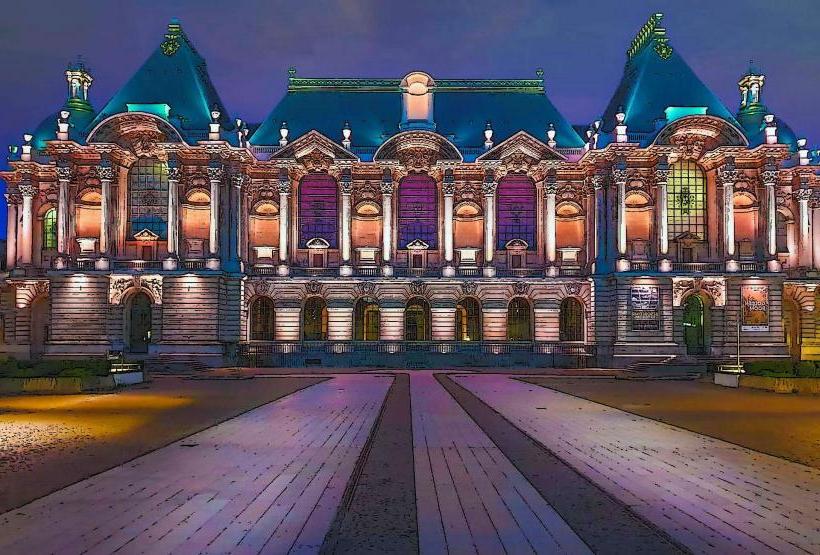
The Palais des Beaux-Arts de Lille is a major municipal museum dedicated to fine arts, modern art, and antiquities. Established in 1809 and housed in a monumental 19th-century Belle Époque building, it is widely considered the second most important museum in France after the Louvre in terms of the scale and quality of its permanent collection.
Visual Characteristics
The museum is housed in a grandiose Italian Renaissance-style palace designed by architects Bérard and Delmas. The exterior features high arched windows, a large central courtyard, and a detailed sculptural frieze. Inside, the architecture is defined by vast, high-ceilinged galleries, a monumental staircase, and the Atrium, a massive glass-roofed central hall often used for large-scale contemporary installations.
Location & Access Logistics
Address: Place de la République, 59000 Lille.
Public Transit: Directly served by Metro Line 1 at the République - Beaux-Arts station. It is a 10-15 minute walk from the Lille Flandres train station.
Hours: Monday: 14:00–18:00; Wednesday–Sunday: 10:00–18:00. Closed on Tuesdays.
Admission: Standard rate is approx. €7; free for visitors under 18 and for all on the first Sunday of each month.
Historical & Ecological Origin
The museum was founded as part of the Chaptal Decree in 1801, which aimed to decentralize artworks from Paris to the provinces following the French Revolution. The current structure was completed in 1892 to replace a smaller facility. The site occupies a significant portion of the Place de la République, a central urban square developed during the city's 19th-century expansion.
Key Highlights & Collections
European Paintings: Includes masterpieces by Rubens, van Dyck, Goya, Delacroix, Courbet, and Monet.
The Relief Maps (Plans-Reliefs): A unique collection of 15 large-scale 17th and 18th-century 3D models of fortified cities in Northern France and Belgium, used by kings for military strategy.
Sculpture Gallery: Features works by Rodin, Claudel, and Carpeaux within the naturally lit central atrium.
Donatello's "Feast of Herod": A high-relief marble masterpiece located in the Renaissance galleries.
19th-Century French Art: Extensive holdings of Impressionist and Realist works.
Infrastructure & Amenities
The museum underwent a major reorganization in 2017 to improve visitor flow and educational spaces.
Dining: Includes an on-site café/restaurant with views of the square.
Accessibility: Fully accessible to individuals with reduced mobility via elevators and ramps.
Technology: Offers digital guides and interactive tablets near major works. 5G signal is robust throughout the district.
Best Time to Visit
Weekday mornings are recommended to avoid school groups. The first Sunday of the month is the busiest due to free entry. The "Open Museum" events periodically pair the classical collection with contemporary music or pop-culture themes to attract a younger demographic.
Facts & Legends
A notable fact is that the museum's "Plans-Reliefs" were nearly moved back to Paris in the 1980s, sparking a major political and cultural battle that resulted in the collection remaining permanently in Lille. Unlike many French museums, the Palais des Beaux-Arts is known for its "Trans-historical" curation, occasionally placing contemporary sculptures directly alongside 18th-century paintings.
Nearby Landmarks
Préfecture du Nord – Directly opposite the square
Grand Place – 0.5km North
Porte de Paris – 0.6km Southeast
Hôtel de Ville (Belfry) – 0.7km Southeast
Rue de Béthune (Shopping district) – 0.2km North