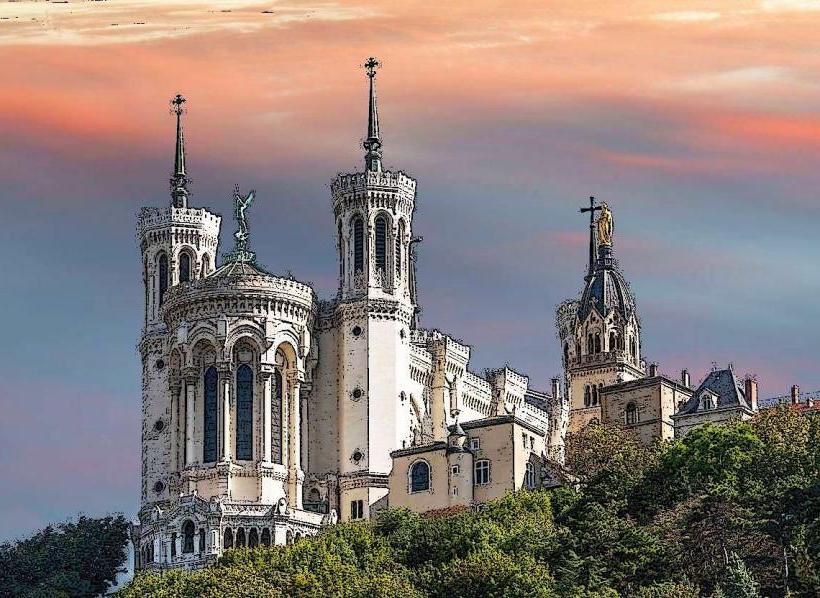
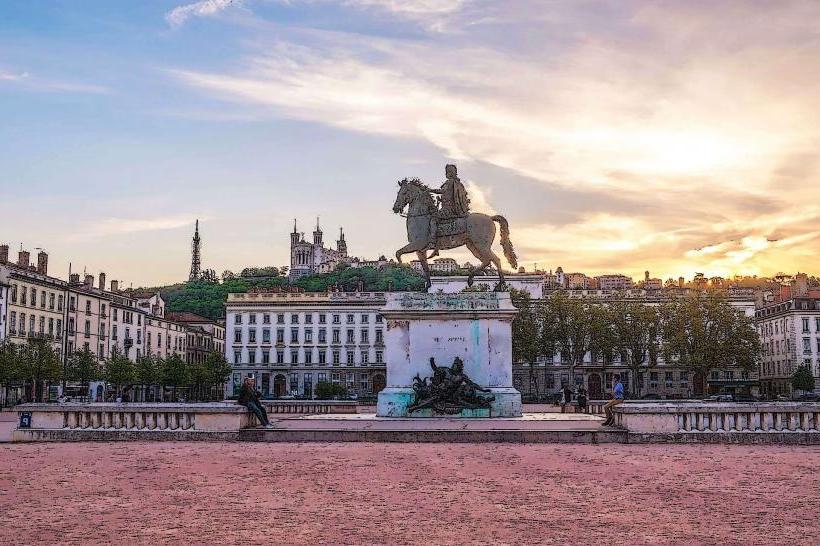
Landmark: Saint Jean Baptiste Cathedral
City: Lyon
Country: France
Continent: Europe
Saint Jean Baptiste Cathedral, Lyon, France, Europe
The Saint Jean Baptiste Cathedral is a medieval Roman Catholic church located in the heart of the Vieux Lyon district. It serves as the seat of the Archbishop of Lyon and holds the title of Primate of the Gauls, situated between the Saône River and the base of Fourvière Hill.
Visual Characteristics
The cathedral is a composite of Romanesque and Gothic architectural styles, constructed primarily with yellow limestone and salvaged Roman stones. The western facade features three portals decorated with 280 stone medallions and a large 14th-century rose window. Inside, the nave reaches a height of 32.5 meters, housing an astronomical clock from the 14th century that stands 9.5 meters tall and features automated figures.
Location & Access Logistics
The site is located at Place Saint-Jean, 69005 Lyon. It is directly accessible via the Vieux Lyon – Cathédrale Saint-Jean metro station (Line D) and the F1 and F2 funicular lines. Pedestrian access is primary, as the surrounding square is car-free; the nearest public parking is the Parc Saint-Georges underground facility located 300 meters south.
Historical & Ecological Origin
Construction began in 1180 on the ruins of a 6th-century church and was not completed until 1476, explaining the stylistic shift from the Romanesque choir to the Late Gothic facade. The building was designed to accommodate the prestigious Council of Lyon and various royal events, including the marriage of Henry IV and Marie de' Medici in 1600.
Key Highlights & Activities
Visitors can observe the mechanical performance of the 14th-century astronomical clock, which activates daily at 12:00, 14:00, 15:00, and 16:00. Exploration of the side chapels, specifically the 15th-century Bourbon Chapel, reveals intricate flamboyant Gothic stonework. Religious services are conducted daily, and silence is strictly enforced during these periods.
Infrastructure & Amenities
The cathedral contains a treasury museum (Trésor de la Cathédrale) exhibiting liturgical items and Byzantine silks. Public restrooms are located outside the building near the metro entrance. The square in front of the cathedral offers multiple food vendors and benches, and 5G cellular signal is strong in the exterior plaza, though intermittent inside the thick stone nave.
Best Time to Visit
Optimal interior lighting occurs during the early afternoon when the sun passes through the southern stained-glass windows. To witness the astronomical clock without maximum crowds, the 14:00 or 15:00 performances on weekdays are recommended. The cathedral is a focal point during the Fête des Lumières in December, featuring elaborate exterior light displays.
Facts & Legends
The astronomical clock is one of the oldest in Europe and was designed to calculate the date of Easter and other movable feasts until the year 2019, though it has since been adjusted. A historical oddity is the use of "spolia"-stones taken from ancient Roman ruins on Fourvière Hill-to build the lower sections of the cathedral walls.
Nearby Landmarks
Musée Cinéma et Miniature – 0.1km North
Basilique Notre-Dame de Fourvière – 0.6km West (uphill)
Palais de Justice (Les 24 Colonnes) – 0.2km North
Traboule de la Tour Rose – 0.2km Northwest
Musée Gadagne – 0.3km North