Landmark: Vieux Lyon
City: Lyon
Country: France
Continent: Europe
Vieux Lyon, Lyon, France, Europe
Vieux Lyon is a 30-hectare historic district situated at the base of Fourvière Hill on the west bank of the Saône River in Lyon, France. As one of the largest intact Renaissance neighborhoods in Europe, it is categorized into three distinct sectors: Saint-Jean, Saint-Paul, and Saint-Georges.
Visual Characteristics
The district is characterized by narrow, cobblestone streets lined with tall tenement buildings featuring stone mullioned windows and internal courtyards. Architectural styles are primarily Renaissance with Italian influence, visible in the terracotta and ochre-colored facades. A defining feature is the system of "traboules," which are vaulted pedestrian passages that transit through buildings to connect parallel streets.
Location & Access Logistics
Vieux Lyon is bordered by the Saône River to the east and the steep inclines of Fourvière to the west. It is accessible via the Vieux Lyon – Cathédrale Saint-Jean metro station (Line D) and the F1 and F2 funicular lines. Public parking is located at the Parc Saint-Georges and Parc Saint-Jean underground facilities. Vehicle traffic is restricted to residents and professional services in the pedestrianized core.
Historical & Ecological Origin
The district developed primarily between the 15th and 17th centuries when Lyon became a major European center for banking and silk trade. The architectural layout reflects the limited space between the river and the hill, necessitating high-density vertical construction. In 1964, it became France's first protected historic sector, preventing large-scale demolition.
Key Highlights & Activities
Visitors can walk through the Traboule de la Tour Rose or the Longue Traboule to observe internal architectural details. The Cathédrale Saint-Jean-Baptiste contains a 14th-century astronomical clock that performs a sequence at specific hours. The Musée Cinéma et Miniature and the Musée Gadagne (History and Puppetry) are situated within historic Renaissance mansions. Dining at a traditional "Bouchon Lyonnais" is a standard local activity.
Infrastructure & Amenities
Public restrooms are available near the Saint-Jean metro station and within the Musée Gadagne. The district is densely populated with commercial vendors, specifically traditional restaurants and artisanal shops. 4G and 5G cellular signals are maintained, although the thick stone walls of traboules and courtyards may cause signal degradation.
Best Time to Visit
The best time for photography and quiet exploration of the traboules is between 08:00 and 10:00 before commercial activity peak. The "Fête des Lumières" in early December features large-scale lighting installations throughout the district's squares. Late spring and early autumn provide moderate temperatures suitable for extended pedestrian movement on cobblestones.
Facts & Legends
The name "traboule" is derived from the Latin "trans-ambulare," meaning to cross through. These passages were historically used by silk workers (canuts) to transport fabric quickly and protected from the weather. During World War II, the traboules served as a vital network for the French Resistance to evade occupying forces due to their complex and discreet nature.
Nearby Landmarks
Cathédrale Saint-Jean-Baptiste – 0.1km East
Musée Cinéma et Miniature – 0.1km South
Musée Gadagne – 0.2km North
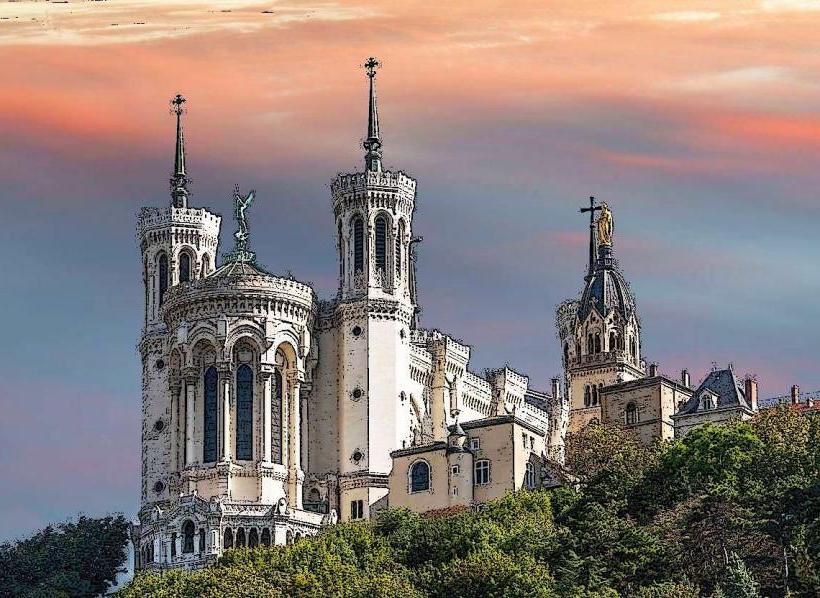
Basilique Notre-Dame de Fourvière – 0.6km West (uphill)
Ancient Theatre of Fourvière – 0.7km Southwest