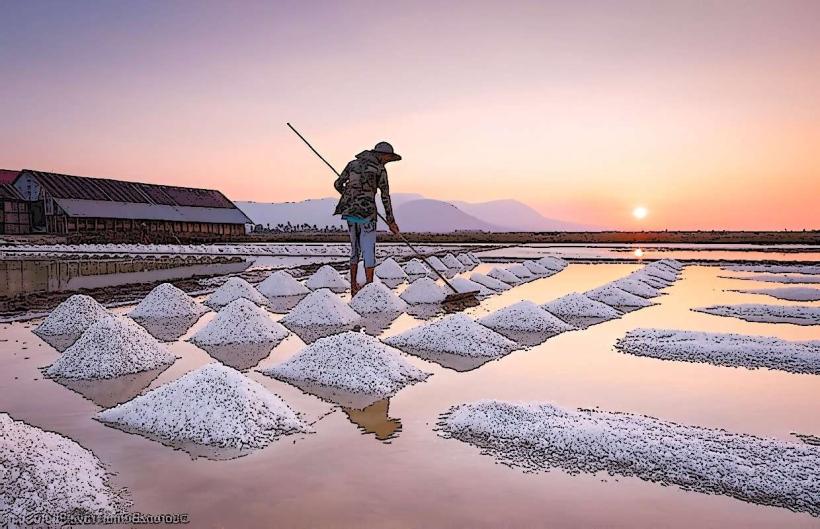
Landmark: Salt Fields of Kep
City: Kep
Country: Cambodia
Continent: Asia
Salt Fields of Kep, Kep, Cambodia, Asia
The Salt Fields of Kep are a series of active salt evaporation ponds located in the coastal region of Kep, Cambodia. These fields produce sea salt through traditional methods.
Visual Characteristics
The fields consist of expansive, shallow ponds arranged in a grid pattern. The water within the ponds varies in color from a pale blue to a milky white, depending on the salinity and mineral content. During the salt harvesting season, large mounds of crystalline white salt are visible. The surrounding landscape is generally flat, with sparse vegetation.
Location & Access Logistics
The Salt Fields are situated approximately 3 kilometers west of Kep town center. Access is via National Road 33. Turn off onto a local unpaved road marked by signs for the salt fields. Parking is available on the unpaved access roads adjacent to the fields; capacity is limited during peak harvesting times. Public transport directly to the fields is not available; visitors typically use private vehicles or hire local taxis from Kep town.
Historical & Ecological Origin
The practice of salt production in this region dates back centuries, utilizing the natural evaporation process of seawater. The fields are a result of human intervention to create controlled evaporation ponds. The ecological origin is the coastal plain, characterized by saline soil and proximity to the Gulf of Thailand.
Key Highlights & Activities
Observation of the salt harvesting process is the primary activity. Visitors can witness workers raking and collecting salt. Photography of the pond patterns and salt mounds is possible. Walking along the dikes between ponds is permitted, but visitors should exercise caution due to the uneven terrain and water depth.
Infrastructure & Amenities
Basic amenities are minimal. There are no dedicated restrooms or shade structures within the fields themselves. Cell phone signal (4G) is generally available. Food vendors are not typically present at the fields; visitors should plan to eat in Kep town.
Best Time to Visit
The most productive period for salt harvesting is during the dry season, from December to April. The best time of day for photography is early morning or late afternoon when the sun's angle creates distinct shadows and highlights on the salt. High tide is not a critical factor for visiting the fields themselves, as they are managed ponds.
Facts & Legends
The salt produced here is known for its purity due to the natural evaporation process. A local practice involves leaving small offerings at the edges of the fields to ensure a bountiful harvest, a tradition rooted in animist beliefs.
Nearby Landmarks
- Kep National Park (1.5km Northeast)
- Crab Market (3.5km East)
- Phnom Chhngok Cave Temple (12km Northwest)
- Bokor National Park (25km Northwest)