Landmark: Tiébélé Painted Royal Court
City: Tiebele
Country: Burkina Faso
Continent: Africa
Tiébélé Painted Royal Court, Tiebele, Burkina Faso, Africa
The Tiébélé Painted Royal Court is a complex of traditional Kassena dwellings located in the town of Tiébélé, southern Burkina Faso.
This site preserves the architectural and artistic traditions of the Kassena people, specifically the royal family's compound.
Visual Characteristics
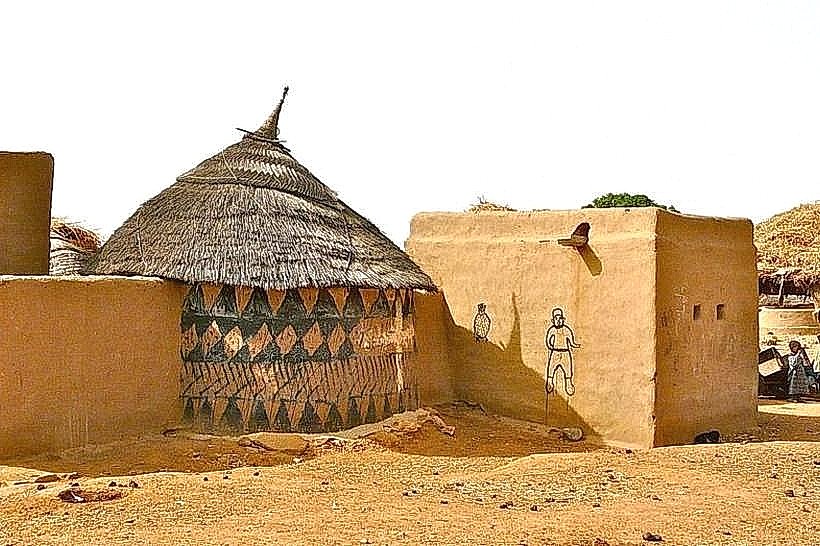
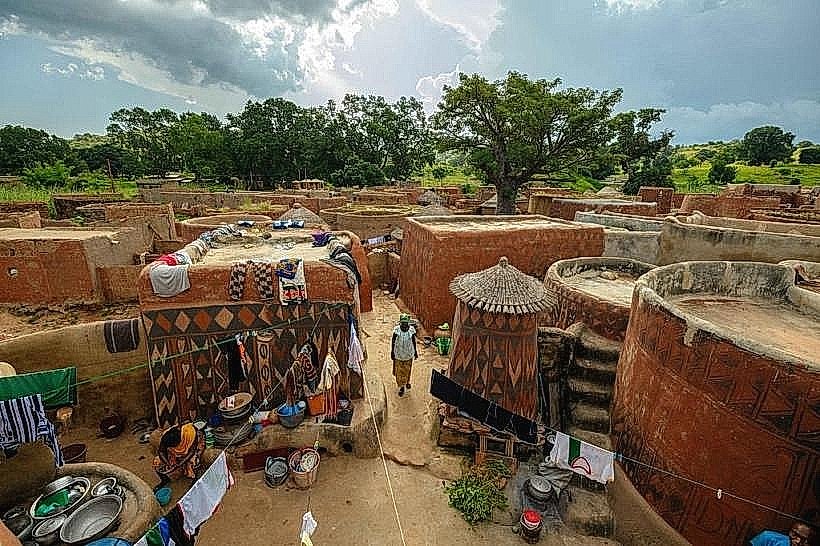
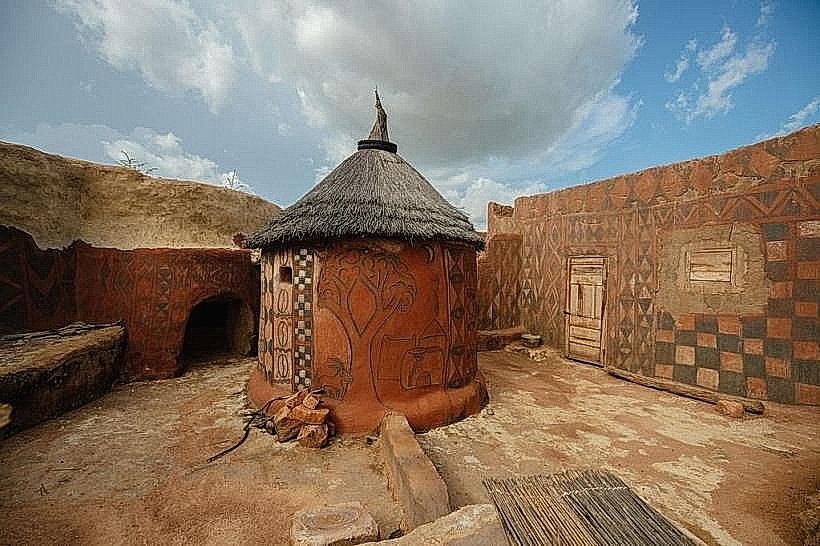
The court consists of interconnected mud-brick houses (known as sitas) with thatched roofs. The exterior walls are decorated with geometric patterns painted in red ochre, white kaolin, and black charcoal. These designs are applied using traditional methods and natural pigments. The structures are low-lying, typically one story, and arranged in a defensive, labyrinthine layout.
Location & Access Logistics
Tiébélé is situated approximately 20 kilometers south of the border with Ghana. Access from Ouagadougou, the capital of Burkina Faso, involves traveling south on Route Nationale 1 (RN1) towards Bobo-Dioulasso, then diverting onto secondary roads. The journey from Ouagadougou is approximately 250 kilometers. Local transport within Tiébélé is primarily by foot or motorcycle. Parking is available on the outskirts of the royal compound, with guidance from local residents.
Historical & Ecological Origin
The Kassena people have inhabited this region for centuries. The construction techniques and decorative styles of the royal court reflect a long-standing tradition of earth architecture adapted to the local climate and available materials. The original purpose of the compound was to serve as the residence and administrative center for the Kassena chief and his lineage. The specific origins of the painted decorations are tied to ritualistic and symbolic practices passed down through generations.
Key Highlights & Activities
Observation of the painted wall decorations and architectural layout. Guided tours of the royal compound are available, led by members of the Kassena community. Photography of the exterior structures is permitted. Visitors can learn about the symbolism behind the geometric patterns and the construction techniques.
Infrastructure & Amenities
Restrooms are not consistently available within the immediate royal compound; visitors should plan accordingly. Shade is provided by the structures themselves and the thatched roofs. Cell phone signal (4G/5G) is generally weak or unavailable within the dense compound. Food vendors are not typically present at the site itself, but basic provisions may be found in the town of Tiébélé.
Best Time to Visit
The dry season, from November to March, offers the most favorable weather conditions. Mid-morning or late afternoon provides optimal lighting for viewing and photographing the painted walls, avoiding harsh midday sun. There are no specific tide requirements as the site is inland.
Facts & Legends
The geometric patterns painted on the walls are not merely decorative; they convey specific messages and symbols related to the history, social status, and beliefs of the Kassena people. For instance, certain patterns represent protection, fertility, or lineage. A unique tip for visitors is to observe the subtle variations in patterns between different dwellings, as these can indicate the family or function of the structure.
Nearby Landmarks
- Kassena Cultural Centre: 0.2km North-West (Approximate distance and direction)
- Tiébélé Market Square: 0.3km North (Approximate distance and direction)
- Saint Joseph Catholic Church, Tiébélé: 0.5km North-East (Approximate distance and direction)
- Border Crossing to Ghana (Kodjebi): 20km South (Approximate distance and direction)