Landmark: Abbey of Park
City: Leuven
Country: Belgium
Continent: Europe
Abbey of Park, Leuven, Belgium, Europe
Park Abbey (Abdij van Park) is a remarkably preserved 12th-century Premonstratensian abbey located on the southern outskirts of Leuven. It is one of the most complete abbey complexes in Belgium and the Netherlands.
Visual Characteristics
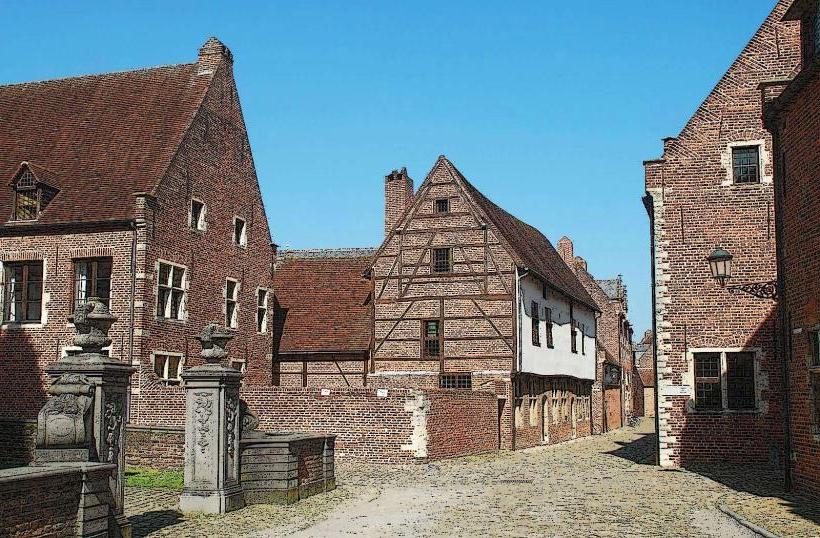
The complex is a sprawling estate of red-brick and white-stone buildings arranged around multiple courtyards. It features a transition from Romanesque foundations to Gothic, Renaissance, and Baroque architectural styles. The site is surrounded by four large ponds, water meadows, and historic farmland. The interior of the abbey church and the cloisters are noted for their exceptional 17th-century stucco ceilings by Jan Christian Hansche and rare stained-glass windows.
Location & Access Logistics
The site is located at Abdij van Park 7, 3001 Leuven.
Public Transport: 20-minute walk from Leuven Railway Station. Accessible via city buses stopping at "Heverlee Abdij van Park."
Pedestrian Access: A scenic 2.5km walk from the city center via the Parkstraat.
Parking: On-site parking is available for visitors.
Access: The outer grounds, ponds, and cemetery are free and open to the public. Access to the museum (PARCUM) and the restored historic spaces (cloisters, refectory, library) requires a paid ticket. The terrain consists of paved paths and cobblestones.
Historical Origin
Founded in 1129 by the Duke of Brabant, Godfrey the Bearded, who invited the Norbertines from Laon to establish a community. The abbey flourished as a center of religious and agricultural activity for centuries. Unlike many others, it was not demolished during the French Revolution, which accounts for its exceptional state of preservation. A massive restoration project beginning in the 2010s has recently returned much of the site to its 17th-century splendor.
Key Highlights & Activities
PARCUM Museum: A dialogue museum for religion, art, and culture featuring rotating exhibitions.
Stucco Ceilings: The library and refectory contain some of the most detailed high-relief plasterwork in Europe.
The Library: A stunning 17th-century interior holding thousands of historic volumes.
The Ponds: Popular for walking and birdwatching; the path around the water provides the most iconic views of the abbey silhouette.
The Watermill: A functional 16th-century mill that still grinds grain, occasionally open for demonstrations.
Infrastructure & Amenities
The facility includes De Abdijmolen, a high-end brasserie located in the historic watermill, and De Kersentuin, a social-economy bistro. De Abdijboerderij (the abbey farm) sells organic local products. Restrooms are available in the museum and restaurant areas. 5G signal is robust across the open grounds.
Best Time to Visit
The museum and historic interiors are open Tuesday through Sunday from 10:00 to 17:00. The grounds are accessible daily until sunset. Late afternoon is ideal for photography as the sun sets over the ponds, reflecting the abbey’s facade.
Facts & Legends
A verified historical detail is that the abbey’s bells were hidden in the ground during World War I to prevent them from being melted down for munitions by the occupying forces. Legend identifies the site as a "park" because it was originally a ducal hunting ground before being donated to the Norbertine order.
Nearby Landmarks
Sportkot (KU Leuven University Sports Center) – 1.0km West
Heverlee Woods (Heverleebos) – 2.0km South
Great Beguinage – 1.8km Northwest
Leuven City Center – 2.5km North