Information
Landmark: Bardo National MuseumCity: Tunis
Country: Tunisia
Continent: Africa
Bardo National Museum, Tunis, Tunisia, Africa
The Bardo National Museum is a historical museum located in Tunis, Tunisia. It houses a significant collection of artifacts from various periods of Tunisian history.
Visual Characteristics
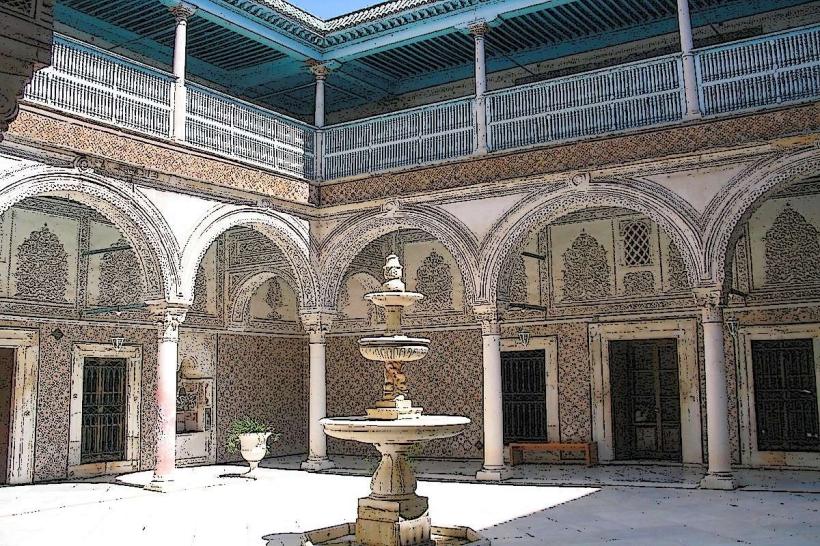
The museum is housed within the former Beylical Palace of Tunis, a 19th-century structure. The palace exhibits a blend of Ottoman and Andalusian architectural styles. Its exterior features white stucco walls with decorative arches and intricate tile work. Internally, many rooms retain their original opulent decor, including carved stucco, painted ceilings, and marble floors. The museum's galleries are organized to display artifacts within historically relevant settings.
Location & Access Logistics
The Bardo National Museum is situated approximately 4 kilometers west of Tunis's city center. Access is via Avenue du 9 Avril 1938. Public transport options include the TGM (Tunis-Goulette-Marsa) suburban train line, with a station located a short walk from the museum. Several local bus lines also serve the area. On-site parking is available for visitors arriving by private vehicle.
Historical & Ecological Origin
The building itself originated as a royal residence for the Beys of Tunis, with significant construction and expansion occurring in the 19th century. It was converted into a museum in 1888, initially known as the Alaoui Museum. Its purpose was to consolidate and display archaeological finds from Tunisia's rich past, spanning Phoenician, Roman, Byzantine, and Islamic eras.
Key Highlights & Activities
Visitors can view extensive collections of Roman mosaics, considered among the finest in the world. The museum also displays artifacts from prehistoric periods, Punic and Roman Carthage, and Islamic art. Guided tours are available, providing detailed explanations of the exhibits. Photography is permitted in most areas, though flash may be restricted.
Infrastructure & Amenities
Restrooms are available within the museum complex. Limited shaded areas are present in the courtyards. Cell phone signal (4G/5G) is generally consistent within the museum. Food and beverage services are not directly provided within the museum, but vendors and cafes are located in the vicinity along Avenue du 9 Avril 1938.
Best Time to Visit
The museum is open year-round. For optimal lighting on mosaics, visiting during daylight hours is recommended. Mornings, particularly between 9:00 AM and 11:00 AM, offer fewer crowds. The months of April, May, September, and October typically provide pleasant weather for travel to Tunis.
Facts & Legends
One of the most significant holdings is the mosaic depicting Virgil reading his Aeneid, a rare artistic representation of the Roman poet. A specific tip for visitors is to allocate at least 3-4 hours to fully appreciate the breadth of the Roman mosaic collection alone.
Nearby Landmarks
- National Institute of Heritage (0.2km West)
- Tunis Zoo (1.5km South)
- Carthage National Museum (4.0km Northeast)
- Amphitheatre of Carthage (4.2km Northeast)
- Antonine Baths (4.5km Northeast)