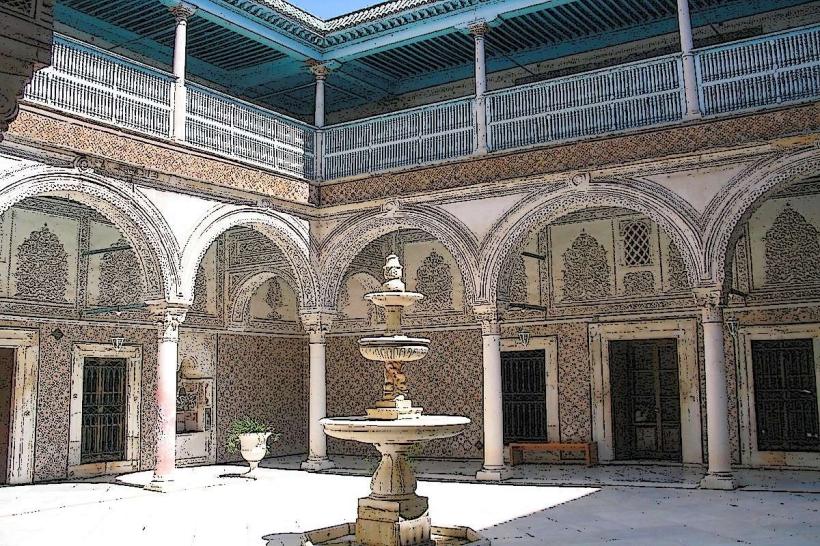
Landmark: Dar Lasram
City: Tunis
Country: Tunisia
Continent: Africa
Dar Lasram, Tunis, Tunisia, Africa
Dar Lasram is a historic building located in the La Medina district of Tunis, Tunisia.
It functions as a cultural center and museum.
Visual Characteristics
The structure is a traditional Tunisian house constructed from stone and plaster. Its exterior walls are painted in a pale ochre color. The building features a central courtyard with arcades, typical of Andalusian architecture. Decorative elements include carved stucco and geometric tilework (zellige). The main entrance is a heavy wooden door.
Location & Access Logistics
Dar Lasram is situated within the La Medina, approximately 1.5 kilometers south of the city center. Access is via narrow pedestrian alleyways within the Medina. The nearest major road is Rue Jamaa Zitouna. Parking is not available directly at the site; visitors must use public parking facilities in the Medina, such as the parking garage near Bab Bhar, which is a 10-minute walk away. Public transport options include bus lines serving the Medina area, with stops a short walk from the building.
Historical & Ecological Origin
Dar Lasram was originally a private residence built in the 18th century. It was later acquired and transformed into a cultural institution. Its architectural style reflects the traditional domestic architecture of the Ottoman period in Tunis.
Key Highlights & Activities
Visitors can explore the preserved interior spaces, including the courtyard and reception rooms. Exhibitions on Tunisian history and culture are often displayed. Photography of the architectural details is permitted. The site hosts occasional cultural events and lectures.
Infrastructure & Amenities
Restrooms are available on-site. Limited shaded areas are present within the courtyard. Cell phone signal (4G/5G) is generally available within the Medina. No food vendors are located directly within Dar Lasram, but numerous options exist in the surrounding Medina streets.
Best Time to Visit
The best time of day for photography is mid-morning or late afternoon when sunlight creates defined shadows on the courtyard walls. The most comfortable months for visiting are from October to May, avoiding the peak summer heat. No tide considerations apply.
Facts & Legends
A specific architectural feature to note is the intricate geometric patterns found in the carved plasterwork, which are indicative of the craftsmanship of the era. Local lore suggests that the original owner was a wealthy merchant who commissioned the house to impress visiting dignitaries.
Nearby Landmarks
- Bab Bhar (Sea Gate) - 0.8km Northwest
- Dar Hussein (National Institute of Archaeology and Arts) - 0.4km North
- Djemaa ez-Zitouna (Great Mosque of Tunis) - 0.6km North
- Souk el-Attarine (Perfume Souk) - 0.3km North
- Palais Khereddine - 0.7km Northwest