Landmark: Fortress of Mainz
City: Mainz
Country: Germany
Continent: Europe
Fortress of Mainz, Mainz, Germany, Europe
Mainz Citadel (Zitadelle Mainz) is one of the most significant and well-preserved Baroque fortresses in Germany. It represents over 2,000 years of continuous military history, from its origins as a Roman legionary camp to its role as a key stronghold of the German Confederation.
Visual Characteristics
The fortress is a massive star-shaped citadel built with red sandstone walls and four prominent bastions (Drusus, Alexander, Germanikus, and Tacitus). The site is characterized by its elevated position on the Jakobsberg, offering a mix of Baroque military architecture, 19th-century Prussian barracks, and hidden underground casemates.
Location & Access Logistics
Located at Am 87er Denkmal, 55131 Mainz, on the southern edge of the old town.
Public Transit: Directly adjacent to the Mainz Römisches Theater station (S-Bahn and regional trains).
Access: The outdoor grounds and ramparts are generally free and accessible during daylight hours.
Museums: The site houses the Mainz Historical Museum and a Garrison Museum (check specific hours for these).
Parking: Use "Parkhaus am Römisches Theater" or "Parkhaus Zitadelle."
Historical Origin
The strategic hill was first occupied in 13 BC by the Romans as the camp Mogontiacum. The current fortress was largely constructed around 1660 under Prince-Elector Johann Philipp von Schönborn. In 1816, it became a "Federal Fortress" of the German Confederation, garrisoned by both Prussian and Austrian troops to defend against French expansion. It served as a POW camp in both World Wars and provided air-raid shelter for thousands during the 1945 bombings.
Key Highlights & Activities
The Drususstein: A 20-meter-tall Roman cenotaph (9 AD) honoring General Drusus. It is the largest Roman funeral monument north of the Alps still in its original location.
Underground Passages: Extensive labyrinthine tunnels and casemates. These are accessible via guided tours, which detail their use as defensive galleries and WWII bunkers.
Mainz Historical Museum (Stadthistorisches Museum): Located in "Building D," it covers the social and economic history of the city.
Commandant’s Building (Kommandantenbau): A stately Baroque structure (1696) located above the main gate facing the city.
Infrastructure & Amenities
The grounds feature the Café Citadelle, public restrooms, and various green spaces popular for walking. The site is a frequent venue for major cultural events, including the Open Ohr Festival and various open-air concerts. While the ramparts are paved, some of the older cobblestone areas and steep inclines may pose challenges for those with limited mobility.
Best Time to Visit
Summer Evenings: For panoramic views of the Rhine valley and the city as the sun sets.
First Sunday of the Month: When public tours of the underground passages are typically scheduled.
Facts & Legends
A technical oddity is that the citadel "enclosed" a medieval Benedictine abbey (St. Jacobs), which was slowly demolished over centuries of military upgrades, though spolia (reused stones) from the abbey can still be found in the fortress walls. Legend says the deep wells inside the bastions are connected to a secret network of tunnels reaching as far as the Rhine, though most are actually rainwater cisterns.
Nearby Landmarks
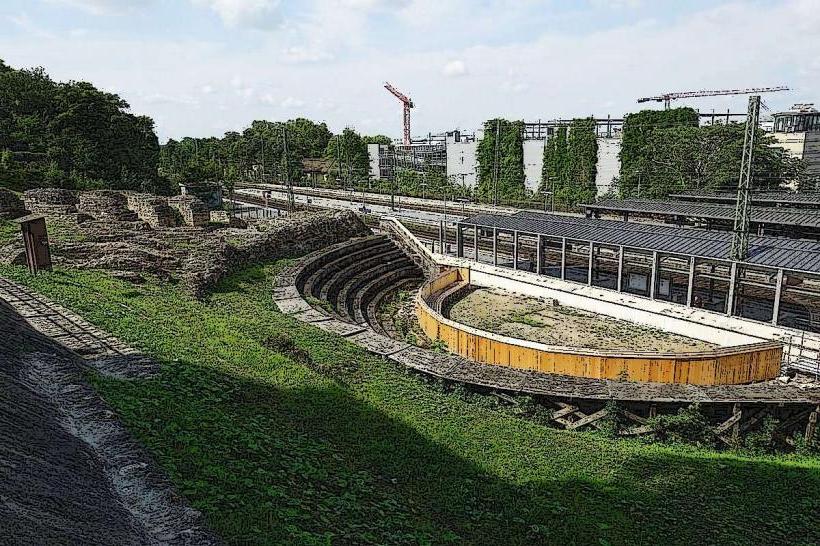
Roman Theater (Römisches Bühnentheater) – Directly at the foot of the hill (East)
St. Stephan’s Church – 0.5km Northwest
Mainz South Station (Römisches Theater) – Adjacent (East)
Kupferbergterrasse – 0.6km West