
Landmark: Roman Mainz
City: Mainz
Country: Germany
Continent: Europe
Roman Mainz, Mainz, Germany, Europe
Roman Mainz, known as Mogontiacum, was founded in 13 BC by Drusus as a strategic legionary camp. For nearly 500 years, it served as the capital of the Roman province Germania Superior and the most important military hub on the northern Rhine frontier.
Visual Characteristics
The Roman heritage of Mainz is integrated into the modern city layout. It consists of massive stone masonry ruins, underground archaeological excavations within modern shopping centers, and specialized museums housing high-fidelity replicas of Rhine fleet warships.
Key Archaeological Sites
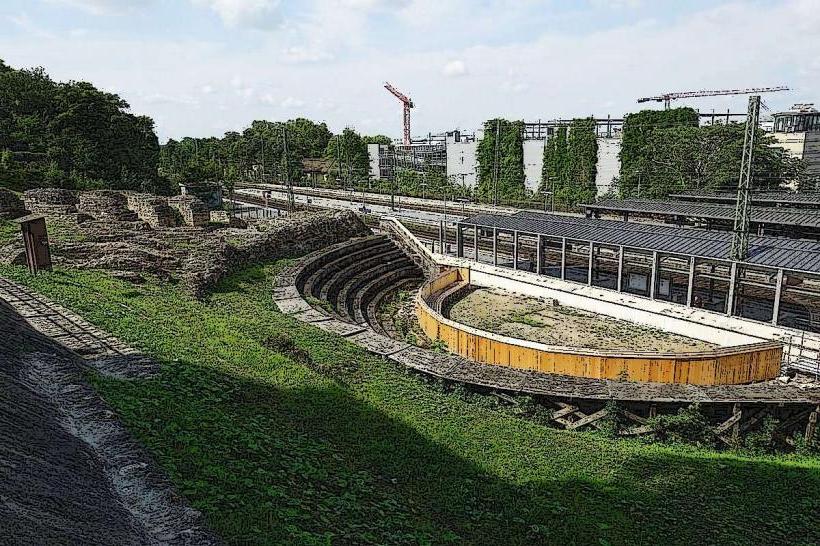
Roman Theatre (Römisches Bühnentheater): Located at the "Mainz Römisches Theater" station. It was the largest Roman theater north of the Alps, once seating 10,000 people. Today, parts of the stage and seating tiers are visible.
Drususstein (Drusus Monument): A 20-meter-high stone core of a Roman funerary monument located within the Mainz Citadel. It is the largest Roman cenotaph in Germany.
Sanctuary of Isis and Magna Mater: An underground temple site discovered during the construction of the "Römerpassage" mall. It displays ritual altars, oil lamps, and sacrificial remains.
The Aqueduct (Römersteine): Located in the Zahlbach valley, these stone pillars are the remains of a 9 km-long aqueduct that supplied the legionary camp with water.
Jupiter Column: A replica stands near the Parliament; the original (in the Landesmuseum) is a highly ornate 9-meter stone pillar dedicated to Jupiter.
Museums & Logistics
Museum of Ancient Seafaring (Museum für Antike Schifffahrt): Houses the remains of five 4th-century Roman patrol boats (Lusoriae) found in the Rhine mud in 1981.
Landesmuseum Mainz: Contains the most extensive collection of Roman stone monuments, tombstones, and military artifacts in the region.
Location: Sites are spread throughout the city; most are within a 15-minute walk of the Mainz Cathedral.
Access: The Theatre and Aqueduct are open-air and free. The Isis Sanctuary and museums require paid admission and have specific hours (typically closed Mondays).
Historical Origin
Mogontiacum was established to secure the Rhine crossing and serve as a launchpad for campaigns into Germania Libera. It became a civilian city (municipium) and remained a Christian stronghold and military center until the collapse of the Rhine border in the 5th century.
Facts & Legends
A technical oddity is the Roman ship preservation; the wood was preserved for 1,600 years because it was buried in oxygen-poor Rhine silt. Legend states that the early Christian martyrs of the "Theban Legion" were executed here, though archaeological evidence primarily supports the city's role as a pagan administrative and military giant.
Nearby Transit
Mainz Römisches Theater Station: For the Theatre and Citadel.
Mainz Hauptbahnhof: 1.5km from the primary Roman sites.


