Landmark: Hortobágy National Park
City: Debrecen
Country: Hungary
Continent: Europe
Hortobágy National Park, Debrecen, Hungary, Europe
Hortobágy National Park is the largest continuous natural grassland in Europe and Hungary's first national park. Located approximately 40 km west of Debrecen, it covers 800 square kilometers of the Great Hungarian Plain (Alföld) and is a UNESCO World Heritage site under the category of "cultural landscape."
Visual Characteristics
The landscape is characterized by a "flat as a mirror" horizon, known as the Puszta. The visual field is dominated by vast alkaline steppes, wetlands, and traditional wooden sweep wells (gémeskút). Architectural elements are sparse and strictly traditional, featuring white-washed, thatched-roof buildings. Mirages (délibáb) are a frequent visual phenomenon during hot summer days due to the flat terrain and temperature gradients.
Location & Access Logistics
The park center is located in the village of Hortobágy, accessible via Main Road 33.
From Debrecen: A 40-minute drive or a direct train/bus from Debrecen Main Station.
Transit: The "Hortobágy" railway station is located within walking distance of the main visitor center.
Access: While the village and main landmarks are open, entering protected wilderness areas requires a permit or a guided tour.
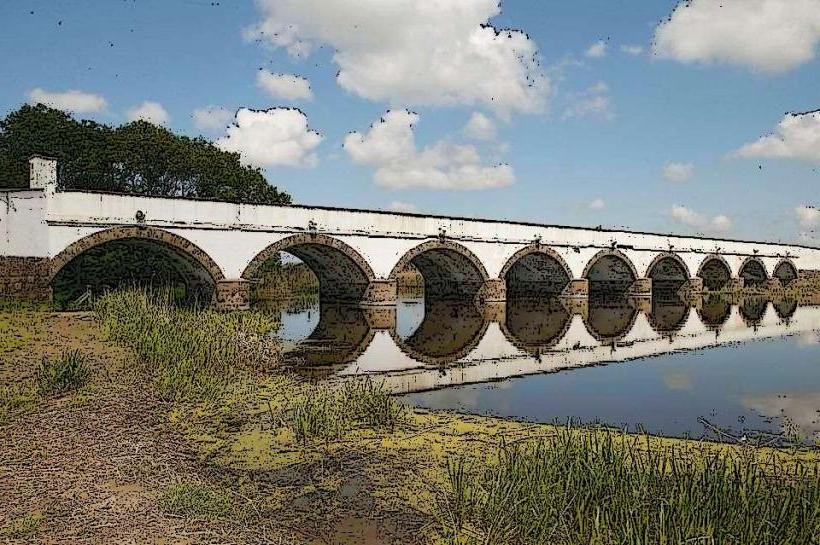
Parking: A large, central paid parking lot is located next to the Nine-Hole Bridge.
Historical & Ecological Origin
Established in 1973, the park preserves a thousand-year-old pastoral culture. It was never plowed due to its alkaline soil, preserving the original flora and fauna. It is an internationally recognized Dark Sky Park, with minimal light pollution, making it a primary site for astronomical observation.
Key Highlights & Activities
Nine-Hole Bridge (Kilenclyukú híd): Hungary's longest stone road bridge (167m), completed in 1833.
Hortobágy Great Fishponds: Accessible via a narrow-gauge railway, this is one of Europe's most important bird-watching sites, especially during the autumn crane migration.
Puszta Animal Park: Showcases indigenous Hungarian breeds, including Hungarian Grey cattle, Racka sheep, Mangalica pigs, and Nonius horses.
Mátra Museum & Shepherd Museum: Located in the village, detailing the traditional nomadic lifestyle of shepherds.
Infrastructure & Amenities
The Hortobágy Visitor Center provides 5G cellular coverage, interactive exhibitions, and information on trail permits. Public restrooms are located at the visitor center and the Great Inn (Hortobágyi Csárda). The Csárda is the primary dining facility, serving traditional shepherd dishes like slambuc.
Best Time to Visit
Spring/Autumn: Ideal for bird watching, specifically the crane migration in October.
Summer: Best for seeing the "Puszta Five" horse shows, though temperatures can exceed 35°C.
Events: The Bridge Fair (August 20th) is the largest local event, featuring traditional crafts and livestock.
Facts & Legends
A central legend of the Nine-Hole Bridge claims it was built with wine instead of water during a drought to mix the mortar. A verified ecological fact: the park is home to nearly 350 bird species, representing over 80% of Hungary's total bird population.
Nearby Landmarks
Wild Animal Park (Vadaspark): 5km from the village (shuttle bus only).
Lake Tisza: 30km West.
Debrecen: 40km East.