Landmark: Kurhaus Wiesbaden
City: Frankfurt
Country: Germany
Continent: Europe
Kurhaus Wiesbaden, Frankfurt, Germany, Europe
Kurhaus Wiesbaden is located in Wiesbaden, the state capital of Hesse, not Frankfurt. It is approximately 40 km (25 miles) west of Frankfurt, reachable in 35–45 minutes by car or S-Bahn train.
Visual Characteristics
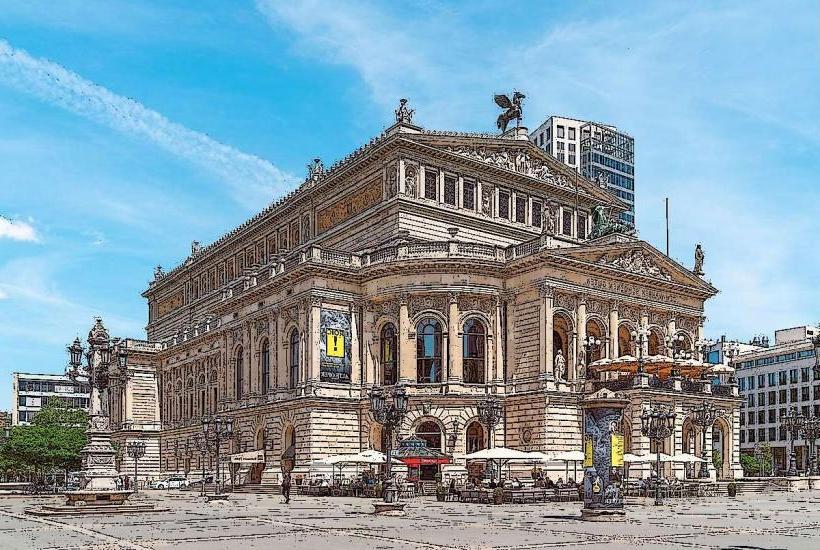
The Kurhaus is a monumental Neoclassical building featuring a massive portico with Ionic columns. The interior is defined by the "Friedrich-von-Thiersch-Saal," a lavish concert hall with cherry wood paneling and gold leaf, and a central rotunda with a 21-meter high dome. It is flanked by the "Kurhaus Kolonnade," the longest pillared hall in Europe (129 meters).
Location & Access Logistics
Address: Kurhausplatz 1, 65189 Wiesbaden.
Transit: Take the S1, S8, or S9 from Frankfurt to Wiesbaden Hauptbahnhof, then a short bus ride or 15-minute walk.
Hours: Public areas daily 9:00 AM – 8:00 PM; Casino hours vary (usually 1:00 PM – 4:00 AM).
Admission: Foyer is free; specific event tickets or Casino entry fees (€5.00) apply.
Historical Origin
The current building was constructed between 1905 and 1907 by architect Friedrich von Thiersch at the request of Kaiser Wilhelm II, who visited the spa city annually. It replaced an earlier 1810 structure. It served as a premier social hub for European royalty and aristocracy during the "Belle Époque."
Key Highlights & Activities
Spielbank Wiesbaden (Casino): One of Germany's oldest and most famous casinos, located in the former wine salon.
The Kurpark: A 7.5-hectare English-style landscape park located behind the building, featuring a large pond and fountain.
Bowling Green: The expansive landscaped square in front of the Kurhaus, framed by the Theater and the Colonnades.
Events: Home to the Rheingau Music Festival and high-profile gala evenings.
Infrastructure & Amenities
The facility is fully wheelchair accessible. It houses the Käfer's Bistro, a high-end restaurant with a large outdoor terrace. Secure parking is available in the underground "Kurhaus" garage. 5G signal is excellent throughout the district.
Best Time to Visit
Evening: To see the building and the Bowling Green fountains illuminated.
December: During the "Twinkling Star Market" (Christmas market) held in the surrounding area.
Facts & Legends
A technical oddity is the Casino's history with the Russian author Fyodor Dostoevsky, who allegedly lost his entire travel fund here in 1865, providing the inspiration for his novel The Gambler. The casino still displays a bust of the author.
Nearby Landmarks
Hessian State Theatre – 0.1km South
Wilhelmstraße (Shopping) – 0.2km West
Market Church (Marktkirche) – 0.6km West
Kochbrunnen (Hot Springs) – 0.4km North