Landmark: Palmengarten
City: Frankfurt
Country: Germany
Continent: Europe
Palmengarten, Frankfurt, Germany, Europe
Palmengarten is one of two botanical gardens in Frankfurt am Main and, at 22 hectares, one of the largest of its kind in Germany.
Visual Characteristics
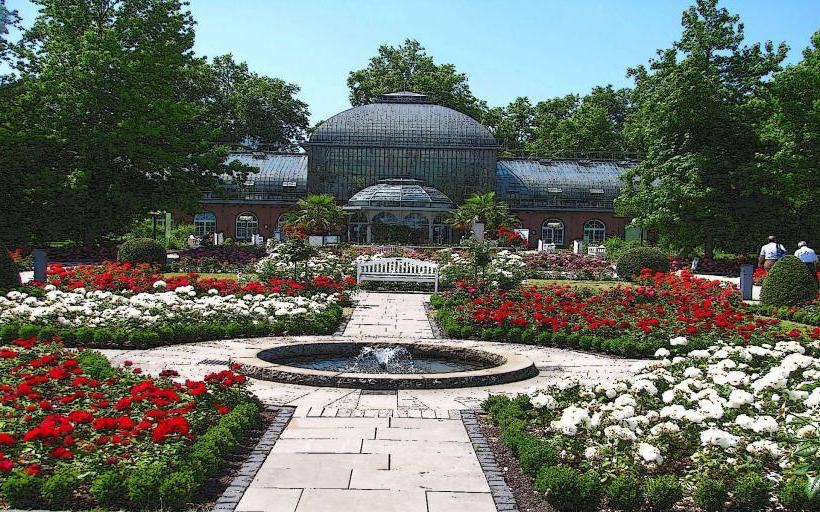
The garden features a combination of historic 19th-century glass structures and modern climate-controlled greenhouses. The centerpiece is the Gesellschaftshaus and the Palmenhaus, a massive iron-and-glass structure housing sub-tropical palms and giant ferns. The landscape includes a large pond with rowing boats, rock gardens with waterfalls, and the "Tropicarium," a modern complex of glass cubes simulating different tropical climates.
Location & Access Logistics
Located at Palmengartenstraße 11, 60325 Frankfurt am Main, in the Westend district.
Public Transit: Served by Bockenheimer Warte (U-Bahn lines U4, U6, U7 and Tram 16) or Westend (U6, U7).
Access: Requires a paid entry ticket. The garden has two main entrances: Palmengartenstraße and Siesmayerstraße.
Parking: Use the "Parkhaus Palmengarten" on Siesmayerstraße.
Historical & Ecological Origin
Opened in 1871, the garden was established through a private citizens' initiative to house the exotic plant collection of the Duke of Nassau. It serves as a major center for biodiversity and botanical research. The Palmenhaus, completed in 1869, remains one of the largest steel-and-glass constructions of its type in Europe. The garden maintains distinct ecological zones, including desert, monsoon forest, and alpine environments.
Key Highlights & Activities
Palmenhaus: The historic core featuring a lush jungle environment and a waterfall.
Tropicarium: A modern facility divided into "Arid" and "Humid" sections, showcasing succulents and rainforest flora.
Goethe Garden: A tribute to Johann Wolfgang von Goethe, featuring plants mentioned in his botanical writings.
Palmen-Express: A miniature electric train that transports visitors through the park grounds.
Rose Garden: A classic geometric garden featuring hundreds of rose varieties and a central pavilion.
Infrastructure & Amenities
The grounds include the upscale Lafleur restaurant (Michelin-starred) and several casual cafes. There is a large playground and a miniature golf course. The majority of the park and the greenhouses are wheelchair accessible. Public restrooms are located at both entrances and near the central pond. 5G signal is stable throughout the park.
Best Time to Visit
Spring: For the rhododendron and azalea blooms.
Summer: For outdoor concerts and the annual "Festival of Lights" (Lichterfest) in June.
Winter: The "Winter Lights" installation features illuminated sculptures throughout the gardens.
Facts & Legends
A technical oddity is the heating system for the Palmenhaus, which was a marvel of 19th-century engineering, using steam to maintain tropical temperatures during harsh German winters. Historically, the garden was nearly lost after WWII but was saved and restored by the city of Frankfurt; it transitioned from a private club to a public municipal institution in the 20th century.
Nearby Landmarks
Grüneburgpark – Adjacent (North)
Senckenberg Natural History Museum – 0.6km West
Goethe University (Westend Campus) – 0.4km Northeast
Main Tower – 1.8km Southeast