Information
Landmark: Oostpoort (Eastern Gate)City: Delft
Country: Netherlands
Continent: Europe
Oostpoort (Eastern Gate), Delft, Netherlands, Europe
The Oostpoort (Eastern Gate) is the only remaining medieval city gate in Delft, Netherlands. Located at the eastern edge of the historic center where several canals converge, it serves as a primary icon of the city's 14th-century defensive infrastructure.
Visual Characteristics
The gate is a prime example of Northern European Brick Gothic architecture. It consists of a land gate and a water gate connected by a small walled courtyard. The most prominent feature is the twin circular towers, which are capped with hexagonal upper floors and steep, slate-covered conical spires. A picturesque white wooden drawbridge spans the canal immediately in front of the land entrance.
Location & Access Logistics
Address: Oostpoort 1, 2611 RZ Delft.
Accessibility: The gate is situated approximately 1.2 kilometers east of the Grote Markt. It is located in a quiet, largely residential area of the old town.
Public Transport: The nearest major hub is Delft Central Station (1.5km). Local bus lines (such as line 63) stop at nearby stations like "Pijpstraat" or "Nieuwe Ebbingestraat."
Parking: The immediate vicinity is traffic-restricted. The closest public parking is the Zuidpoort Garage, located about a 10-minute walk away.
Historical & Ecological Origin
Built around 1400, the Oostpoort was one of eight (or nine, depending on historical records) gates in the city's defensive wall. It survived the Great Fire of 1536 largely intact because of its peripheral location. Around 1510, the towers were heightened with the addition of the octagonal floors and high spires seen today. While most other gates were demolished in the 19th century (1834–1847) to improve traffic flow, the Oostpoort was preserved due to its lower traffic volume and architectural significance.
Key Highlights & Activities
Current Use: Since a major restoration in 1964, the interior has served as a private residence and an art gallery. The interior is generally not open to the general public for tours.
Photography: The gate is widely considered one of the most "fairy-tale" locations in the Netherlands. The best view is from the opposite side of the canal, capturing the drawbridge, the towers, and their reflection in the water.
Walking: The gate is a key stop on the "Vermeer Walk," as the artist depicted the city's gates and walls in his famous View of Delft (though historians clarify that the gates in the painting are actually the Schiedam and Rotterdam gates, not the Oostpoort).
Infrastructure & Amenities
There are no public restrooms or commercial facilities located inside the gate itself. Benches are provided along the canal for resting. Basic amenities, including cafes and small shops, can be found within 300 meters as you walk toward the city center.
Best Time to Visit
The exterior is accessible 24 hours a day. For optimal photography, visit during the "Golden Hour" (shortly before sunset) when the low sun illuminates the red brick and white bridge. Morning visits provide a quieter experience away from the tourist groups that often congregate by mid-afternoon.
Facts & Legends
The Sniper's View: The ground floor was designed with high ceilings and narrow loopholes, allowing defenders to fire at approaching enemies from relative safety.
The Survivor: Local guides often note that the Oostpoort is the "lucky gate," having survived not only the 1536 fire but also the 1654 "Delft Thunderclap" (gunpowder explosion) which flattened much of the northwestern part of the city.
Nearby Landmarks
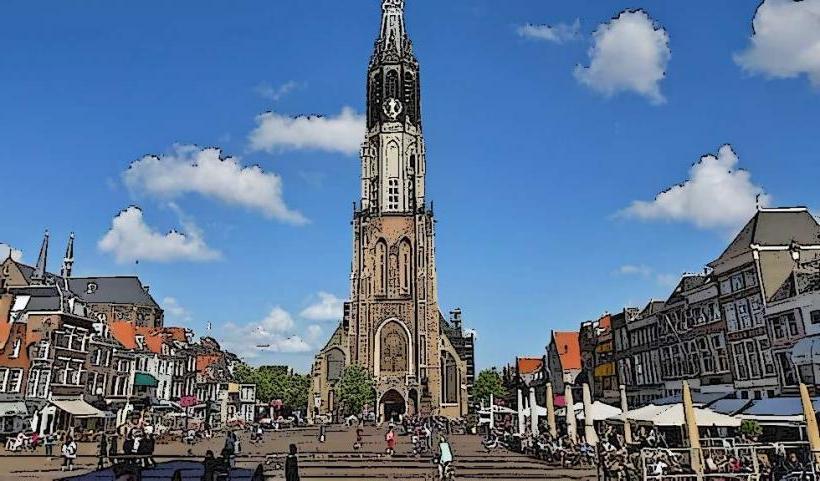
Nieuwe Kerk (New Church) – 0.9km West
Royal Delft (Porceleyne Fles) – 1.2km South
Botanical Garden TU Delft – 1.0km Southeast
Vermeer Centrum Delft – 1.0km West
Maria van Jessekerk – 0.8km West