Landmark: Place de la Comedie
City: Montpellier
Country: France
Continent: Europe
Place de la Comedie, Montpellier, France, Europe
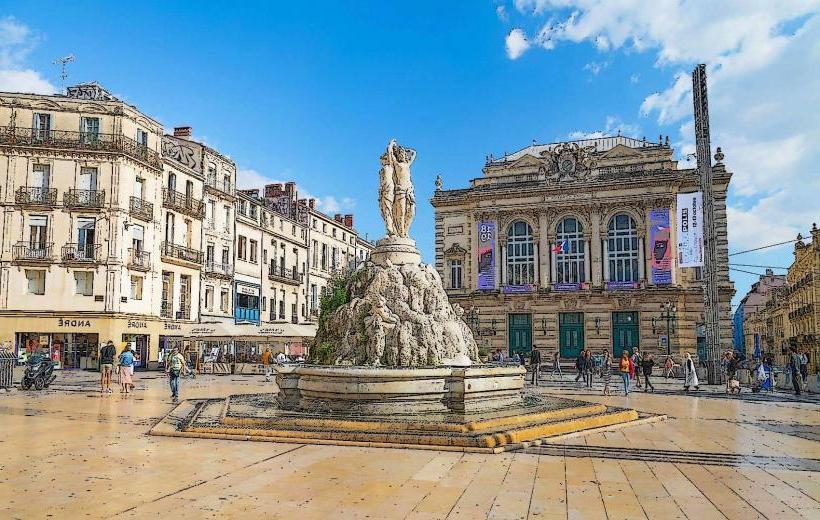
The Place de la Comédie is the central focal point of Montpellier, France. Often referred to as "L'Œuf" (The Egg) due to its original oval layout, it serves as the primary connection between the medieval old town (L'Écusson) and modern urban developments.
Visual Characteristics
The square is an expansive pedestrian plaza defined by its "egg" shape, which is visible through the use of smooth, light-colored stones in the center. It is surrounded by 19th-century Haussmann-style buildings with ornate limestone facades and slate roofs. At night, the area is illuminated with atmospheric blue lighting designed by artist Yann Kersalé.
Architectural Style & Materials
The architecture is predominantly Beaux-Arts and Haussmannian, reflecting the city's 19th-century prosperity. The primary material is local white limestone. Key structures include:
Opéra Comédie: An Italian-style theater built in 1888 with a monumental facade featuring Corinthian columns and arched windows.
Fountain of the Three Graces: A central sculpture carved from Carrara marble in 1776 by Étienne Dantoine. The figures represent the goddesses Aglaé, Euphrosyne, and Thalie. (Note: The outdoor statue is a replica; the original is preserved in the Opéra's lobby).
Location & Access Logistics
Located in the heart of the city (34000 Montpellier), the square is one of Europe's largest pedestrian areas.
Transport: It is a major hub for the tramway network, specifically lines 1 and 2 at the "Comédie" stop.
Parking: The "Parking Comédie" provides subterranean parking directly beneath the square.
Connectivity: High-speed 5G/4G signals are consistent across the plaza.
Historical Origin
The square was first established in 1755 on the site of the city's former fortifications. It has undergone several transformations, notably in the 19th century following fires that destroyed previous theater buildings. In 1986, the square was fully pedestrianized, removing vehicle traffic to create the current open-air social hub.
Infrastructure & Amenities
The perimeter is lined with expansive café and restaurant terraces.
Restrooms: Public facilities are located near the Esplanade Charles-de-Gaulle and inside the nearby Polygone shopping mall.
Shade: Historically limited, a 2023 greening project reintroduced Elm trees to provide natural shade and climate benefits.
Shopping: The eastern end leads directly to the Le Triangle gallery and the Polygone commercial center.
Unique Facts
The Dive Helmet: The Gaumont Cinema building on the square features a unique architectural detail known as the "scaphandrier" (dive helmet).
Good Luck Tradition: Local tradition suggests rubbing the base of the Three Graces fountain for good luck.
Street Art: The square is a primary stage for daily street performers, ranging from jazz ensembles to breakdancers.
Nearby Landmarks (within 5km)
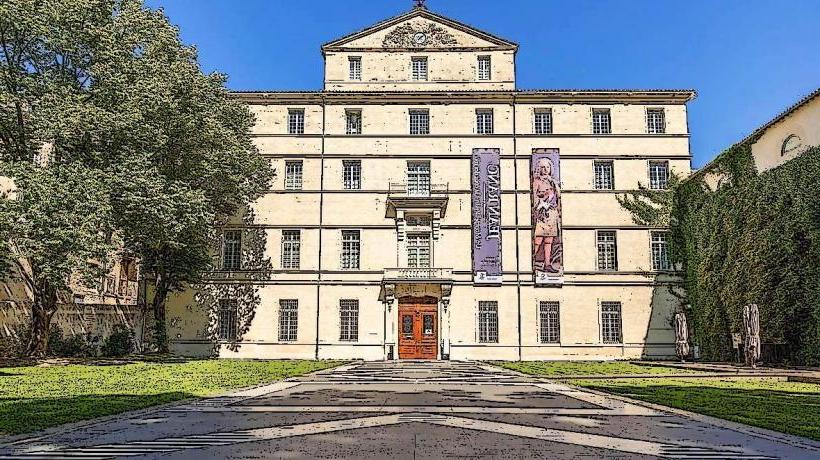
Musée Fabre: 0.2km North (one of France's most important art museums).
Esplanade Charles-de-Gaulle: 0.1km North (a leafy park hosting seasonal markets).
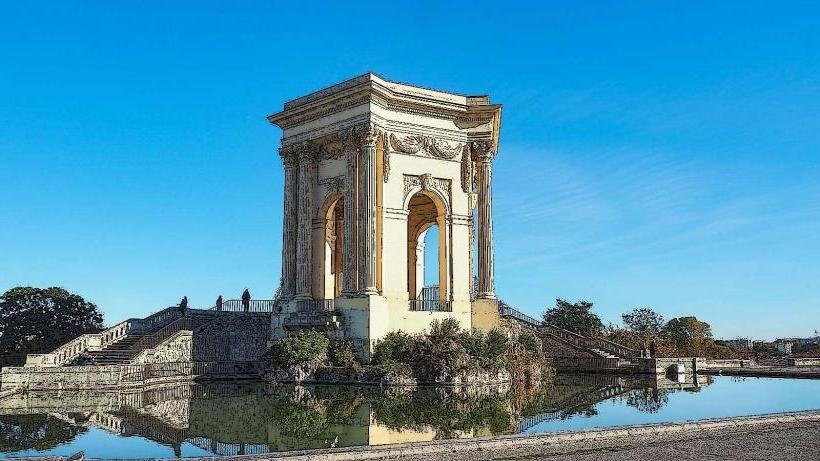
Porte du Peyrou (Arc de Triomphe): 0.6km West.
Montpellier Cathedral (Saint-Pierre): 0.8km Northwest.
Antigone District: 0.5km East (Neoclassical district designed by Ricardo Bofill).
Jardin des Plantes: 1.0km Northwest (France's oldest botanical garden).